Saturday, 5 May 2007

Papal Regensburg

I don't want to sound like a nerd but while in Regensburg (or Ratisbon) I passed this attractive house, not far from the gothic Cathedral:


The bell revealed whose house it is:


The Holy Father's elder brother, Georg, lives here, cared for by his trusty housekeeper, Agnes Heindl. For a split second I was tempted to ring the bell for a photo opportunity before pulling myself together! Mgr Georg must get his fair share of nuisance calls: the plaque placed on the house by the Chapter of the Johanneskirche publicly says that it was here that Pope Benedict met his brother on 13 September 2006:

.
Georg is now retired (as his brother, before his election, hoped to be by the age of 80) and says his daily Mass at the Johanneskirche, next to the Cathedral:
.
.
And here's one of various papal teddys currently available in the Bavarian shops:
.

Labels: ,

Thursday, 3 May 2007

The Shrines of the Upper Palatinate

Last Friday we drove around the Oberpfalz (Upper Palatinate) and accidentally stumbled across three Wallfahrtkirchen (pilgrimage churches) within a short distance of each other. First stop was the shrine at Freystadt, which orginated in 1644 when two peasant boys built a small clay chapel and placed in it a modest image of Our Lady. They collected alms and soon built a more permanent chapel, which they called Maria Hilf.


A larger church was built in 1670, with a new statue of Mary, followed by yet another building in 1700. Devotion particularly intensified to Maria Hilf after the Siege of Vienna (1683) and miracles began to be reported, including the appearance of a star during a sermon in the church about Mary, the Star of the Sea.


A short distance away is the shrine of the Holy Name of Mary at Trautmannshofen, one of the oldest Marian shrines in the area.


According to tradition, the statue of Our Lady was attacked by the Hussite heretics in 1432 and thrice survived being thrown into the flames.

The statue is known as Die unversehrte Mutter (the unhurt Mother). One of the ceiling frescoes, showing a phoenix, alludes to the tradition:


Finally we visited the hilltop shrine of Habsberg, where since 1680, pilgrims have venerated Maria, Heil der Kranken:


I liked the 'box' in the sanctuary for the local aristocratic family.

Labels:

Tuesday, 1 May 2007

Bavarian Baroque I


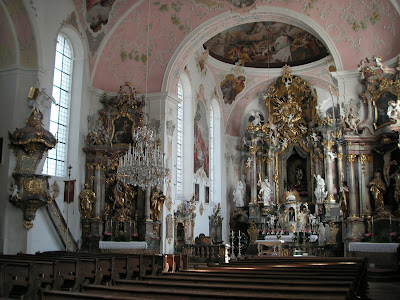
Bavaria is full of outstanding churches - often very old foundations which were rebuilt or redecorated in the baroque period (partly a reaction to the devastation of the Thirty Years War). Staid Anglo-Saxons are often dismissive of this style (especially Victorian tourists) but I find it fully 'incarnational,' a feast for the eyes, mind and heart. In the memorable words of art historian, John Bourke:
A great multitude of figures and groups surrounds the visitor in one of these churches. He sees saints and prophets and Fathers of the Church at decisive points of vantage, significantly poised and with their appropriate attributes. He sees angels and putti flying, sitting, leaning, supporting, listening, adoring, pointing, reproving, on altar and pulpit, organ and confessional, making jubilant music, bearing emblems of the Betrayal or the Crucifixion, bringing messages from on high, in charge of the mounting horses of Elijah’s fiery chariot, attending the crucified and awaiting the risen Saviour, up-bearing the Virgin at her Assumption. He sees symbols of dogma and doctrine – of the Trinity (a triangle); of the all-seeing eye of God (an eye, usually framed in the triangle), of the self-sacrificing love of Christ (a lamb or a pelican), of his wounded heart (a heart clasped by a crown of thorns), of the Annunciation of the Virgin (a lily) or of her sorrows (a sword or swords piercing her bosom), of the revelation of divine mysteries (a curtain over choir arch, altar or pulpit drawn aside by putti); of the transitoriness of mortal things (a clock), and of much else.
The pictures above and below illustrate this well. They were taken in the former Augustinian church of Rottenbuch: a late fifteenth century basilica redecorated in the mid eighteenth century by Josef Schmutzer.

Incidentally, the Augustinian house at Rottenbuch was founded by Duke Welf IV (I of Bavaria) in 1073 (see picture below). He was the brother-in-law of William the Conqueror and is also regarded as the founding father of the House of Hanover (a junior branch of the House of Welf). The Hanoverian George II was reigning in England while his ancestor's Catholic foundation at Rottenbuch was being baroqued up - I don't think he would have approved!


Another magnificent church, also formerly Augustinian, is the Marienmunster at Dießen, situated on the Ammersee.


Even humble village churches share in this splendour - such as the parish church of Oberammergau, dedicated to SS Peter and Paul.


Here's a fine fresco at Oberammergau of St Gregory the Great, one of the four Latin Doctors of the Church:


And an interesting fresco by Gunther above the choir gallery of the view from the confessio at St Peter's, Rome, looking up to Bernini's baldacchino. Now that's what I call communion with Rome:

Labels:

Sunday, 29 April 2007

Great St George


I was away from blogging on the Solemnity of St George, but as we come to the end of the Octave (!) I thought I'd better pay tribute to our glorious patron. I can think of no better way of doing this than by posting some photos that I took last week in the church of St George in Amberg.


I particularly liked the early eighteenth century frescoes on the walls of the nave showing examples of St George's powerful intercession - the usual stuff (sickness, fire, death, etc) but also various military situations involving the great enemy of Christian Europe at the time: the Ottoman Turks. The first fresco, with the inscription Ecclesiae Tropoeophorus Tuetur - in Duello, shows a 'duel' between a Christian knight and a Turk:


This fresco, in pugna navali, shows St George using what looks like thunderbolts against the Turks at Lepanto (1571):


Finally, this one, in obsidione, refers to the Siege of Vienna (1683), again showing St George's assistance:
.
Great St George, our patron, help us,
In the conflict be thou nigh;
Help us in that daily battle,
Where each one must win or die.

Labels: ,

Saturday, 28 April 2007

The Pope's Private German Address


Bergstraße 6 in Pentling, on the outskirts of Regensburg, isn't mentioned in the guidebooks but this very normal looking suburban house belongs to none other than Pope Benedict. Indeed, although his visits here will now be, at best, highly infrequent, he once said that 'Pentling is my home in the deepest sense.' He bought the site in 1970 and oversaw the building of the house, into which he moved with his late sister (and housekeeper), Maria. He lived here until 1977, when he became Archbishop of Munich and Freising, but still regarded it as his true home, even as a Roman Cardinal, and during his pilgrimage to Germany last September he visited the house. Back in the 1970s Georg, of course, was busy directing the Cathedral choir down in Regensburg and, to bring the family together in one place, they moved their parents' remains to a nearby cemetery, the Ziegtsdorfer Friedhof (where we said prayers for the Pope's family).


The grounds of the Pope's wohnhaus in Pentling are clearly visible from the street. Here, for example, is the papal beehive (hmm, I wonder if he's thought of selling pots of honey to raise funds for the Holy See?):

.
The bees - and the garden - are now cared for by the Holy Father's neighbour, Herr Hofbauer (the owner of Chico the cat and Igor the golden retriever, who were great favourites of the Pope). It was good to see the traditional Epiphany blessing on the back door:
.

At first I was reluctant to post information on the papal house - until I got there and discovered that everyone knows it belongs to the Papa. A large sign announces to the passer-by who the famous owner is and there's a large papal flag outside. So, I'm not breaking any Vatican secrets!


Labels: ,

<< # St. Blog's Parish ? >>