A Hidden Gem
Today, wearing my archivist hat, I gave a talk to Jill and Brett Kelly's group at their house in Evenley, Northamptonshire. The Kellys run a good Catholic library in their home and people come to the monthly meetings from near and far. They also sell books and I particularly enjoyed their 'bargain basement,' where secondhand books were available at £2 each (I picked up several Ignatius Press titles, mostly by Peter Kreeft). The Kellys (who have 17 grandchildren) made me think of penal times, when Catholic households and families provided such powerful centres of the Faith for the surrounding area.


On the way back to the station we popped into the charming little church of the Holy Trinity at Hethe, just inside Oxfordshire and the Archdiocese of Birmingham. Catholicism survived in this area thanks to the Fermor family of Somerton and Tusmore, who maintained a chapel and priest over many generations. The present church was opened in 1832 to look after the needs of local Catholics after the Fermor's estate passed into Protestant hands. It has just celebrated its 175th anniversary. From the outside it looks unprepossing:
It seats about 150 people, has a glorious presbytery next door and the sanctuary arrangement would undoubtedly meet with the Holy Father's approval:
I loved the little 'harmonium' at the back:
It's good to know these hidden gems still exist.
posted by Fr Nicholas at 6:35 pm
1
comments


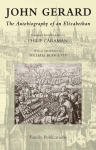 There was time, also, to pop into the book launch of the latest offering from Family Publications: a reprint of
 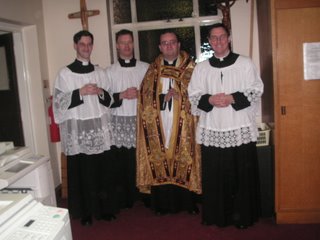 And the evening finished with a jolly meal on Newington Green. A great Catholic London day!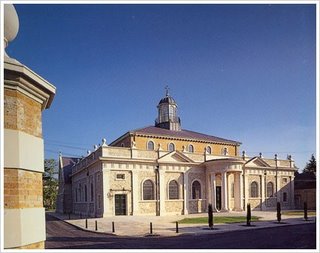
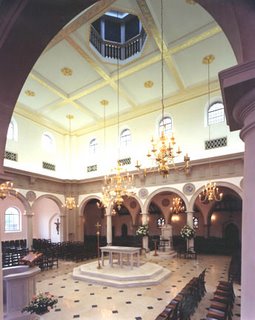 The neo-classical architecture is undoubtedly tasteful but it seems strange that the most prominent decorative feature of the church interior are the massive golden chandeliers - prominent because there is hardly any other decoration. It took me some time to notice the presence of the cross; there are very few images and the stations (the roundels above the arches) are in a modern style and very hard to make out.

