Saturday, 10 May 2008

A Sea Symphony

It's been a noisy evening - as I sit at my desk I can hear both the Irish singer crooning away in the parish club and the Nigerians making their novena for Pentecost (there's a lot of 'congregational participation' at the moment and this is upsetting the presbytery dogs) - and, to top it all, I've just returned from a performance of Vaughan-Williams' Sea Symphony by the Hackney Singers (of which a parishioner is a member).

They did an excellent job, as did the Essex-based Forest Philharmonic Orchestra (which is of professional quality). I had a good view of the triangle-player, who was kept surprisingly busy during the 70 minute piece. Call me a cultural philistine but I'm not really into the big choral set pieces of the nineteenth and early twentieth centuries, although the texts used by the choir certainly contained a searching meditation on the journey through life, which are just like the storms and calm of the sea.

The concert was held at the huge 1790s church of St John-at-Hackney - built for a congregation of 2,000 but now attracting a congregation of 60 or 70 (judging from the newsletter). It replaced the medieval church (only the sixteenth century tower remains), which has always fascinated me because the nephew of John XXII, Cardinal Gauscelin Jean d'Euse, held amongst many other posts that of Rector of Hackney (1328-34) - a rather unexpected link between Hackney and papal Avignon!

In the parish newsletter there was an interesting review of a book written by a more recent Rector, describing his experiences as 'an inner city parson.' Although described as a Christian agnostic (!), the reverend author did make a good point about the Anglican clergy that is just as valid for Catholics - as the reviewer put it, 'clergy are expected now to be not so much ministers as managers of the local branches of a national chauin store, with "delivery strategies" and targets, except without the staff to order around...John [the author] deplores what he sees to be a Church of England culture "intolerant of the idiosyncratic...the bland leading the bland."'

Moreover, 'he was proud to say he belonged to a passing generation of clergy taught that mornings should be spent in your study. Books are always more important than meetings.' Hmmm, that's rather commendable.

So, the words of the 'Sea Symphony' and this rather eccentric article in an Anglican parish newsletter provided me with food for thought; appropriate since on Monday I go on my annual retreat...

Labels: ,

Wednesday, 3 January 2007

Meet One of My Parishioners...


...well, she would have been was I curate of this parish 500 years ago. Her name is Cecily Heron, the youngest daughter of St Thomas More and the wife of Giles Heron. The couple married at Willesden (my previous parish!) on 29 September 1525 - Giles had become a ward of More's after the death of his father (Sir John Heron). They lived mostly at Shacklewell Hall (for any Hackney readers, that was around the area of present day Seal Street, not far from the Ridley Road Market).

Heron was intimately involved in More's household and it was during one of the future martyr's visits to Shacklewell that they were alleged to have had a treasonable conversation. Giles was eventually hanged for treason on 4 August 1540 - a bumper day in the bloody history of Tyburn gallows. Heron died alongside the Carthusian martyr, Blessed Thomas Johnson, and Robert Bird (layman), Lawrence Cook (Carmelite Prior of Doncaster), Thomas Epson (Benedictine) and probably William Bird (Rector of Fittleton and Vicar of Bradford, Wiltshire). Heron's cause was considered a hundred years ago but passed over (praetermissi) due to the lack of evidence.

I mention this little sidelight on Hackney's past because yesterday afternoon I went to the Holbein in England exhibition at Tate Britain. It finishes on Sunday, so I thought I'd better see it. I get rather impatient in crowded exhibitions, especially ones like this where many of the items are small and you have to slowly follow a long line of art lovers to catch even a glimpse of a Holbein masterpiece. So I concentrated on a few choice items and rushed through the less interesting rooms (eg Hanseatic Commissions and Designs for Goldsmiths).

Luckily what was (for me) the jewel in the crown could be found in Room 1 - a series of magnificent drawings of St Thomas More's family, made in preparation for a group painting that eventually ended up in what is now the Czech Republic and was lost in a fire that devastated the summer palace of the bishop of Olmütz in 1752. The drawing of Cecily Heron at the top of this post breathes life into this historical figure. She has vividly been caught as she glances away - and it is clear from her dress that she is pregnant. I like what the Guardian's Jonathan Jones wrote about Holbein's celebrated drawing of the saint:


Thomas More is in front of you, as close as if you were looking in the bathroom mirror. Dots of black stubble dirty his chin. There's a little wrinkling at the corner of his eye, perhaps proof of yet another night's reading and writing: he wrote that the only time he got for literature was what he could steal from sleep. But he looks away from the artist through clear blue eyes, wearing the brown fur robe and wide black hat of a powerful man about town, someone who needs to leave in a moment to meet the king. This is a portrait of someone with barely the time to pose, at once mildly impatient, tolerant and - which is what makes this such a disarming image - a little bit self-mocking. The suppressed smile on his face finds the idea of posing pleasantly ridiculous.

Walking around the exhibition was like seeing the dead come back to life. One of Holbein's later paintings even has the inscription: 'add but the voice and you would wonder if his father or the painter created him'. And this was a little unnerving because, as we all know, the iconic figure that dominates the show - 'Bluff King Hal' (Henry VIII) - was responsible for imprisoning or executing so many of Holbein's sitters and destroying the peace of More's family group.

To see all the More family portraits, click here.

Labels: , , ,

Sunday, 22 October 2006

The Horrors of Hackney?

So far, I've enjoyed getting to know the area around my new parish, much of which is in the London Borough of Hackney (the arms can be seen above). It's a very mixed place - rundown estates alongside smart squares - but I was surprised to see the following on BBC news:
Hackney has accused television producers of "middle class snobbery" as it hit back at a survey branding it the worst place to live in the UK. The London borough came bottom in the Channel 4 survey of the UK's 434 local council areas.

But the area's directly-elected mayor, Jules Pipe, rubbished the survey, which is based on crime, environment, lifestyle, education and employment. Past shows had said Hackney was a great place to invest in property, he said. The borough replaced Hull, which was ranked the worst place to live in last year's survey.

"Of course Hackney has problems, as do all inner city boroughs, but it is an amazing place to live. It is diverse and exciting with fantastic architecture, a vibrant arts and cultural scene, and a bright future as an Olympic borough.It's got a great atmosphere, a bohemian feel, fantastic markets and nightlife. Schools are improving and, all in all, it's a great place to live."

Well, I haven't yet discovered the 'Bohemian lifestyle' or plunged the hidden depths of the 'vibrant arts and cultural scene,' but I'd certainly be keen to defend Hackney. With its considerable history, community spirit and warm-heartedness, I'd certainly much rather be here as a priest than many other places, which might seem superficially more attractive.

Labels: ,

Friday, 15 September 2006

A Local Link to Pre-Reformation Days


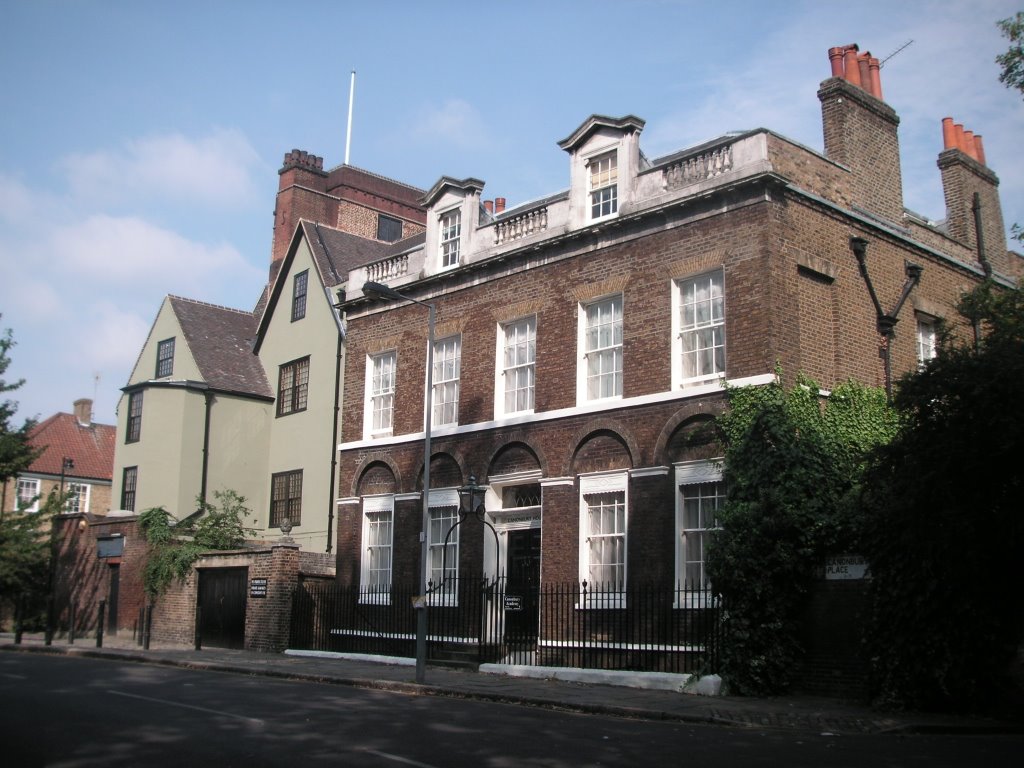
Much of Greater London may seem little more than a sprawl of modern suburbs, but if you scratch the surface you soon find links to the more distant past. My new parish of Kingsland grew as a suburb in the early nineteenth century - and there are some quite pleasant terraced streets - but the name of one of the local stations, 'Canonbury,' takes us immediately back to the Middle Ages. The name 'Canonbury' originates from the 'Canons Burgh' - the manor which belonged first to the bishops of London and then, from 1253, to the Augustinian Canons of St Bartholomew's Priory in Smithfield. Another part of London to the west, Canons Park (on the Jubilee Line), also got its name from this religious house.

Above are pictures of Canonbury House and Tower (Canonbury Place, N1), which I passed on my afternoon stroll today. The tower (which you can see above) dates from the rebuilding of the manor by Prior William Bolton just before the Reformation (mercifully he died in 1532, just before things got really sticky). Apparently you can still see traces of his heraldic device on parts of the building, so I must go back with camera in hand to find these.

At the Dissolution the manor passed into lay hands - including, for a few years, Thomas Cromwell (boo, hiss). Famous residents have included Samuel Humphreys (Handel's librettist), Ephraim Chambers (the encyclopaedist), Oliver Goldsmith and Washington Irving.

It's great to have a link to Catholic England just five minutes walk from the presbytery, even though part of the building is now used for the Canonbury Masonic Research Centre, which describes itself as 'an educational institution for the independent study of Freemasonry and the traditions linked to it, and of mystical and esoteric traditions worldwide.' I wonder what the good Prior Bolton would think of all this!

Labels:

<< # St. Blog's Parish ? >>