Thursday, 1 May 2008

Monastery Crawl

Earlier this week I popped over to Downside Abbey in Somerset to collect a monastic archive (as you do). A parishioner kindly agreed to provide transport and, as there was room, Cally's Kitchen also joined us. Here is the boot of the car groaning with dusty documents concerning the English Augustinian Canonesses of Paris:


En route we drove through Woolhampton (on the other side of Reading) so we made the short detour to Douai Abbey, another house of the English Benedictine Congregation. Like Downside, the Abbot there is one of our leading Catholic historians. The exterior is rather unusual, due to the modern extension:


However, I think the interior works rather well - lots of space and light:


In the monastic cemetery we paid our respects at the grave of Dom Basil Griffin, twin brother of Cardinal Bernard Griffin, sixth Archbishop of Westminster (1943-56):


Of course, arriving at Downside we were able to visit the tomb of another brother of a Cardinal - Dom Jerome Vaughan, who effectively founded Fort Augustus Abbey up in Scotland, though he later had to leave the community. He was one of the many clerical or monastic siblings of Cardinal Herbert Vaughan.
.

Labels: ,

Thursday, 27 March 2008

Dissolution


These ruins were once one of the largest churches in medieval Europe - the Abbey at Bury St Edmund's in Suffolk. The tower in the background, which belongs to the Anglican Cathedral, was only completed a few years ago. The first monastic community here was founded in 633 and it had grown in fame and wealth after the translation in 903 of the relics of St Edmund of East Anglia, King and Martyr:


He had been killed by the Danes (869) - captured, shot by arrows and then decapitated, his head later being found by a friendly wolf - and his shrine became one of the great spiritual treasures of England. It is hard to imagine what the great Abbey looked like, though some idea of the magnificence can be gained from this surviving gatehouse:
.

'Bare ruin'd quires' have been very much on my mind these last few days. Not only did I visit St Edmundsbury on Tuesday but this morning there was a very interesting Radio 4 programme on the Dissolution, with some of our leading historians - you can listen to it over the next week here. You may not agree with everything that is said, but it gives an insight into the cunning tactics of Henry VIII.
.
Then, the post brought me an Amazon packet containing Geoffrey Moorhouse's new book, The Last Office: 1539 and the Dissolution of a Monastery. It studies the Benedictine community at Durham and looks not only at monastic life on the eve of the Reformation and the process of Dissolution but also what happened to the monks afterwards.

Labels: ,

Wednesday, 5 March 2008

Goodbye to the World


I've just had an extraordinary evening. A member of the parish's young adults group is entering an enclosed Benedictine monastery on Friday. So, tonight a group of us went to a local Indian to bid her farewell. I'm not sure how to refer to such a gathering - not quite a Hen Night but certainly a closing of a chapter in her life! Yet, although the parting of friends is not easy, I think her heart is already in the convent and she is visibly excited about becoming a postulant.

She is the second religious vocation from the parish this year - another girl has just joined the Franciscan Sisters of the Immaculate. Please remember them in your prayers, together with all young people discerning their vocation.

Labels: ,

Thursday, 22 November 2007

Dies Memorabilis


I've had quite a Benedictine week. Yesterday I was over at Downside Abbey in Somerset to collect the papers of the English Augustinian Canonesses of Paris (going back to the 1630s), which will now be housed in the Westminster Diocesan Archive.

Yesterday happened to be the 400th Dies Memorabilis of the English Benedictine Congregation. This requires a bit of explanation. It refers to an event that took place in London (possibly in Holborn or St John's Wood) on 21 November 1607. Despite the Reformation, young Englishmen had continued to join religious Orders on the continent. At first, if you wanted to become a Benedictine you joined the Spanish or Italian (Cassinese) Congregations (the Benedictine Order exists in Congregations, originally organised on national lines) . In 1602 these English-born monks obtained a faculty from Clement VIII to join their secular and Jesuit counterparts on the English Mission.

Two English members of the Cassinese Congregation, Robert Sadler and Edward Maihew, soon sort out the last surviving member of the original English Benedictine Congregation (EBC), which dated back to 1218/19. His name was Dom Sigebert (or Sebert) Buckley, then aged 90, who had formerly been a monk at Westminster Abbey during the community's restoration by Mary I. On 21 November 1607 Buckley aggregated these two young priests to himself - and through him to Westminster Abbey and the old Benedictione body in England. The ceremony was masterminded by the former lawyer and noted spiritual writer Dom Augustine Baker and it meant that the re-founded English Benedictine Congregation still claims to be the oldest Congregation in the Benedictine world.

Today I was lucky enough to attend a half-day conference at Westminster Abbey to commemorate this great event. We listened to two talks in the magnificent Jerusalem Chamber, part of the original Abbot's Lodging, dating to the fourteenth century. The original ceiling can still be seen, under which Henry IV died in 1413. The King was about to make a pilgrimage to the Holy Land but suffered a stroke while praying at the shrine of St Edward. He was carried to this chamber and when he asked where he was, he was told he was in Jerusalem. The King had once been told that he would die in Jerusalem and so it came pass in the Abbey's Jerusalem Chamber.

The most moving aspect of the conference, though, was to see monks and nuns walking around the great Abbey Church once again, just like the good old days. They included four current Abbots, an Abbess and the (titular) Abbot of Westminster (such titles are given to senior or retired members of the Congregation). Some of the tourists probably thought they were seeing ghosts!

After Evensong (which included a Palestrina Magnificat and Peter Philips' Cantantibus organis, Cecilia), we gathered round the shrine of St Edward, more or less untouched by the Reformation, as the monks sang the responsary Posuisti Domine. Then we processed to the chapel of St Benedict, just off Poets' Corner, where the Suscipe was chanted. It was as if the centuries rolled back.

Then I had to make a mad dash to Kingsland to preach at our parish Requiem for all those who have died over the last twelve months.

Labels: ,

Monday, 19 November 2007

1964 Dominican Vocations Film

Some of you may have seen this already, but I've only just discovered it. There are some fascinating shots of a Dominican Rite Mass and other beautiful scenes of conventual life. It was filmed at St Stephen's Priory, Dover, MA, the Dominican House of Studies, Washington, D.C., and St. Dominic's Church, Washington, D.C.

Labels: ,

Tuesday, 6 February 2007

The Community of Our Lady of Walsingham


Many readers will have heard of the Community of Our Lady of Walsingham, based in Abbotswick in Essex, where they run the House of Prayer for the Diocese of Brentwood. Established three years ago out of a Vocations Group for Women that met at Westminster Cathedral, they are Britain's youngest religious community. I've never visited them but have heard good reports from my brother priests. Anyway, they have just launched a new website (including a blog).

Although rooted in the Carmelite tradition, they describe their 'central charism' as 'vocational' and aim to support people in all states of life and especially diocesan clergy. With this in mind they are organising annual conferences, retreats and seminars to help people live their calling to the full - including one for priests this coming October.

They're also probably the first religious community to use the term 'chill out time' in their daily timetable!

Labels:

Sunday, 4 February 2007

An Audience with Fr Giles


It's amazing what you find on the net - here is a 53 minute 'audience' with Fr Giles, sometime Prior of Pluscarden Abbey in Scotland. It brings back particularly happy memories for me since he led my pre-diaconal and priestly ordination retreats. The interviewer is an anthropologist from Cambridge and seems to have a particular interest in the organisational and technological aspects of monasteries (especially clocks!). Although this is not a 'religious' interview as such, Fr Giles' wisdom shines through.

So, if you want to discover some unusual sidelights on monastic history (and if you have the time), pour yourself some whiskey, sit back and enjoy!

Labels: ,

Tuesday, 23 January 2007

A Remarkable Woman


Post-Reformation England has produced very few religious Orders and Institutes. Perhaps the most famous is the Institute of the Blessed Virgin Mary (or the Congregation of Jesus, as it is now called), founded by that mulier fortis, Mary Ward (whose birthday, incidentally, it is today).

Less well known is the Institute of the Poor Servants of the Mother of God, whose house and archive I visited yesterday at Brentford (across the river from Kew). The Poor Servants were founded by Frances (Mother Magdalen) Taylor in 1869. The Foundress was a remarkable woman. The daughter of a High Church Lincolnshire parson, Fanny (as she was called) volunteered as a nurse during the Crimean War and worked alongside Florence Nightingale. In the Crimea she was impressed by the example of the Catholic soldiers (mostly Irish) in hospital, as well as the nursing nuns, and she was received into the Catholic Church by a Jesuit army chaplain, Fr Woollett, in 1855.

On her return to England, she became known in Catholic literary circles - producing an account of her Crimean experiences (Eastern Hospitals and English Nurses), writing a novel set at the time of the English Martyrs (Tyborne and Who Went Thither) and, rather unusually for a Victorian lady, editing Catholic journals like The Month and The Lamp - she persuaded Newman to publish the Dream of Gerontius for the former in 1865. She continued to write up until her death and later was instrumental in bringing the Apostleship of Prayer and its journal, The Messenger of the Sacred Heart, to England.

Taylor did much work for the London poor and began to think about founding a sisterhood. With the invaluable support of the great Catholic philanthropist and writer, Lady Georgina Fullerton, she considered the Sisters of Charity and the Polish Little Sisters of Mary, before establishing her own Order, under the authority of Cardinal Manning, which founded a number of institutions, including the Providence Free Hospital near Liverpool.

A house was founded in Rome in 1886, just round the corner from the Spanish Steps (which, in the nineteenth century, was the city's English quarter), with an English school for girls. The chapel, dedicated to St George and the English Saints, has an interesting shrine to Our Lady Regina Prophetarum, erected for the express purpose of prayer for the conversion of England. It was in the church that the Guild of Our Lady of Ransom was canonically erected in 1890.

Mother Magdalen Taylor died on 9 June 1900 and the cause for her beatification is currently being considered at diocesan level here in Westminster.

Labels:

Tuesday, 2 January 2007

Die Grosse Stille

Well, I feel as if I've just made a day of recollection - and the rather unusual means of doing this was a small cinema on the fourth floor of the Barbican Centre. I had a free evening so I decided to catch Die Grosse Stille (translated as Into Great Silence) while it's being shown in London.

Now, this is not a film to go to if you have a bad cough or if you're going to arrive late. I've never experienced such silence in a film auditorium (thank God there was no popcorn for sale) - and most people left in silence.

According to the programme notes that we were given by the attendant, this film is about time: 'the silence of the piece and the focus on the repetitive rituals of monastic life, heighten awareness of time.' In his beautifully-written account of visiting monasteries, A Time to Keep Silence (1957), Patrick Leigh Fermor writes:

Time passes in a monastery with disconcerting speed. Except for the great feasts of the church, there are no landmarks to divide it up except the cycle of seasons; and I found that days, and soon weeks, were passing almost unperceived. The speed of this temporal lapse is a phenomenon that every monk notices: six months, a year, fifteen years, a lifetime, are soon over and, as I found it easier to talk to them [the monks of St Wandrille de Fontanelle], the only regret I heard was that they had delayed so long in the world before coming to the Abbey.
The film, though, is chiefly about the search for God - and it is evident that the monks of the Grande Charteuse have found Him through the silence and discipline of their lives. An apt quotation repeated throughout the film is: 'O God you seduced me and I am seduced.'

The film is a great advert for the Carthusian Order and the monks come across very well and destroy the stereotype of a fanatical monk, completely out of touch with the world. There are some charming 'human' moments - such as the brother feeding the monastery cats or the scene of monks joyfully playing in the snow.

Two little niggles: firstly, a non-Christian viewer who has no prior experience of monasteries would probably not leave the cinema particularly enlightened - there is no explanation of the Carthusian vocation, the meaning of the Religious Life or the history of the magnificent Grande Chartreuse. However, I'm sure many viewers will be inspired to find out more and visit the official Carthusian website.

Secondly, if I'd been the Director, I would have made the film shorter. Beautiful though it is, 162 minutes is too long for a documentary with virtually no dialogue. The people around me were growing quite restless in the last half hour. But then, since most of them probably live busy, largely secular lifestyles, such total immersion into the 'great silence' of the Chartreuse will be fruitful - it certainly did me good!

A rather strange thing happened on my journey home. As I waited for a bus just outside the Barbican Underground station, I noticed the street sign behind me: Carthusian Street. I suddenly remembered that the site of the pre-Reformation London Charterhouse was a stone's throw from the Barbican. So, I made a quick pilgrimage to Charterhouse Square and the monastery buildings, many of which still survive (including the gatehouse). I said a prayer to St John Houghton and the Carthusian Martyrs. And my prayers were swiftly answered - a Number 56 bus came into sight as soon as I got back to the bus stop!

Labels: ,

Saturday, 16 December 2006

The Friars of Canning Town


Looking back at this blog, there aren't many posts about my parish and the activities that take up 95% of my time. Of course, it wouldn't be appropriate to publish posts about many aspects of priestly ministry since it would be an abuse of the 'internal forum.' However, I will write a little about today, when I took 21 of our teenagers to Canning Town (East London) to visit the Franciscan Friars of the Renewal for a Confirmation recollection day (see group picture above).

The Friars are based at St Fidelis Friary on Killop Close, in the midst of a housing estate. The building was originally a parish hall and is used by the Friars, amongst other things, as a soup kitchen for the poor.

I greatly admire the Friars, partly because they are so good at talking to young people - the American accents, long beards and radical lifestyle all helps to make them appear authentic and appealing as followers of Christ. We had a series of talks on the meaning of Confirmation and the importance of Mass and Confession. We then had an opportunity for Confession and, as far as I know, every young person went - inspired, no doubt, by the talk one of the brother's gave, mentioning things like pornography, sex, drugs, alcohol and bad pop music. Here is a photo of Br Martin in full flow. Note the very Franciscan life-size crib behind him. We later said Mass beside it, which I found quite moving:


In the break there was an opportunity to play basketball. I chose to remain a spectator but took the following pictures, just to show that the Franciscans know how to combine praying with playing:


And finally here's an exclusive video of a Friar playing basketball (apologies for the quality).

Labels: ,

Friday, 15 December 2006

Bluefriars

Now, I've heard of the 'Blackfriars' (Dominicans), 'Greyfriars' (Franciscans) and 'Whitefriars' (Carmelites), but I only came across the 'Bluefriars' the other day on the Wikipedia. 'Bluefriars' was the name apparently given to the members of the College of Bonhommes at Ashridge, Hertfordshire. This house was founded by Edmund, Earl of Cornwall in 1283, who granted it a major relic that he had obtained from Germany - a phial of the Precious Blood. This made Ashridge a centre of pilgrimage up until the Reformation and the pilgrims included Edward I (at Christmas 1290) and the 'Black Prince' (who was considered the second founder of the house).

The 'bonhommes' were a community of priests who followed the Rule of St Augustine and were ruled over by a 'Rector' and his assistant, the 'corrector.' Nobody seems to know much about them - even whether to correctly describe them as monks, friars or canons! Clad in their grey-blue habits, the brothers never grew beyond the mother house at Ashridge and further foundations at Edington, Wiltshire and (possibly) Ruthin, Denbighshire (North Wales). Some confuse them with the Grandmontines; others accuse them of Albigensian sympathies (although this may be due to a confusion with the bonshommes, a name sometimes given to the Cathars).

When Henry VIII broke with Rome the relic of the Precious Blood at Ashridge was declared to be nothing but coloured honey and the house was dissolved and passed into the hands of the Crown and (between 1604 and 1848) the Dukes and Earls of Bridgewater. The seventh Earl built the present neo-Gothic Ashridge House, now a business college.

The last Rector of the College of the Bonhommes, Thomas Waterhouse, like so many, made no public protest at the Dissolution but privately adhered to the Old Faith. He carefully preserved his priestly vestments, which he bequeathed to various churches at his death in 1554.

Labels:

Tuesday, 28 November 2006

Oratorian Cabaret


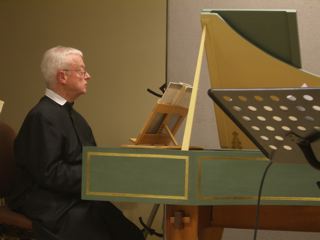
H/T to Devout Life for this footage of the 'Men in Black' fundraising concert at the Toronto Oratory - featuring an Oratorian on a tuba and, forming a backdrop, the harpischord belonging to the distinguished Fr Jonathan Robinson - which can be seen more clearly in the picture below:


Very much in the spirit of St Philip Neri!

Labels: ,

Sunday, 26 November 2006

Institute of Christ the King

Today's Feast of Christ the King made me think of the Institute of Christ the King Sovereign Priest, based outside Florence, which has a well illustrated website. The Institute was founded by two French priests, Mgr Gilles Wach and Fr Phillipe Mora - both graduates of the Pontifical Irish College, Rome - and canonically erected in the African Diocese of Mouila (Gabon) in 1990. I hope they won't mind me using a few sample pictures to illustrate their apostolate.

First of all the new dress of the Chapter of the Institute, complete with blue pom-poms:

The Institute now has a female branch, the Sisters Adorers of the Royal Heart of Jesus Christ Sovereign Priest. Here is a picture of five young ladies receiving the habit from the hands of the Bishop of Fiesole on 30 October this year:


The seminary at Gricigliano has many visiting dignitaries. Here the subdeacon sings the Epistle in the presence of the Abbot of Fontgombault:

And Cardinal Antonelli of Florence arriving in deep snow to celebrate the Feast of St Francis de Sales a few years ago:

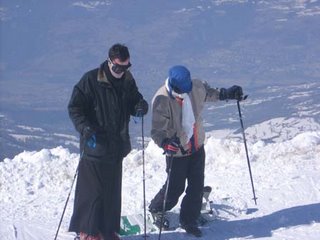
Finally, a photo from a recent ski camp - showing that a cassock is not an obstacle on the ski slopes (I must get a pair of goggles like that):

Labels: ,

<< # St. Blog's Parish ? >>