Sunday, 16 December 2007

Parish Cinema

Just back from our Young Adults group. Normally we have prayer and discussion (I'm thinking about taking up the Holy Father's suggestion and focussing on Spe Salvi in the new year). Tonight, though, 12 of us (including a Hindu!) watched a DVD - The Nun's Story. This is one of my favourite films, mixing plenty of exterior action with Sister Luke (Audrey Hepburn)'s interior struggle against her pride. Although she does not persevere in the end, both she and the nuns come across very well. One of the leitmotifs of the film is particularly striking: 'You can cheat your sisters but you cannot cheat yourself or God.'

Labels: ,

Saturday, 21 July 2007

La Vie En Rose

Tonight I accompanied the parish's new Young Adult Group (18-35) to see La Vie en Rose at a packed cinema in Islington. Marion Cotillard gives a superb portrayal of Edith Piaf, the French singer and national icon - in fact, it's hard to believe that she is lip-synching to Piaf's unique voice.

The heroine, Piaf, is not the most attractive of characters - proud, obstinate and leading a life that caused the Archbishop of Paris to refuse her a Catholic funeral. However, her childlike piety also comes across very strongly. She refuses to go on stage at the Paris Olympia without wearing her crucifix and she is often shown praying before a performance.

Rather unexpectedly, St Therese of Lisieux has a constant and unseen presence in the film. As a child Piaf suffered from blindness (a result, it seems,of keratitis). The kindly prostitutes who cared for her arranged for Piaf to visit the saint's tomb to pray for a recovery. Shortly afterwards she could see again. The saint's influence continued in Piaf's life until the very end, making La Vie en Rose a powerful essay on the efficacy of prayer.

I recommend readers to see the film - and in the meantime, here is the 'Little Sparrow' herself performing her most celebrated song:

Labels: , ,

Sunday, 20 May 2007

Change of Habit

As I sit here at my computer, I can clearly hear the drums and shouts from our monthly Nigerian Mass. For some reason it made me think of the final scene of Elvis' last movie, Change of habit (1969), which presents the rather novel spectacle of Mr Presley singing and playing the guitar at what seems to be an interim Mass (just before the 1970 Missal). The celebrant is ad orientem and the offertory procession is unusually reverent. I love the grumpy priest! Do any American readers recognise the church?

The film is all about Sister Michelle (Mary Tyler Moore) meeting a doctor (Elvis) whilst on pastoral placement. You'll be pleased to know that in the end she defeats temptation and dumps Elvis in order to go back to the convent.

Labels: ,

Thursday, 17 May 2007

The Inquisition Myth Perpetuated

Not much blogging these last days since things have been busy in the parish and archive, plus I've had a priest friend staying.

On Monday night (the beginning of my day-off) I went to the cinema - the only film which looked mildly interesting was Goya's Ghosts, which I hadn't heard of before. Set in 1790s/1800s Spain, it is a lavish costume drama with some impressive set-pieces but weak characterisation. Weakest of all is the perpetuation of the myth of the Inquisition:
  • torture is used indiscriminately and with the slighest excuse (in actual fact there was a strict code regarding its use and it was heavily restricted, especially by the late eighteenth century)
  • torture (or being 'put to the question') is presented as part of the Church's teaching: if the accused is innocent God will give surely him the strength to stick to the truth; therefore a person who confesses is infallibly guilty. This is, of course, complete rubbish
  • the dungeons are dire - in actual fact Inquisition prisons compared favourably to secular ones
  • all the clergy and religious in the film are corrupt and tyrannical

As well as basing its depiction of the Inquisition on post-enlightenment anti-Catholic literature, the film also attacks the tyranny of rationalism and the French Revolutionary forces, which at least restores some balance!

Labels:

Thursday, 29 March 2007

Passion of the Christ - Director's Cut

For many people watching Mel Gibson's The Passion of the Christ forms part of their Holy Week observance. Yesterday the new double-DVD Director's Cut came through my letterbox and, unlike the previous edition, contains loads of special features. This is definitely a good investment for priests, teachers and catechists - there are features on the history of crucifixion, for instance, or what happened to the main characters after the passion, which could be used in classes.

Most amazing is the fact that this movie blockbuster has, amongst its options, a 'theological commentary.' This is provided by Fr William J. Fulco, S.J. of Loyola Marymount University, who translated the script into Aramaic and Latin; Fr John Bartunek, L.C., a former actor and author of Inside the Passion; and Gerry Matatics, who describes himself on his website as 'Founder and President of Biblical Foundations International, an apostolate that demonstrates to Catholics and non-Catholics alike the scriptural case for Catholicism and provides a critique of the sham neo-Catholicism that has captured the hearts and minds of so many contemporary Catholics.' I only listened to a short part of this commentary and the panel were explaining how the Real Presence is demonstrated by John 6 - so, it's unlike any other movie DVD I've come across! I'd be interested to know what effect it might have on non-Catholics.

The perfect DVD companion to the drama of the Sacred Triduum...

Labels: ,

Wednesday, 7 March 2007

Lost Tomb of Jesus


Here's a clip of Chicago's Fr Robert Barron neatly destroying the recent theories regarding the Lost Tomb of Jesus. I've always admired Fr Barron's ability to communicate the Church's teachings in such an effective way (through his online sermons and DVDs) and I'm glad to see he's now using You Tube to comment on contemporary issues.

Labels:

Tuesday, 2 January 2007

Die Grosse Stille

Well, I feel as if I've just made a day of recollection - and the rather unusual means of doing this was a small cinema on the fourth floor of the Barbican Centre. I had a free evening so I decided to catch Die Grosse Stille (translated as Into Great Silence) while it's being shown in London.

Now, this is not a film to go to if you have a bad cough or if you're going to arrive late. I've never experienced such silence in a film auditorium (thank God there was no popcorn for sale) - and most people left in silence.

According to the programme notes that we were given by the attendant, this film is about time: 'the silence of the piece and the focus on the repetitive rituals of monastic life, heighten awareness of time.' In his beautifully-written account of visiting monasteries, A Time to Keep Silence (1957), Patrick Leigh Fermor writes:

Time passes in a monastery with disconcerting speed. Except for the great feasts of the church, there are no landmarks to divide it up except the cycle of seasons; and I found that days, and soon weeks, were passing almost unperceived. The speed of this temporal lapse is a phenomenon that every monk notices: six months, a year, fifteen years, a lifetime, are soon over and, as I found it easier to talk to them [the monks of St Wandrille de Fontanelle], the only regret I heard was that they had delayed so long in the world before coming to the Abbey.
The film, though, is chiefly about the search for God - and it is evident that the monks of the Grande Charteuse have found Him through the silence and discipline of their lives. An apt quotation repeated throughout the film is: 'O God you seduced me and I am seduced.'

The film is a great advert for the Carthusian Order and the monks come across very well and destroy the stereotype of a fanatical monk, completely out of touch with the world. There are some charming 'human' moments - such as the brother feeding the monastery cats or the scene of monks joyfully playing in the snow.

Two little niggles: firstly, a non-Christian viewer who has no prior experience of monasteries would probably not leave the cinema particularly enlightened - there is no explanation of the Carthusian vocation, the meaning of the Religious Life or the history of the magnificent Grande Chartreuse. However, I'm sure many viewers will be inspired to find out more and visit the official Carthusian website.

Secondly, if I'd been the Director, I would have made the film shorter. Beautiful though it is, 162 minutes is too long for a documentary with virtually no dialogue. The people around me were growing quite restless in the last half hour. But then, since most of them probably live busy, largely secular lifestyles, such total immersion into the 'great silence' of the Chartreuse will be fruitful - it certainly did me good!

A rather strange thing happened on my journey home. As I waited for a bus just outside the Barbican Underground station, I noticed the street sign behind me: Carthusian Street. I suddenly remembered that the site of the pre-Reformation London Charterhouse was a stone's throw from the Barbican. So, I made a quick pilgrimage to Charterhouse Square and the monastery buildings, many of which still survive (including the gatehouse). I said a prayer to St John Houghton and the Carthusian Martyrs. And my prayers were swiftly answered - a Number 56 bus came into sight as soon as I got back to the bus stop!

Labels: ,

Tuesday, 31 October 2006

Marie-Antoinette

It was busy day at the diocesan archive yesterday, catching up with a week's worth of correspondence and receiving five visitors - including an Australian Bishop, the Most Rev. Geoffrey Jarrett, DD (Bishop of Lismore). Having been present at the Abbatial Blessing at Farnborough, he was spending a few days in London and had expressed a desire to see our collection. It's nice to meet a bishop with such keen interest in the English Martyrs and ecclesiastical architecture.


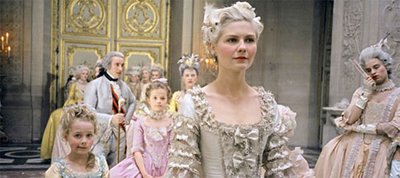
Anyway, I relaxed in the evening by accompanying Fr Richard Whinder to see Marie-Antoinette at the cinema just round the corner from the Archives. The film has had a mixed reception - the French critics at Cannes are said to have booed - but I loved it! I wasn't expecting a film with a clear beginning-middle-end nor was I looking for strict historical accuracy. But as an impressionistic portrait of a lost age, it was second to none.

Unlike any other film I've seen, you really felt as if you were there - at Versailles (and it helped, of course, that the film was shot 'on location' at the great palace). The film deserves at least Oscar nominations for costume design and photography. There were some impressive shots of the royal carriages trundling along and of the gardens of Versailles, full of courtiers as far as the eye could see. I must say Miss Dunst also cut a fine Marie-Antoinette, despite (or perhaps because of) the relative lack of dialogue. The film, I must add, was comparatively 'priest-friendly' and, with its 12A certificate, did not go down the path (which many other directors would have chosen) of including lots of sex scenes.


There were some minor irritations. Louis XV had a particularly strong, cowboy-like American accent (apologies to readers across the pond). Joseph II didn't resemble the obsessively enlightened despot that he was. The modern rock music (juxtaposed with the odd Baroque aria) didn't always work as a soundtrack. And - as always with big films - there were numerous liturgical errors in the ceremonial scenes, such as cardinals wearing chasubles under their copes (unless it was an ancient Gallican privilege?!). This is particularly tragic because the Versailles area is not short of a few traditionalist clergy who could have advised on such matters.

Worst of all, in my mind, is the fact the film stops at the Revolution, which was the Queen's finest hour. As Elena Maria Vidal (Catholic author of such novels as Trianon) has pointed out:

The Coppola film ends when the Revolution begins, at the moment when Marie-Antoinette came into her own as the daughter of a great empress and as a queen who would not forsake her husband or her duty, even when to do so cost her her life. The new generation of movie goers will be deprived of such an inspiration that would be so powerful on screen. Antoinette's Christian fortitude is ignored and her personal tragedy is trivialized amid a movie of froth. Without the spiritual depths, the depiction is shallow and incomplete.

However, at least Marie-Antoinette is very much the heroine and, in its quiet way, the film is a piece of historical revision and goes against the traditional 'let them eat cake' image of the French Queen (although the 'myth' of her affair with Count Axel von Fersen is repeated). For a historical critique of the film, see Elena Maria Vidal's website (raised biretta to Dappled Things). But, on the whole, the film gets a thumbs up from the Roman Miscellanist.

(All pictures copyright Columbia Pictures)

Labels: , ,

Saturday, 21 October 2006

The Queen

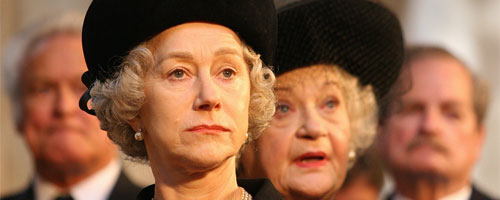
Last night I met a priest friend and went to see The Queen (starring the wonderful Helen Mirren) at a cinema which, appropriately enough, is a short walk away from Kensington Palace.

Based on the events following Diana's death, I wasn't quite sure that I would enjoy the movie but the acting certainly kept my attention and there were some interesting details of palace life. Her Majesty came across fairly well, even if her stiff resolve to 'do nothing' after Diana's death proves to be the wrong decision - but I don't think any of the audience in Kensington would have left with radical republican sentiments. In fact, the only opponent of the Monarchy in the film is Mrs Blair. All in all, it's an interesting study of power and the British Establishment.

According to the today's Telegraph, the film is proving quite a hit in New York and everyone wants to imitate Her Majesty's dress sense. As a regular wearer of a black barbour jacket (it goes nicely with a Roman collar), I was pleased to read that the latest must-have item across the pond is the Beauford - 'a zip-up "classic country" waxed number with a corduroy collar and optional hood.' Another great English export!

Labels: , ,

<< # St. Blog's Parish ? >>