Sunday, 30 November 2008

Seasonal Music

Advent and Christmas are richly musical seasons and there are many recordings available of carols and noels, cantatas and oratorios. Each year I look with interest at the many new CDs produced for the festive Season, although it is always a great temptation to put on recordings of carols as soon as we light the first candle on the Advent Wreath.

Here are two particularly fine new CDs, though rather different from the usual ‘Ultimate Carol Collection’ or ‘Best Christmas CD Ever.’


Hieronymus Praetorius, Magnificats and motets
(The Cardinall’s Musick, Andrew Carwood)
Hieronymus Praetorius (1560-1629) – not to be confused with the slightly more famous Michael Praetorius (curiously not related) – worked in Hamburg and produced some ravishing and lively polyphonic music. This CD includes his masterpiece, the Magnificat quinti toni to which is attached two popular Christmas carols: Joseph, liber Joseph mein and In dulci jubilo (my favourite carol). The booklet notes that the former piece was ‘associated with the cradle-rocking ceremony at Christmas vespers – a priest would sit next to a cradle containing an effigy of the baby Jesus and would rock the cradle gently in time to the lilting rhythm of the music.’ The Cardinall’s Musick is one of our best choirs and its director, Andrew Carwood, was formerly Director of Music at the Brompton Oratory and is now in charge of the choir at St Paul’s Cathedral. For more information and samples, click here.


Natalis Cordat and Nicolas Saboly, Noel Baroque en Pays D’Oc
(La Camera delle Lacrime, Bruno Bonhoure)
This rather obscure CD contains C17 settings of French Noels by Natalis Cordat (c.1610-63), parish priest of Cussac-sur-Loire, and Nicolas Saboly, an organist in Avignon. It includes some familiar tunes, such as Li a pron de gens (allegedly written by Saboly to make fun of a lame priest he knew). The pieces are excitingly performed on period instruments and have a rustic charm, which makes you think back to C17 Provence. For more information and samples, click here.

Labels: , ,

Thursday, 17 July 2008

L'Arpeggiata

Fr Blake has recently been delighting us with pictures and clips of lutes and lutenists. Well, I've long been meaning to post some videos of one of my favourite early music groups - Christina Pluhar's L'Arpeggiata. The first clip is a seventeenth century madrigal, Bastiao, featuring the famous King's Singers:


The second is a Tarantella dance composed by the Jesuit polymath, Fr Athanasius Kircher, most noted for his scientific work:


And finally a lively Jacaras:


Who says 'old' music is boring?

Labels:

Thursday, 6 September 2007

O Lux Beatissima


I was recently sent a free sample of a CD called O Lux Beatissima, performed by the Oregon-based choir, Cantores in Ecclesia. It contains 35 of 'the most useful and accessible' Gregorian chants: not only obvious pieces such as the complete Missa Simplex and Missa de Angelis, but also chants from the Requiem Mass, the Asperges, Hosanna Filio David (for Palm Sunday), Pange lingua, several Office hymns (eg Lucis Creator Optime and Te Lucis) and many others - all on one disc.

Not only are the pieces well sung, with full use of adult and children's voices, but the recording is most useful for all those wishing to learn the basic Gregorian repertoire - for either the ordinary or extraordinary forms of the Roman Rite.The pieces were chosen not only for their importance but also their simplicity.

The CD can be bought here or, for UK readers, priced £14.35 from Viewpoint Resources Direct Ltd, 21 Point Hill, Greenwich SE10 8QW (02086921138).

Labels:

Thursday, 16 August 2007

Five Catholic Facts About Elvis


I have a grave confesion to make. I own some Elvis CDs. In fact, I used to be quite keen on his music and one has to admit that, despite his unedifying lifestyle and tragic final years, he was a talented musician. Many people around the world are marking the 30th anniversary of Elvis' death. Here are five top Catholic facts about the 'King':
  • one of Elvis' early performances (1955) was at the Catholic Club, Helena, Arkansas. However, his unorthodox performance did not impress the parish priest, Fr Keller, especially when the singer autographed a female fan's leg. 'You are a disgrace to manhood', he was allegedly told, 'don't come back anymore'. Read more about it here.

  • It is well known that the beautiful Dolores Hart, the niece of Mario Lanza who starred alongside Elvis in Loving You (1957) and King Creole (1958), left Hollywood in 1963 to become a Benedictine nun at the Abbey of Regina Laudis, Bethlehem, Connecticut. There have long been rumours that Dolores previously had romantic attachments to Mr Presley. 'I'd done two movies with Elvis Presley', she later said, 'I'd been around Hollywood for a while - and saw how needlessly competitive and negative it could be. It never held my interest'. She eventually became Prioress and Mother Hart now holds the unique distinction of being the only nun to be a voting member of the Academy of Motion Picture Arts and Sciences.

    Before...

    ...and after

  • I've mentioned before Elvis' last feature film, Change of Habit (1969), in which he plays a doctor working alongside three sisters 'on placement' (see picture at top of post). The unique finale, showing Elvis as part of a folk group at an interim, pre-Novus Ordo Mass, can be seen here.

  • Elvis recorded a song called 'The Miracle of the Rosary' in 1971 (issued on the 1972 album, Elvis Now), with the lyrics: 'O Blessed Mother we pray to thee/Thanks for the miracle of your Rosary/Only you can hold back/Your holy son's hand/Long enough for the whole world to understand/Hail, Mary full of grace/The Lord is with thee/Blessed are thou among women/And blessed is the fruit of thy womb, Jesus/O Holy Mary dear mother of God/Please pray for us sinners/Now and at the hour of our death/And give thanks once again/For the miracle of your rosary'.

  • When Elvis died in his Graceland bathroom thirty years ago today, he is said to have been reading a book about the Holy Shroud of Turin - normally identified as A Scientific Search For The Face Of Jesus (1972) by Frank O. Adams, which argues that the Turin Shroud really is Our Lord's Shroud. It has since become eagerly sought after by Elvis fans. Less impressive is the other book he was allegedly reading - Sex and Psychic Energy. Hmmmm, we better move quickly along.

NB There really was a Celtic saint called St Elvis, who was a bishop of the Irish See of Munster and may even have baptised St David, Patron of Wales - so it is a valid baptismal name!

Labels:

Saturday, 21 July 2007

La Vie En Rose

Tonight I accompanied the parish's new Young Adult Group (18-35) to see La Vie en Rose at a packed cinema in Islington. Marion Cotillard gives a superb portrayal of Edith Piaf, the French singer and national icon - in fact, it's hard to believe that she is lip-synching to Piaf's unique voice.

The heroine, Piaf, is not the most attractive of characters - proud, obstinate and leading a life that caused the Archbishop of Paris to refuse her a Catholic funeral. However, her childlike piety also comes across very strongly. She refuses to go on stage at the Paris Olympia without wearing her crucifix and she is often shown praying before a performance.

Rather unexpectedly, St Therese of Lisieux has a constant and unseen presence in the film. As a child Piaf suffered from blindness (a result, it seems,of keratitis). The kindly prostitutes who cared for her arranged for Piaf to visit the saint's tomb to pray for a recovery. Shortly afterwards she could see again. The saint's influence continued in Piaf's life until the very end, making La Vie en Rose a powerful essay on the efficacy of prayer.

I recommend readers to see the film - and in the meantime, here is the 'Little Sparrow' herself performing her most celebrated song:

Labels: , ,

Monday, 30 April 2007

Free Ascension Day Recital

The world-renowned vocal group, The Tallis Scholars, are giving a FREE recital in the Front Hall of the British Library on Thursday 17 May at 1pm, with music by Gombert (In illo tempore) and Monteverdi (Missa In Illo Tempore). This has been organised, rather amazingly, to mark the traditional Feast of the Ascension, although in this country we will for the first time be keeping the transferred feast the following Sunday, 43 days after Easter. If you're in the London area, put the date in your diary!

Labels: ,

Tuesday, 20 March 2007

Quarant'Ore

Tonight I had a rare opportunity to tear away from my parish and benefit from the vibrant Catholic life of Central London by attending the magnificent opening of the Forty Hours at the Oratory. It's always good to visit the Oratory, since this was the church of my First Holy Communion and my childhood attempts at altar-serving - but the Quarant'Ore is something special.

Firstly, High Mass (Novus Ordo) was celebrated by the Provost. According to my swift calculations, 179 candles were lit during the Liturgy of the Word - such things can be done when you have a splendid seventeenth century Neapolitan High Altar with spacious gradines. The Blessed Sacrament was placed in the monstrance after Holy Communion and solemnly processed around the church, as the choir sang F. Correa de Arauxo's Lauda Sion and Palestrina's stunning Pange lingua. Then the Sanctissimum was placed on the altar, the ministers quietly left and the lights dimmed. Theatrical and baroque, yes - but I think everyone felt very much 'involved' and the ritual was a genuine means to adoration of the Blessed Sacrament.

Afterwards I bumped into a fellow Westminster priest and two musician friends (one of whom is the author of the Surge illuminare blog) and we retired to The Oratory brasserie, where I was able to sample an 'Oratory Burger and chips' and a few glasses of 'Holy Trinity.'

As I write this, I'm listening to the Oratory Choir's new CD: Vexilla Regis Prodeunt - Music for Holy Week and Easter - highly recommended for these final weeks leading to Easter. To quote the website, this CD:
presents a musical journey through the great liturgies of the most solemn week in the Church’s year. The spiritual power of these ceremonies, as celebrated at the Oratory, is evoked through some of the most profound masterpieces of the Latin liturgical repertoire, in which the Oratory Choir’s qualities of ‘musical self-control combined with passionate expression’ (to quote Church Music Quarterly) are famed.

Starting with the excitement and glowering splendour of Palm Sunday in Victoria’s Pueri hebraeorum and Wingham’s Vexilla Regis prodeunt, the programme continues through the dignified, reflective atmosphere of Maundy Thursday with Anerio’s Christus factus est and Duruflé’s Ubi caritas to the humbled adoration and penitence of Good Friday with King John of Portugal’s Crux fidelis and Byrd’s Civitas sancti tui. Palestrina’s Sicut cervus and Taverner’s Dum transisset sabbatum embody the gathering crescendo of joy at the Easter Vigil, and the full light of Easter Day is conveyed by Palestrina’s Haec dies and Allegri’s brilliant double-choir Christus resurgens. In addition, familiar Gregorian chants such as Vidi aquam and Victimae paschali laudes punctuate the choral progress.

Nearly all these items were recorded on the affectionately remembered 1979 LP Music for Holy Week and Easter made by the Oratory Choir under the direction of John Hoban. The longer playing time on CD means that this new recording also includes additional items including Victoria’s glorious Tantum ergo and haunting Reproaches (with a distant solo quartet singing the Greek text), Monteverdi’s intense Adoramus te Christe and Lhéritier’s refulgent Surrexit pastor bonus, now sung during Communion at High Mass on Easter morning.

The booklet documentation is comprehensive and the recording quality is superb. Like the Oratory Choir’s previous two CDs(Totus tuus sum, Maria and Jesu dulcis memoria – both acclaimed in the musical press) Vexilla Regis prodeunt has been sponsored by the Catholic charity Aid to the Church in Need, to whom go all profits from sales, and is now available in the Oratory shop at £11.50.

Labels: ,

Saturday, 20 January 2007

In Honour of Our Lady

Since it's Saturday, here's a sublime Salve Regina by Giovanni Battista Bassani (c.1657-1716) - out of liturgical season, I know, but beautiful nevertheless. The singer is the superb French alto, Gerard Lesne, whose recordings are always worth buying.

Labels:

Friday, 19 January 2007

Something for the Weekend

And now for something completely different...


I was pleased to find this on You Tube - a colourful clip from one of my favourite opera DVDs. It just proves that early/baroque music is anything but stuffy, thanks to this slightly surreal production by William Christie. The extract is from Act IV of Rameau's Les Indes Galantes, an opera-ballet first performed in Paris in 1735. The characters in this scene are les sauvages ('savages') of North America. Zima (played by Patricia Petibon), the daughter of a Red Indian chief, is pursued by a Spaniard and a Frenchman, but in the end she chooses one of her own people.

I hope it cheers you up this weekend!

Labels:

Wednesday, 6 December 2006

Another Seasonal Recommendation

Here's another new recording which I'd like to highly recommend to readers searching for presents or needing some seasonal inspiration: Christmas Vespers at Westminster Cathedral (on the Hyperion label).

It presents 'an adorned version of the Office of Vespers as it might be heard on the eve of Christmas in Westminster Cathedral' - by 'adorned' read 'Old Rite,' since there are five psalms, no bidding prayers and everything is sung in Latin. The recording includes Tallis' Magnificat, Victoria's Alma Redemptoris, Schutz's Hodie Christus natus est and Langlais' Fete for organ. It demonstrates the Cathedral's liturgical excellence and the famous Westminster sound.

Labels: ,

Sunday, 3 December 2006

Desert Island Discs

And now for something completely different...

I'm a keen armchair musician, although sadly (despite taking lessons in the Highland Bagpipes as a teenager) I play no musical instrument. As we approach Christmas, I thought I might provide my shortlist of some of my favourite recordings at the moment. Any of these would make a fine present for family or friends.

Charpentier, Music for Christmas
A beautiful disc of seasonal music from the French baroque composer, Charpentier, played by Canada's Aradia Ensemble and at a bargain price. The selection includes ten charming Noels (capturing the mystery of Christmas night) and the extensive In Nativitatem D(omini) N(ostri) J(esu) C(hristi).


Monteverdi, Vespro della Beata Vergine (2 CDs)
This is a much recorded piece - and deservedly so - but the new recording from Paul McCreesh's Gabrieli Consort has already become a favourite of mine.

Handel, Messiah (2 CDs)
Another popular piece which I love listening to at this time of year. This new release from Naxos is the first modern reconstruction of the Handel's London performances of 1751. It's inexpensive and features the famous choir of New College, Oxford, and the rising countertenor star, Iestyn Davies.

L'Arpeggiata
I love early music and over the last few years there have been many lively and imaginative recordings, especially in the world of Spanish American Baroque. I'm a big fan of Christina Pluhar's L'Arpeggiata group and their 'fusion' of different musical genres (early music, jazz, folk), using authentic instruments (Pluhar herself is a noted theorbo player). Their latest CD, on the Naive label, is called Los Impossibles (featuring the King's Singers and coming with a free DVD) but Amazon have no links to it. So, to get you started, try All'Improvviso. Andrew McGregor of the BBC referred to its 'toe-tapping continuo on baroque guitars, harp, lute and theorbo, some sparkling cornet-playing and lively strings, and you have crossover of the highest quality, from performers who recognise no boundaries in 400 years of music. Magical results, from the meanest ingredients, and it ought to be available on prescription to the clinically depressed.'

Le Voeu de Louis XIII
Many early music and baroque CDs have great interest for the Catholic. This fine recording from the Centre de Musique Baroque de Versailles provides a musical reconstruction of Louis XIII's consecration of France to Our Lady on 10 February 1638.

Hang On Little Tomato
And just to show you that I do listen to music composed after the French Revolution, here is a stylish and mellow album from Pink Martini. According to the band's founder, Thomas Lauderdale, 'we’re kind of like musical archaeologists, bringing melodies and rhythms from different parts of the world together to create something which is modern.' This is the perfect CD to put on at the end of a busy day:

Labels:

Tuesday, 28 November 2006

Oratorian Cabaret


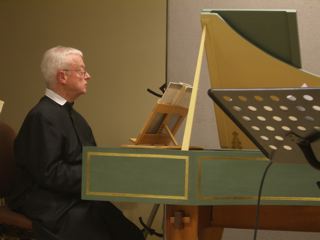
H/T to Devout Life for this footage of the 'Men in Black' fundraising concert at the Toronto Oratory - featuring an Oratorian on a tuba and, forming a backdrop, the harpischord belonging to the distinguished Fr Jonathan Robinson - which can be seen more clearly in the picture below:


Very much in the spirit of St Philip Neri!

Labels: ,

<< # St. Blog's Parish ? >>