Monday, 11 August 2008

A Recording of Cardinal Manning's Voice

Flicking through a volume of The Tablet from 1894 the other day - as you do - I found a fascinating report of a phonograph that was made of Cardinal Manning's voice as he lay dying in 1891 (he finally passed away on 14 January 1892). He was encouraged to do this by his friend, Charles Kent (author of The Modern Seven Wonders of the World), and the recording was made by Edison's representative in the UK, Colonel Gouraud. 'In the beautiful library of the Cardinal,' we read in the report, originally printed in the Pall Mall Gazette, 'the message was dictated and afterwards reproduced, to the unconcealed pleasure and amazement of its author.'

Three recordings were made - one for Cardinal Gibbons in America, another for Pope Leo XIII ('the reception of which made a great effect upon the Pontiff, who could hardly believe that it was not the actual voice of his friend that he heard') and the third for posterity, to be played only after the Cardinal's death death. 'Upon my handing him the cylinder,' wrote Colonel Gouraud, 'the Cardinal took it with a curious expression in his eyes, as if he were trying to realize that the next time the message was heard he would be in his grave.'

The message was finally played on 16 February 1894 in a large reception room of Whitehall Court. Distinguished guests were invited, rather morbidly, 'to meet his Eminence Cardinal Vaughan and Henricus Edwardus Cardinalis Manning, Archepiscopus Westmonasteriensis.' Those assembled included the Cardinal's faithful Secretary, Mgr Johnson, the American Ambassador and a representative of the Prime Minister, Sir Algernon West. 'The scene was a very impressive one and the audience listened with bated breath to the faint scratching of the phonograph...the message came forth slowly, solenly, deliberately, and with long pauses of thought: "To all who come after me; I hope that no words of mine, written or spoken in my life, will be found to have done harm to any one after I am dead - Henry Edward Manning, Cardinal Archbishop." A few other voices were put upon the phonograph after this, including those of Tennyson, Browning, General Sharman, and others who in life will never be heard again. It is the intention of Colonel Gouraud some day to deposit these priceless treasures in the British Museum. Till then they will in all probability never be listened to in England again' (Tablet, 24 Feb 1894, pp290-291).

I must investigate to see if this valuable recording is to be found in the British Library's hi-tech Sound Archive.

UPDATE: I've received a reply from the British Library saying that they don't have the recording in their collection and don't know whether it survived. It's the sort of thing that might be lying around in an attic somewhere!

Labels: , ,

Tuesday, 27 March 2007

Religious Archives


Priests get used to public speaking, even if they're not particularly good at it, but I must confess feeling rather apprehensive yesterday when I spoke at a meeting of religious archivists at the swish British Library Conference Centre near King's Cross. There were about 70 in attendance, including the Chief Executive of the National Archives, and I felt very aware of my lack of professional training. Still, it seemed to go OK and I was able to avoid any difficult questions! It was a good day, despite all the ghastly jargon (eg 'profile raising advocacy,' 'visibility levels,' 'collection level descriptions,' etc), which began to get rather confusing.

It was interesting, though, to hear about the archives of other religious groups - for example, the sheer number and anti-hierarchical nature of many nonconformist sects (with curious names like the 'Countess of Huntingdon's Connexion') makes centralised archiving very challenging.

One of those present was a Mormon from Utah. The Mormons are well-known for their interest in family records; in fact the Family History Library in Salt Lake City is the world's largest genealogical library, with information relating to over two billion people. The Mormons run over 4,500 family history centres and mega websites like familysearch.org. Their motives? These records allow them to perform 'sacred ordinances' on behalf of the dead - including baptism, confirmation and even ordination. According to the Wikipedia:
Latter-day Saints perform these proxy ordinances because they believe deceased non-Mormons are in a condition commonly referred to as "Spirit Prison." They believe that Christ went to the righteous spirits and organized a great missionary force to teach the gospel to others of the dead who, in turn, may be baptized by proxy in a temple. It is believed that the dead may accept or reject the other ordinances done by proxy on their behalf prior to the final judgement.
It's important to point out that Catholic institutions need to be very careful when approached by agencies from Utah offering to copy baptism registers and the like! Their purpose is not as straightforward as it might seem.

Labels: ,

Tuesday, 21 November 2006

Manning and Harrow

It's been a rather mad day - stayed Monday night with a recently married University friend who lives in Guildford and has just qualified as a British Airways pilot. Then I met friends for lunch in Leatherhead.

My final destination was Harrow School, where a new exhibition was opened outlining the life and work of the school's two most eminent nineteenth century churchmen: Charles Gore (sometime Anglican bishop of Worcester, Birmingham and Oxford) and our very own Cardinal Manning. I was invited to the launch since there were items from our archive on display and I was welcomed by the School's excellent Catholic chaplain, Fr Andrew Wadsworth:

Harrow is one of our finest public schools - founded in 1572 and boasting Churchill, Peel, Palmerston, Byron, Trollope and nineteen winners of the Victoria Cross as old boys. It has an impressive exhibition area, the Old Speech Room Gallery, and part of the Manning display can be seen in the picture above, including the mitre the Archbishop wore at Vatican I.

Dinner followed in the Senior Common Room, where our table had an ecumenical flavour - I had a very pleasant conversation with the Anglican chaplain and a representative of the Community of the Resurrection at Mirfield (founded by Bishop Gore).

We toasted Cardinal Manning, despite his celebrated teetotalism. His years at Harrow formed in him a regular prayer life, but there was little indication of Manning's future career. His greatest distinction at school was playing in the criclet eleven. During one inter-house match around 1823 two future archbishops (Manning and Trenchard of Dublin) and three bishops (Wordsworth, Oxenden and Terry) all played. Manning, we are told, also liked wearing tasselled Hessian top-boots!

Labels: , ,

Saturday, 18 November 2006

A Busy Week

It's been a pretty busy week, especially since my PP has been away the last fortnight, leaving me 'in charge' of one of the largest parishes in this part of London. Luckily no major disasters - last time he went away part of the sacristy ceiling fell down!

I meant to mention that I paid a visit to Westminster Cathedral on Monday. After chatting with the Administrator, Mgr Mark Langham (who reads this blog!), I was shown the Cathedral archive, which is situated in a room once used by the architect, John Francis Bentley, in one of the towers. I spent a happy two hours looking at medieval Books of Hours, Bentley's plans, drawings by Eric Gill, photos of grand functions and a huge model of the Cathedral. Unfortunately, I forgot to take my camera!

On Friday evening I had a pleasant drink with the author of Cally's Kitchen, who lives in the parish. My rooms are finally ready for entertaining friends, which is always a pleasure, and over the last fortnight a number of brother priests have popped over for drinks or impromptu meals. Anyway, inspired by the conversation with the Dúnadan , I decided to overcome my reservations and upgrade to Blogger Beta. I think it's worth it and I'm currently putting labels on my old posts.

Labels: , ,

Thursday, 2 November 2006

A Passion for Archives

Scots Passionist blogger, Laus Crucis, recently had a very interesting post on his Generalate Archives at SS Giovanni e Paolo in Rome. There are some good pictures, which will please all archive geeks - including one of several shelves of theological works by Blessed Dominic Barberi. We all remember him as the humble missionary who received Newman into the Church that it's easy to forget his academic background. Apparently, several Italians have recently completed doctorates on his Mariology and ecumenical spirituality.

Labels:

Monday, 16 October 2006

The Wit of Adrian Fortescue

Greetings from the Diocesan Archives! As I speak we have four people looking at the papers of Adrian Fortescue (1874-1923), the great polymath priest, writer and liturgist. They're hoping to organise a local exhibition in Letchworth. His letters are written in beautiful script and are full of wit. Some time ago I started transcribing them - I didn't get too far but here's one example (blog exclusive!):

To Canon Edwin H. Burton at St Edmund's College, Ware (20 September 1902)

I have been missing you horridly at breakfast, though the salutary vision of you fully vested & waiting with lacerating meekness in my sacristy when I rolled out of bed has not yet lost its effect. The nuns (little pink daughters of the penitent thief) are here now; so I get up at 7am, like an early Christian martyr. Sister Joanna Baptista of the Pinnacle of the Temple L.P.D. of P.T. (the she-superior) is a Tartar & won’t stand no fooling, nor can I imagine her waiting meekly as you did, though she would wear vestments like a shot if I let her. This order is an entirely new idea of my Rector at the German Church (a Bohemian monomaniac): its originality consists in the fact that the members go to the Sacraments several times during the year, abstain from fleshmeat on all Fridays, & endeavour generally to cultivate a spirit of Christian virtue & untarnished morality. These proceedings are rightly supposed to be very gratifying to the better nature of the penitent thief – hence the order’s name.

Also they have 15 little boys, so that when you come at Christmas you shall have no lack of servers. They sing Vespers in the evening in what purports to be the Latin tongue, Sister Philipina Canaria (of the way to Jericho) wearing a cope & a Roman missal, from which she tells me that she always sings Vespers.

They have given me a picture of a gentleman whom I recognise as that illustrious prelate the present incumbent of the Roman bishoprick: I am informed that if I look at it in the proper spirit it will give the pontifical blessing – a striking sight which I am naturally anxious to enjoy. Hitherto I have not succeeded in convincing it of my spiritual propriety. I have told it all the things that I think it would like to hear – that I am dead nuts on Encyclicals, that ubi Petrus ibi the whole show, that Roma locuta est (she never stops) nulla salus est (I hope I haven’t got this mixed); I have even said polite things about its fel. Rec. predecessors of the X & XV centuries; alas, in vain! It hasn’t once burst into: Sit nome Domini benedittumme [sic]. When you come I hope you will start it: it can’t doubt your propriety of spirit!

Note: Fortescue was a loyal Roman Catholic but he was proud to be English and certainly was not unduly Ultramontane, hence his tongue-in-cheek humour regarding the Holy Father.

Labels: ,

Wednesday, 11 October 2006

A Cardinal on the Western Front

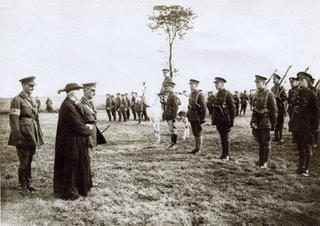
I was just playing around with my new scanner and thought I might include these wonderful photos from the diocesan archives. They show Francis Cardinal Bourne, Archbishop of Westminster, visiting the Dublin Fusiliers Brigade on the Western Front during the First World War.


Labels: ,

<< # St. Blog's Parish ? >>