Wednesday, 19 November 2008

Poleiana

Continuing the Cardinal Pole theme - today I popped over to Lambeth Palace, at the invitation of a friend who works in the Library and has been very helpful in advising the diocesan archive. They have displayed some 'Pole memorabilia' to commemorate the 450th anniversary of his death and to show the English and Welsh bishops, who were over there on Monday. Particularly impressive was the Cardinal's register, with a magnificent depiction of his coat of arms (with more tassels than I have ever seen on a cardinaltial arms). There is a picture here (go to 'Image of the Month: November').

The Times has a report of the Requiem Mass held on Monday at Magdalen College, Oxford.

Labels:

Monday, 17 November 2008

Cardinal Pole and Mary I - 1558-2008


Today is the 450th anniversary of the deaths of both Cardinal Pole, last Catholic Archbishop of Canterbury, and Mary Tudor. The English and Welsh bishops met today and visited Lambeth Palace to honour the memory of Cardinal Pole; meanwhile, a number of Requiem Masses were held in Oxford, Cambridge, Birmingham and London. I had the privilege of preaching at one of these:

We gather here this evening to remember a series of deaths that occurred exactly 450 years ago. At about six in the morning of 17 November 1558, Mary Tudor died at St James’ Palace, as Mass was being celebrated in her chamber and the priest was elevating the Sacred Host. Twelve hours later her cousin, Reginald Pole, Cardinal Priest of Santa Maria in Cosmedin and Archbishop of Canterbury, died across the river at Lambeth Palace. With them died hopes for an English Catholic restoration and the subsequent long reign of Elizabeth did much to consolidate the newly-founded Church of England.

The two cousins had much in common. Both had saintly mothers – in the Queen’s case, Catherine of Aragon (the discarded wife of Henry VIII, who remained loyal to the Catholic Faith and to the bonds of marriage); in the Cardinal’s case, Blessed Margaret Pole, the last of the Plantagenets and martyr. When Pole heard of her execution in May 1541, he declared that ‘until now I had thought God had given me the grace of being the son of the one of the best and most honoured ladies in England...but now he has vouchsafed to honour me still more by making me the son of a martyr.’ Both the Queen and the Cardinal also tried to heal the English schism but their efforts were cut short by premature death. Both have been largely vilified by posterity – the Queen remembered as ‘Bloody Mary’ and the Cardinal as her henchman.

At this Mass, we particularly pray for the repose of the soul of Cardinal Pole and we pay tribute to his legacy, even though when he died all his efforts seemed to have failed. Mgr Robert Hugh Benson once wrote that ‘it is hardly possible to imagine a character less suited, in popular estimation, to the needs of his time, than was that of Reginald Pole to the period of the English schism. They were days of fierceness, brutality and literally Machiavellian diplomacy; and the nature of the Cardinal who played so great a part in them was one of gentleness, kindness and simple transparence...It is no wonder then that the Cardinal, a lover of peace and study, sensitive in conscience and passionately zealous for souls, should, as the world reckons success, have failed in nearly every task to which he set his hand.’

In the eyes of the world, Pole was a failure. He failed in his various diplomatic missions or legations aimed against King Henry. He famously failed to be elected Pope by just a handful of votes in the Conclave of 1549 – so certain was his election thought to be that pontifical vestments were even made for him. He failed in his desire for the Church to reach reconciliation with the schismatics and, in fact, at the time of his death he was suspected by Rome of having Protestant sympathies - only the protection of Queen Mary prevented him from facing the Roman Inquisition. Moreover, his plans for Catholic restoration in England ultimately came to nothing.

Pole was perhaps a failure in temporal terms, and yet his failure can be seen also as a victory from the perspective of Divine grace. Though, unlike his mother, he was not called to shed his blood for the Faith, he risked much in defending the Papal primacy.

We remember him today as a great scholar and the friend of the likes of Michelangelo. We recall his central role in the opening sessions of the Council of Trent. Above all, we celebrate his achievements in England, even though they were left unfinished. On 30 November 1554 he reconciled the realm to the Holy See during an emotionally-charged service at Whitehall Palace. ‘If the angels in Heaven,’ the Cardinal said, ‘rejoice over the conversion of a single sinner, what must be their joy to-day at the sight of a whole kingdom which repenteth?’ Pole set aside St Andrew’s Day as an annual celebration of ‘the return this kingdom to the unity of the Church.’ The following Sunday Pole was at St Paul’s and the Lord Chancellor, Bishop Gardiner, preached on the theme, ‘Now it is high time to awake out of sleep.’

Pole told Parliament that he aimed ‘not to pull down but to build; to reconcile not to censure; to invite but without compulsion.’ He took a gradual and realist approach to the Catholic restoration, confirming property rights and refusing help from St Ignatius and the newly-founded Jesuits - not because he opposed them but because he thought England was not yet ready and because they had too close a connection to Spain. Pole organised a Legatine Synod, perhaps his greatest legacy.. He stressed the importance of the residence of clergy and of preaching and catechesis in each parish. Most notably, he decreed ‘that in Cathedrals a certain number of initiated persons be brought up, whence as from a Seminary, men may be chosen who may be worthily set over Churches...We especially wish,’ he added, ‘the children of the poor to be chosen into these seminaries.’ The Cardinal was one of the first to speak of seminaries and anticipated the Tridentine decrees, though his vision would not be actualised in his own country for another 250 years.

But these battles and dreams have long since ended for our Cardinal. We pray that he is now at peace, united with his mother, the Blessed Margaret. Though we live in very different times, the battles that Pole fought so courageously have now passed down to us. The words of Bishop Gardiner, preached on that First Sunday of Advent 1554, echo in our ears: ‘Now it is high time to awake out of sleep.’ Like the Cardinal, it is up to us not so much to pull down but to build; to reconcile rather than simply to censure; to work for the unity of the Church and to re-evangelise our increasingly ‘post-Christian’ culture. As Fr Aidan Nichols showed recently, much of this project has to happen within the Church – the re-enchantment of the Sacred Liturgy, the on-going revival of catechesis and preaching, the rediscovery of the Catholic reading of the Bible, the preaching of the Gospel of Life and, most importantly, the continual striving for holiness on the part of us all. Cardinal Pole would approve of all these targets. As we pray for the repose of his soul (and also that of Mary Tudor), we continue to pray and work for the conversion of England.

Labels: , ,

Friday, 13 July 2007

'Henry IX' 1807-2007


Today is the bicentenary of the death of Cardinal Henry Stuart, brother of 'Bonnie Prince Charlie', Stuart claimnant to the British Throne (1788-1807) and popular Bishop of Frascati. In fact, the day of his death, 13 July 1807, was the 46th anniversary of his enthronement as Cardinal Bishop of that See. In the revised calendar, of course, it is the feast of St Henry the Emperor (though this was originally 15 July).

The Cardinal has left his mark in and around the Eternal City more than any of the other English Cardinals. His coat of arms can be found in Santa Maria in Trastevere and his monument stands proudly at the back of St Peter’s. There is a Largo Duca di York in Frascati and a Via di Cardinal di York near a villa that still bears his name in the Riserva Naturale della Valle dei Casali, to the west of Rome. Throughout the Castelli area there are numerous plaques in churches and on streets witnessing to his munificent patronage. In the little town of Monte Porzio, for example, there is a tablet on the Via Giuseppe Verdi recording the school he established in 1773 for ‘the education of young girls in piety and the useful arts’. A stone’s throw away in the duomo of San Gregorio Magno inscriptions recall the dedication ceremonies at which he pontificated in 1766 and the translation of the relics of the martyr, St Laconilla, which he organised in 1783. The Cardinal is indeed remembered as the benemerito Cardinale Tuscolano (‘well-loved cardinal of Frascati’).

With his death, the House of Stuart came to an end. The de jure Crown passed to his second cousin twice removed, Charles Emmanuel IV of Savoy, who was noted for his piety and ended his days in a Jesuit novitiate. After lying in state at the Palazzo Cancelleria, ‘Henry IX’ was buried at St Peter's together with his father ('James III') and brother. A monument by Antonio Canova was later placed near the entrance of the basilica, which was paid for partly by the Prince Regent. The bodies were placed in the crypt and moved slightly to the east in 1938 to make way for the eventual tomb of Pius XI. This time the new tomb was financed by George VI.

May he rest in peace!

Labels: ,

Sunday, 8 July 2007

The English Cardinals


Can I draw people's attention away from all the exciting documents being issued by the Holy See for a moment? I'm certainly not trying to compete but a book of mine is being published tomorrow (9 July) by Family Publications. It's called The English Cardinals and it is co-written by my friend, Fr Gerard Skinner, who recently published a study of the pallium.

The book has individual chapters on each of the 50 English Cardinals, from Robert Pullen (created c.1144) to Cormac Murphy-O'Connor (created 2001). These include pre-Reformation prelates such as Stephen Langton, Henry Beaufort and Thomas Wolsey; heroes of the Catholic resistance like St John Fisher, Willam Allen and Philip Howard; and the 'big three' of the 'Second Spring' - Wiseman, Manning and Newman. There are many less well-known figures, such as Edward Howard, who led the funeral procession of the Duke of Wellington before entering the clerical state, and English Cardinals who spent most of their lives overseas - such as Pope Adrian IV, the Cardinal Duke of York and Rafael Merry del Val (a priest of Westminster and Secretary of State to St Pius X).

Best of all, the book has loads of pictures, some of which make their first appearance in print - there are four colour sections and black and white illustrations throughout (including coats of arms and pictures of the titular churches). The book is hardback, 304pp, and sells at a modest £19.50. Probably the easiest way of getting the book is from the Family Publications website. Waterstone's has a link here, with free postage. Or a slightly more expensive deal from Amazon:


No pressure!

Labels: , ,

Wednesday, 2 May 2007

A Cardinal's Skull


While in the north of England I had the opportunity of visiting the Jesuit College of Stonyhurst, Lancashire, which is a fantastic treasure-trove of Catholic relics and antiquities. Sitting on one display cabinet was the skull of Cardinal Morton, one of the last great Churchmen before the Reformation.

Born at Milborne St Andrew or Bere Regis in Dorset, he was educated at nearby Cerne Abbey and then Oxford as a lawyer and soon attracted the attention of Cardinal Bourchier. He rose up the ecclesiastical ladder, ending up as Bishop of Ely (1478), Archbishop of Canterbury (1486), Lord Chancellor (1487), and Chancellor of Oxford University (1494). In 1493, he became Cardinal Priest of S Anastasia.

Fifteenth century England was in the grips of a civil war between the Lancastrian and Yorkist factions, both fighting for the Crown. Morton was a staunch Lancastrian and was briefly imprisoned in the Tower of London after the battle of Towton (1461). Morton is, in fact, the only Cardinal to have managed to escape from this formidable fortress-prison. He spent several years in France with the Lancastrian government-in-exile. It was only with Henry VI’s final defeat at Tewkesbury and subsequent murder in 1471 that he was able to give himself to Edward IV’s Yorkist regime: hence his promotion to the See of Ely in 1479. One of the more unexpected results of his rule in the fenland See was the building of a twelve-mile dyke from Peterborough to Wisbech known as ‘Morton’s Leame’. This was a pioneering feat and, later in Canterbury, Morton turned his mind to the drainage of lands in Kent.

In 1485 Henry Tudor landed in England and defeated the King at Bosworth Field. Henry found it difficult to assert his authority, especially in the North, and increasingly relied upon a small circle of advisers, including Morton. Morton was held responsible by many for the high taxation that marked the first decade of Henry VII’s reign thus it was easy for the early seventeenth century historian Francis Bacon to falsely ascribe to Morton a notorious principle for tax assessment that he called ‘Morton’s Fork’. This device involved ‘persuading prodigals to part with their money because they did spend it most, and the covetous because they might spare it best’.

Morton kept a magnificent court at Lambeth, where the young St Thomas More, from the age of twelve, served as a page and attended the small private school. It was thanks to Morton’s nomination that the future martyr got a place at Canterbury College, Oxford. More was clearly influenced by Morton, as can be seen most clearly in his controversial History of Richard III – his old mentor would have undoubtedly approved of his account of the ‘croke backed’ tyrant and usurper. Although Francis Bacon said that Morton was ‘in his nature harsh and haughty…envied by the nobility and hated of the people’, this comment does not at all agree with the more reliable witness of Thomas More who held as the model of an astute and prudent administrator. William Roper’s biography of Sir Thomas More recalls that Morton also had a high estimation of the young Thomas More: 'in whose wit and towardness the Cardinal much delighting, would often say of him unto the nobles that divers times dined with him: “This child here waiting at table, whosoever shall live to see it, will pove a marvellous man.”'

Morton died at the manor of Knole, near Sevenoaks, on 15 September 1500 during a plague epidemic and was buried in the crypt of his Cathedral, close to the shrine of Our Lady of the Undercroft. His skull somehow ended up at Stonyhurst.

Labels:

Wednesday, 31 January 2007

Hertfordshire Rambles

As a priest of the Archdiocese of Westminster working in an urban parish, it's easy to forget that the diocese includes not only the bustling metropolis - most of London north of the Thames - but the more peaceful County of Hertfordshire.

Yesterday I spent a happy day roaming round the Hertfordshire countryside. My first stop was St Edmund's College, Ware - now a very successful independent Catholic school but, between 1793 and 1975, the site of a seminary that originated at Douai in 1568 and is now situated at Allen Hall, Chelsea. Here you can see the magnificent Pugin chapel:


The College (which was part school and part seminary) claims among its alumni 20 canonised saints, 133 beati, a posthumous holder of the Victoria Cross (Everard Aloysius Lisle Philipps - he has to be Catholic with that name - who died in action during the Indian Mutiny), Sir Edward Henry (a pioneer of fingerprinting) and hundreds of priests. Members of staff have included Ronald Knox and Fulton Sheen.

There are many distinguished tombs in the church, including Francis Cardinal Bourne, Archbishop of Westminster between 1903 and 1935:


and the Vicars Apostolic Bonaventure Giffard (1642-1734) and Benjamin Petre (1672-1758). They lived at a time when bishops and priests were no longer dragged to Tyburn for a gruesome death but still suffered many legal penalties. Indeed, Giffard was imprisoned in Newgate for two years (1688-90) and often had to go into hiding. Especially in the light of the recent gay adoption controversy and the attack on the Church's right to teach a God-given doctrine that contradicts the secular world view, I wondered whether in my lifetime we would see a return to 'penal times,' albeit under a modern guise.


I was particularly pleased to pop into the chantry chapel founded for the suffrage of the soul of Edward Scholfield (which happens also to be my father's name, though without the 'l'):


We then went to the tiny village of Hare Street. After lunching in Chestertonian fashion at the Three Tuns, we paid a quick visit to the country residence of the Archbishops of Westminster - a particular favourite with Cardinals Bourne and Hume and the place of Cardinal Hinsley's death in 1943.


The house was given to the diocese on the death of the great convert writer and preacher, Mgr Robert Hugh Benson, in 1914 (author of Lord of the World, Dawn of All, Come Rack! Come Rope!, etc) . As well as being occasionally used by the Cardinal, priests are able to visit the house for short stays and support groups - though not many do. The house is a bit of an Edwardian tardis, substantially untouched since Benson's time, but full of character and guaranteed to provide a good night's sleep - unless, of course, you sleep in the room that is supposed to be haunted, as I did on my first visit!


Benson has left his mark on the house - especially in the carvings that decorate the staircase (instruments of the Passion, family arms, monograms, etc), the Priest's hiding hole that he designed and his tapestry of the Quest of the Holy Grail (now kept in an upstairs room). Benson's chapel is outside, now derelict. Compare my photo with a drawing of it in its prime:


A more recent memorial chapel lies a short distance away, where Benson is buried. I booked myself in for an overnight stay in May - and I can't wait!

Labels: ,

Wednesday, 29 November 2006

Arinze in London

Cardinal Arinze was in town recently to inaugurate the Nigerian Catholic Chaplaincy (the national chaplain lives on the same floor as me) and to celebrate the Academic Mass at Westminster Cathedral (see the splendid photo above). In his homily he meditated on the meaning of faith:

My Catholic faith gives unity and meaning to my life. Otherwise the various things I do, or bear, or receive or hope for in life would be like scattered mosaics without a unified meaning. My daily duties would be one monotonous and dull detail after another, without connected meaning. I would be facing heat, cold, traffic jam, insistent telephone calls and endless office meetings which make every new day saluted with lack of enthusiasm, if not with a sense of boredom, meaninglessness and growing tiredness.

On the contrary, my Catholic faith is a dynamic and bright lantern for my path in life. It shows me Jesus as the way, the truth and the life (cf. Jn 14:6). It harmonizes my duties as a citizen and as a Christian (cf. Gaudium et Spes, 43). It excludes all divorce between my Sunday Mass and my duties on Monday to Saturday. My plans and hopes, my achievements and failures, my pains and aches as one grows older, and my joys and celebrations of milestones in life are all given a vital synthesis and sense of direction. I do not live with a pessimistic melancholy outlook on life. I have no temptations to suicide because such are often based on seeing no meaning in life. With St Paul I can humbly say that I know in whom I have believed and I have every reason to put my trust in Christ Jesus (cf. II Tim 1:12).


The Cardinal went on to talk about the position of a Catholic in a pluralistic academic institution:
It is a risk to try to meet people of other religions if one does not have a clear idea of one’s Catholic identity and a calm insertion in it. A country does not send as its ambassador a citizen who cannot distinguish the flag of his country from two other flags, who has forgotten the name of the President or King/Queen of his country and of the Minister for Foreign Affairs, and who cannot sing the National Anthem!

A Catholic who is not well inserted in our Catholic faith and community is threatened by many dangers in the academic community. There is the error of secularism which lives or wants to conduct society as if God did not exist, as if religion were a private property which must not be allowed to show its face in public. There is religious or theological relativism which denies objective truth in any religion, which assumes the attitude that one religion is as good as another, and which is practically saying that your religion is true for you and my religion is true for me, as if sincerity were the only virtue and were the objective criterion of truth! Every teacher knows that sincerity is not enough, otherwise all students would pass the mathematics examination. Practical materialism can become equivalent to implicit or practical atheism when only material things are taken seriously and the existence of God is denied or ignored. The error of liberalism, which can sometimes approach indifferentism, is that of people who regard themselves as superior to all considerations of adherence to a definite religion or set of beliefs and who look on all religions with indifferent and benign compassion.

The full text of the homily can be accessed here.

Labels: ,

Tuesday, 21 November 2006

Manning and Harrow

It's been a rather mad day - stayed Monday night with a recently married University friend who lives in Guildford and has just qualified as a British Airways pilot. Then I met friends for lunch in Leatherhead.

My final destination was Harrow School, where a new exhibition was opened outlining the life and work of the school's two most eminent nineteenth century churchmen: Charles Gore (sometime Anglican bishop of Worcester, Birmingham and Oxford) and our very own Cardinal Manning. I was invited to the launch since there were items from our archive on display and I was welcomed by the School's excellent Catholic chaplain, Fr Andrew Wadsworth:

Harrow is one of our finest public schools - founded in 1572 and boasting Churchill, Peel, Palmerston, Byron, Trollope and nineteen winners of the Victoria Cross as old boys. It has an impressive exhibition area, the Old Speech Room Gallery, and part of the Manning display can be seen in the picture above, including the mitre the Archbishop wore at Vatican I.

Dinner followed in the Senior Common Room, where our table had an ecumenical flavour - I had a very pleasant conversation with the Anglican chaplain and a representative of the Community of the Resurrection at Mirfield (founded by Bishop Gore).

We toasted Cardinal Manning, despite his celebrated teetotalism. His years at Harrow formed in him a regular prayer life, but there was little indication of Manning's future career. His greatest distinction at school was playing in the criclet eleven. During one inter-house match around 1823 two future archbishops (Manning and Trenchard of Dublin) and three bishops (Wordsworth, Oxenden and Terry) all played. Manning, we are told, also liked wearing tasselled Hessian top-boots!

Labels: , ,

Thursday, 16 November 2006

Cardinal Heenan on the Vernacular

I recently found this interesting extract from an account of the First Session of Vatican II by John Carmel Heenan, then Archbishop of Liverpool and soon-to-be Cardinal Archbishop of Westminster. He states that, in the debate surrounding the vernacular liturgy, many undecided bishops were won over by the testimonies of bishops behind the Iron Curtain, who saw liturgy as a catechetical tool in the absence of Catholic schools, universities, etc:

In general terms it can be said that the English-speaking bishops tend to oppose the use of the vernacular in the liturgy. The probable reason is that we have all around us evidence of the failure of Protestant churches, despite their vernacular and their beautiful choirs, to attract worshippers. It has always been the boast of Catholics that wherever in the world they go they are at home at Mass…But our apprehensions seem to be shared by comparatively few abroad. The Italians, for example, display surprisingly little heat in this controversy. It would, of course, make comparatively small difference to their faithful whether the Mass were in Latin or Italian.

Germans tend to favour the vernacular partly because they have so wonderfully developed popular singing and, generally speaking, the participation of the faithful in the sacred liturgy. The People’s Mass has long been a feature of the Church in Germany and is the envy of like-minded Catholics elsewhere. But it is possibly more difficult than enthusiasts realise to introduce this kind of disciplined participation to English congregations. Community exercises are easily taught in schools and other communities but there are formidable difficulties in attempting to organise English adults.

A second reason why the Germans advocate the vernacular is that a far larger proportion of their priests and people are interested in the ecumenical movement. They believe that Christian Unity will be promoted if the obstacle of Latin is removed. What is true of most (but not all) of the German bishops is also largely true of the French, Belgians and Dutch.

Personally I entered the Council with a fairly open mind. I was determined to oppose the abolition of Latin but prepared for certain vernacular concessions to be made. Others had come with much more pronounced views. Some intended to resist any advances by the vernacularists. Some, on the other hand, were determined to have done with the whole Latin tradition of the Mass…My guess is that if on the first day of the Council a vote on the vernacular had been taken it would have been defeated by about two to one. But our vision was to be extended by what we heard from bishops with whose home circumstances we had been acquainted at third hand from our reading. I refer, especially, to those from Communist countries and from the least developed mission fields. Bishops from the Balkans rose to describe the Catholic educational system that had once been theirs. Parochial and convent schools, grammar schools and Catholic universities. All this was now destroyed…There now remained only one way of teaching and that was through the liturgy. Since informers and secret police were active even sermons were not always a safe method of instruction. But through the liturgy a Catholic teaching could be provided. It would mean, of course, that the shape of the liturgy would have to be altered. The first part of the Mass would obviously be conducted near the people. Much wider selections from the Scripture for the Epistles and Gospels would be required. But here was the chief hope of preserving an instructed Catholic laity. Hundreds of bishops altered their mind after a single such speech as this.

(from Heenan, Private Notes on the Vatican Council)

Labels: ,

Wednesday, 11 October 2006

A Cardinal on the Western Front

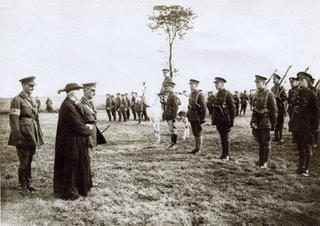
I was just playing around with my new scanner and thought I might include these wonderful photos from the diocesan archives. They show Francis Cardinal Bourne, Archbishop of Westminster, visiting the Dublin Fusiliers Brigade on the Western Front during the First World War.


Labels: ,

Wednesday, 4 October 2006

The Westminster Succession

Hat-tip to Brendan Allen for alerting the blogosphere to the article in the Racing Post (that great Catholic publication, at least in terms of readership) concerning the next Archbishop of Westminster. Of course, despite the ever-present 'speculation,' it's rather premature to consider such a topic since Cardinal Cormac won't reach 75 until 24 August 2007 and who knows what Rome will decide.

However, it's interesting to see who are thought to be the favourites:

7-2 Kevin McDonald (Southwark)
9-2 Alan Hopes (Aux, Westminster)
9-2 Aidan Nichols OP
5-1 Vincent Nichols (Birmingham)
7-1 Michael Fitzgerald
8-1 Patrick Kelly (Liverpool)
8-1 Arthur Roche (Leeds)
10-1 Peter Smith (Cardiff)
12-1 Bernard Longley (Aux, Westminster)
14-1 Michael Evans (East Anglia)
14-1 Timothy Radcliffe OP
16-1 Patrick O'Donoghue (Lancaster)
20-1 John Rawsthorne (Hallam)
25-1 John Crowley (Middlesborough)

Well, there's a good chance that at least one of these names is a future Archbishop of Westminster. My hunch would be with Roche, V Nichols or Smith. But then the present incumbent at Archbishop's House was given odds of 25-1 at the death of Cardinal Hume...

Labels: ,

Sunday, 27 August 2006

Canterbury's Huguenot Cardinal


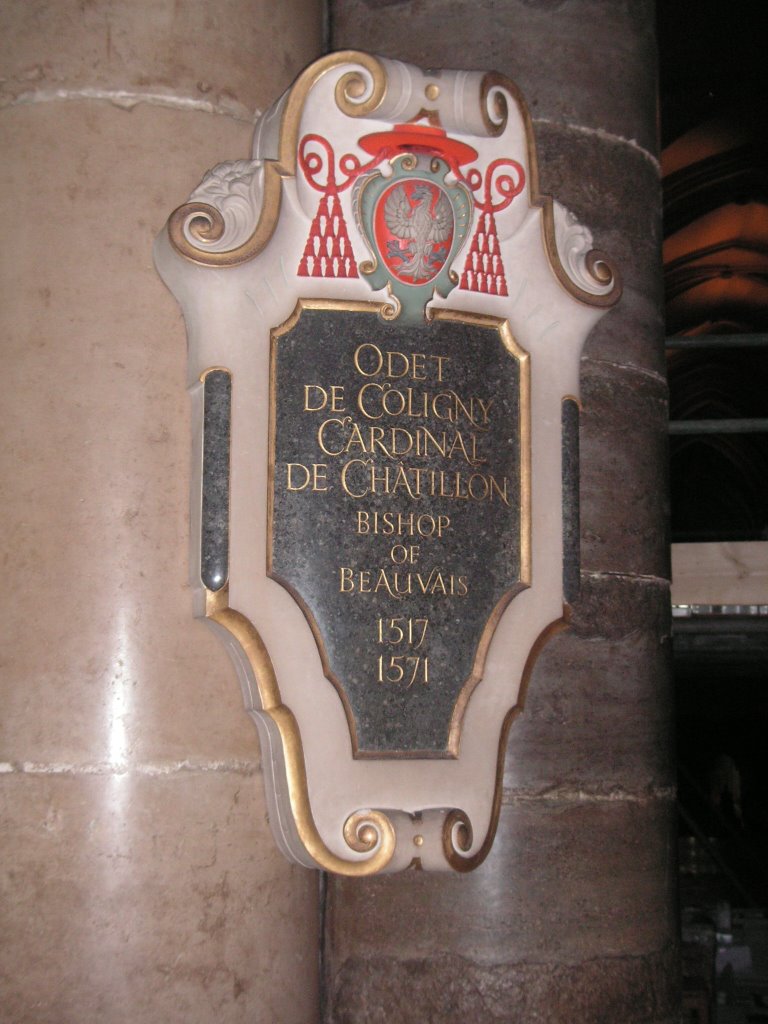
Canterbury Cathedral boasts a whole array of cardinalatial bones in its vaults: Langton, Kemp, Bourchier, Morton and Pole. However, Pole was not the last cardinal to be buried in the Cathedral. At the southeast end of the Trinity Chapel is a plaque marking the tomb of Odet de Coligny, an apostate prelate who was known as the ‘Cardinal de Châtillon.’ He died mysteriously in a guesthouse at Canterbury in 1571, as he was returning to France. Most historians agree that he was poisoned by his valet de chambre, who may have been in the pay of Catherine de’Medici, well known for her opposition to the Huguenots. He was buried in a temporary tomb in the Cathedral awaiting translation to France.

Some claim that he was eventually buried in his homeland and that the incumbent of his tomb at Canterbury is someone much more worthy: St Thomas Becket himself, whose magnificent shrine once stood nearby. It is certainly unusual that a visiting Frenchman should have been buried in such an important position, surrounded by the likes of Henry IV and the Black Prince. However, the theory is made unlikely by the fact that Coligny died over thirty years after the destruction of Becket’s shrine.

Who was this poisoned Frenchman? The member of one of the most influential French families of the time, Odet de Coligny was born on 10 July 1517 at Châtillon-sur-Loing, the second son of Gaspard de Coligny, maréchal de France. He received the red hat from Clement VII on 10 November 1533 at the request of the King of France, Francis I. He was aged just sixteen. The following year he became Administrator of the Archdiocese of Toulouse, even though he was not yet in Major Orders, and participated in the Conclave that elected Paul III. As well as holding a number of Abbacies in commendam, which guaranteed him a stable income, he became in 1535 Administrator of the diocese of Beauvais. In 1560 Pius IV appointed him Grand Inquisitor of France, but was prevented from taking up the position because of the opposition of the powerful Parlement of Paris.

In 1561, encouraged by his family, he rejected his Catholic Faith and became a Calvinist. His volte face caused great scandal, especially coming one year after his papal appointment as a Grand Inquisitor. In 1563 he was deprived of his cardinalate and other benefices, and excommunicated. However he continued to wear his scarlet robes, most famously on the occasion of his marriage, in 1564, to Isabelle de Hauteville, who was presented to fashionable society as Madame la Cardinale. In 1567 he fought with the Huguenots at the Battle of St Denis and travelled to England in 1568, disguised as a sailor, partly to flee persecution and partly to secure negotiations with Queen Elizabeth. He was never to return to his homeland and he still lies awaiting judgement day at the Cathedral of Canterbury.

Labels:

Thursday, 17 August 2006

The Cardinal and the Boat Race

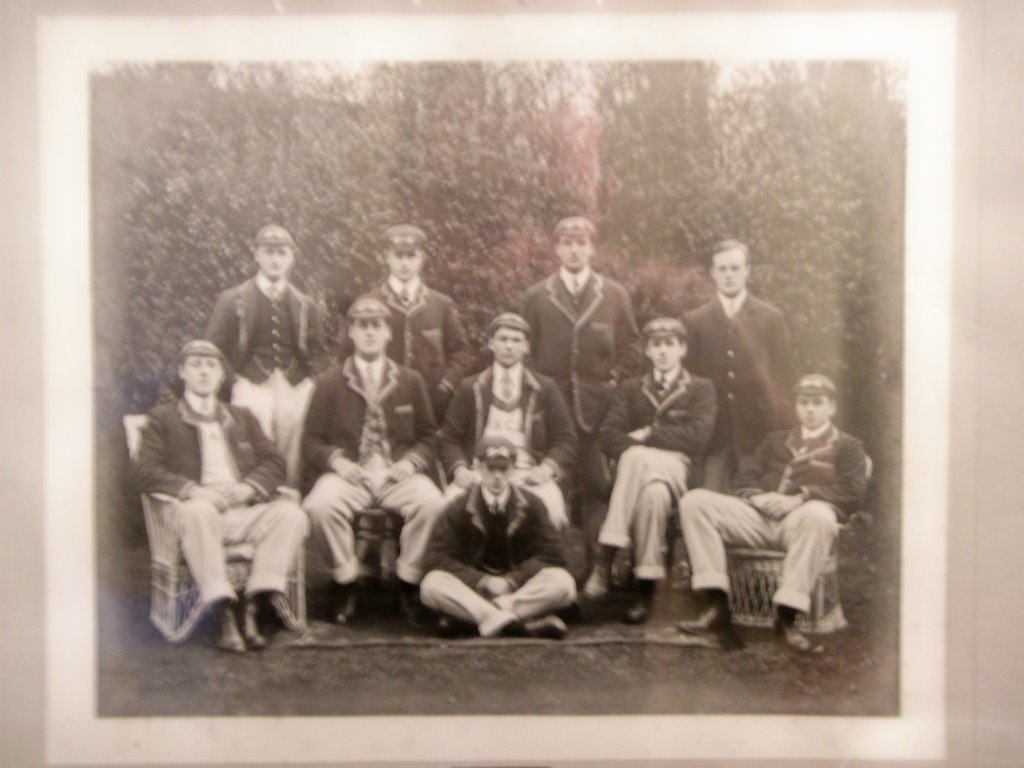
Here's another picture from my brief visit to the English College, Rome - a difficult one to take (you can just make out my reflection in the glass of the frame) but a fascinating one nevertheless. This is the Oxford Boat Race Team of 1907. Not a very successful one because Cambridge won that year by four and a half lengths. The Oxford rowers in the faded photo are now long forgotten - except one, William Theodore Heard (possibly the guy sitting at the front). He later became Auditor of the Roman Rota and Cardinal. Here's the story of the Cardinal with the Oxford blue.

William Theodore Heard was born in Edinburgh on 24 February 1884, the eldest son of the headmaster of Fettes College, where he was sent to school. Later in life, he usually took his vacations in Scotland and, at the time of his elevation to the Sacred College, was declared to be the first Scottish-born Cardinal since the Reformation. However, it was to Balliol College, Oxford that the young William was sent in 1903, and at this quintessentially English institution he took part in Union debates and, as we've seen, was a keen rower. Heard was a contemporary at Balliol of another future Catholic convert, Ronald Knox, who later said that ‘my clearest recollection of him is his coming hurriedly into my room one day and asking my weight. This I gave him, and he was off again in a moment with a murmur of vague dissatisfaction that it was no use at all. Apparently he was looking for a rowing cox and my poundage let him down.'

Armed with a Third Class degree and rowing blue, he was articled to a legal firm in London and was admitted as a solicitor in 1910. The same year he was received into the Catholic Church at Farm Street and started running a Catholic boys’ club in Bermondsey, where he was inspired by the example of the parish priest, Canon Edward Murnane.

In 1913 Heard entered the English College in Rome as a student for the diocese of Southwark. Among his fellow students was William Godfrey. He also became acquainted with Mgr John Prior, Vice-Rector of the Beda and Auditor of the Rota. After Ordination at the Lateran on 30 March 1918 and the completion of his doctorates in Philosophy, Theology and Canon Law, Heard returned to his beloved Bermondsey in 1921 as curate to Canon Murnane.

In 1927 he was called to Rome on the death of Mgr Prior to succeed him as Auditor. He remained in Rome for forty-six years, dealing with marriage annulment cases – including that of Evelyn Waugh’s first marriage to the Hon. Evelyn Gardner. He also worked for the Congregation of Rites, saying that he preferred to deal with annulments in the mornings and canonisations in the afternoon; the canonisations were less depressing because even the failed candidates had at least tried to be good!

For much of his time in Rome Heard lived at the English College, where he acted as confessor, spiritual director and eventually as its last Cardinal Protector (1961-73). One student, Gerald Creasey, later wrote : 'he was a very popular figure despite his apparently grumpy exterior…I owe much to him since he lent me endless books from his library which distracted me happily from the tedium of scholastic philosophy. He had a very healthy attitude to one’s transgressions, usually blaming them on the weather ("that damned scirocco").'

According to another Venerabile student, Anthony Kenny, 'Heard was an impressive figure, and some of us treated him as an oracle. He lived a solitary and austere life, rarely eating in Hall since his health permitted him only the most meagre diet. He slept little and rose early to make himself available for confessions to those who might wish to confess, before Communion, any sins that might have been committed during the night. He had decided and outspoken views on a variety of topics from dental surgery to the history of cheese.'

Promotion came late in life, although he had been mentioned as a possible successor to Cardinal Bourne in 1935. At the end of 1958 Heard succeeded Cardinal Julien as Dean of the Rota, and the following December, at the age of seventy-five, was created a Cardinal Deacon with the newly re-established diaconia of San Teodoro in Palatino. In 1962 he was consecrated titular Archbishop of Feradi Maius by Blessed John XXIII, and took part in all four sessions of the Council. He was the only British cardinal at the 1963 Conclave, and was raised to the rank of Cardinal Priest in 1970.

In the summer of 1973 he holidayed in Scotland as normal, but returned to Rome in an agitated state and was taken to the hospital of the Blue Nuns at San Stefano Rotondo. He died there peacefully on 16 September at the age of 89. This thoroughly English Scots cardinal was buried far from home in the English College vault at the Campo Verano cemetery, but it would have pleased him that his last Mass had been celebrated in Glasgow.

Labels:

<< # St. Blog's Parish ? >>