Sunday, 4 May 2008

Thoughts for Ascensiontide


The Ascension is the grand finale, when Jesus, having completed His mission of salvation, returns to the Father in Heaven. The problem is that it is very hard to imagine the circumstances of the Ascension. It is easy enough to imagine the manner of Christ’s coming into the world – His birth in the stable of Bethlehem and the adoration of the angels, shepherds and wise men – but the manner of His departure fills us with many questions.

Most paintings show the Ascending Christ being propelled up towards Heaven, rather like a rocket lifting off into space. In some churches in the past today’s Feast saw the elaborate ascension of a statue of the Risen Christ right up into the roof of the church, and sometimes a parallel descent into the ground of a figure of the devil. But we shouldn’t imagine the Lord hurtling through the stratosphere or start wondering how many light years it took Him to reach Heaven! When we talk of ‘Ascension’ we are using human language where human language doesn’t really apply. Indeed the Gospels speak of the Lord’s disappearing beneath a cloud, which in the Bible is always a sign of the mystery and majesty of God. For thirty-three years the Word was made flesh, the invisible God made visible. Now He becomes invisible once again in the cloud and God’s definitive Revelation has ended.
.
There is a pious tradition that the Ascension of the Lord took place at midday. The symbolism behind this is very powerful. After all, He is thought to have been born at midnight, at an hour when the world covered in darkness – for Jesus came into a world darkened by sin and showed us the way back to the Light. He ascended at midday, the hour when the sun is at its strongest – for Jesus, the ‘Sun of Justice,’ has now conquered death and given us new life.

And yet His light does not disappear with the Ascension; the disciples are not suddenly shrouded in darkness. No, Christ has given His light to the Church, to His followers, until He comes again. The Ascension passes Christ’s mission on to us: ‘Go, therefore, make disciples of all the nations,’ we hear in St Matthew’s Gospel, ‘baptize them in the name of the Father and of the Son and of the Holy Spirit.’ We are to become His hands and feet, His eyes and ears, His lips and tongue, and we are assured of His abiding presence with us, to the end of time. Christ is with us in the words of Scripture and in the teachings and guidance of the Church; Christ is with us most particularly in the Blessed Sacrament that we find in every church; Christ is with us in our brothers and sisters and especially in those who are most vulnerable – the unborn, the sick and the needy; Christ is with us in ourselves, thanks to our Baptism and the work of the Holy Spirit, and in the everyday situations that challenge us to put our faith into action.

The Ascension, then, is not a feast of God’s absence but a feast of God’s presence. Alleluia!

Labels: ,

Saturday, 8 December 2007

Immaculate Conception


In order to reach Jesus, who is the true light and the sun that dissipates all the darkness of history, we need to have people near us who reflect the light of Christ and illuminate the way. And who is brighter than Mary? Who can be a more hopeful star than her, the aura that announced the day of salvation? That is why the liturgy today celebrates, just before Christmas, the magnificence of the Immaculate Conception of Mary: the mystery of God’s grace who embraced the existence of the creature destined to become the Mother of Jesus, preserving her from original sin. From her we see the grandeur and beauty of God’s project for each of us: to become saints and immaculate in love, in the image of our Creator.

Pope Benedict XVI, 8 December 2007

Labels: ,

Friday, 17 August 2007

Sabbath Inculturation

Here's one thing I hadn't realised before my recent travels: in Muslim countries, the weekend is kept either on Thursday and Friday or on Friday and Saturday. The point is that Sunday is a normal working day, which means that Masses for the Sunday can start as early as Thursday evening and continue until Sunday evening (though Saturday morning Masses are normally of the Saturday). This means that those who go to daily Mass may have to listen to the same sermon two or three times, though the priests do try to vary them. Also, since Friday is a festal day, the usual Friday observance is transferred to the Wednesday.

Confusing, but it does seem to work!

Labels:

Thursday, 7 June 2007

Ave Verum Corpus

It feels strange not celebrating Corpus Christi today. However, I did spent part of the morning at our Primary School organising next Friday's Eucharistic Procession. We'll be going round the corridors of the school and into the playgrounds, with some of the smaller children throwing petals before the path of the Sanctissimum. There will be Benediction in the new school garden. Prayers for fine weather, please!

Let me mark today by telling a rather quaint Blessed Sacrament story. Since visiting Bologna about seven years ago, I've been fascinated by St Catherine of Bologna (1413-63), whose incorrupt body you can venerate at the Corpus Domini convent. It's unusual in that it sits in the chair that the saint used in her lifetime ( the body is not fastened to the chair in any way):


After death, the body remained flexible and the nails continued to grow until the end of the sixteenth century. She also gave orders regarding the room in which her body was to be kept and its decoration.

Anyway, after several years her body was carried - still sitting in the chair - through the church to a room near the sacristy with an open window in the wall, where she could be more accessible to the pilgrims. As the body went past the tabernacle, it made a profound inclination (I suppose a genuflexion would have been rather awkward). An example to all of us about the honour and respect that is owed to the Real Presence!


(pictures - courtesy of the Santi e Beati site)

Labels: ,

Saturday, 26 May 2007

The Saint of Pentecost


I've just celebrated the Vigil Mass of Pentecost - and, this year, there is a rather nice coincidence since today is the Feast of that great saint of the Holy Spirit, St Philip Neri.

As I'm sure you know, as a young man it was his custom to spend whole nights in prayer in the catacombs, the underground burial places of the early Christians outside the walls of the City. On the vigil of Pentecost in 1544, St Philip was praying in the Catacombs of Saint Sebastian, on the Via Appia, as he had done many times, and asked God to give him the Holy Spirit. St Philip was suddenly filled with great joy, and had a vision of the Holy Spirit as a ball of fire. This fire entered into St Philip’s mouth, and descended to his heart, causing it to expand to twice its normal size, and breaking two of his ribs in the process (a fact later proven by his autopsy). He later said that it filled his whole body with such joy and consolation that he finally had to throw himself on the ground and cry out, “No more, Lord! No more!”

During his lifetime many people noticed that he seemed always to be warm; he was often flushed, and would walk around with his cassock unbuttoned at the chest, even in the middle of winter. Not only that, but several of his disciples reported that his heart used to beat violently when he prayed or preached, sometimes enough to shake the bench on which he was sitting. Some people could hear his heart beating across the room, and others experienced unspeakable peace and joy when he embraced them and held their heads to his breast.

St Philip's experience of the Holy Spirit was unique - but we pray that the same Spirit will come upon us this Pentecost. Leo XIII said that ‘if Christ is the head of the Church, the Holy Spirit is her soul.' He abides in each member of the Church as the dulcis hospes animae (sweet guest of the soul), so that we receive His consolation and strength and bear witness to Christ, just like the apostles on the day of Pentecost and just like the lives of countless saints down the centuries.

Labels: ,

Sunday, 20 May 2007

Viri Galilaei, quid admiramini aspicientes in caelum?


'Where he is gone, we hope to follow'
(Ascension Preface I)

'In the person of Christ, we have penetrated the heights of heaven'
(St Leo)

Labels:

Sunday, 13 May 2007

Our Lady of Fatima


Today is the ninetieth anniversary of the first of the apparitions at Fatima. It's also (a providential coincidence) the ninetieth anniversary of the episcopal ordination of Eugenio Pacelli, who as Pius XII was a great promoter of the Fatima message, and the twenty-sixth anniversary of the assassination attempt on John Paul II (the fact the bullet avoided all major organs was a result, he believed, of Our Lady's protection).


At Kingsland today we welcomed Br Aldo and Br Michael of the Heralds of the Gospel, together with members of their Third Order. They are a private association of pontifical right, originating in Brazil and with a house in London - in Hampton Wick (near Hampton Court Palace). At three of the morning Masses we started with a procession of the statue of Our Lady of Fatima and a prayer of consecration. Most impressive of all was the long queue of people after each Mass, waiting to venerate the image and receive from the Heralds a prayer card. Thanks to Br Michael, I thought I might post a few pictures to give you some of the 'flavour' of the morning. Popular piety is such an important part of the Church's life and much more accessible to the people than some other attempts at making the faith 'meaningful.' As one of the Heralds said, Our Lady is the 'key' that leads people so effectively to her Son.


P.S. The Heralds joined us for lunch (before going onto an Anglican church to preach the message of Fatima!). Also present were the two presbytery dogs, Oscar and Bruno, who were joined by their friend, Titus. Here are the three of them waiting on the stairs to see what was going on in the kitchen.

Labels: , ,

Friday, 4 May 2007

Relics of the English Martyrs


To commemorate today's Feast of the Martyrs of England and Wales, I thought I might post some pictures of relics I came across during my travels around Lancashire. The above picture shows one of the most grisly I've seen - the eyeball of Blessed Edward Oldcorne, SJ. He was martyred at Worcester in 1606, just after the Gunpowder Plot. After being hanged and disembowelled, he was decapitated and the executioner struck with such force that the martyr's eye flew out. The reliquary is in the shape of ane eye - complete with eye lashes! - and bears the inscription: Oculis dexter P. Ed. Olcorni Soc. Jesu.


The priests of the time went about secretly, wearing disguise and using false names. Above you see a travelling Mass kit (with vestments) used by one of the martyrs and now kept at Stonyhurst. Pious ladies often made vestments for these underground Masses, including this fine seventeenth century example:
.

Special pieces of furniture, which folded out to become dignified altars, were designed. The one below is now kept at the shrine of Ladyewell. It dates from 1560 and is made in the shape of a bureau. It was used by St Edmund Campion at Eastertide 1581, St Edmund Arrowsmith in 1622 and Blessed John Woodcock.


Finally, also at Ladyewell, a mummified hand that is believed to have belonged to that great Yorkshire woman and martyr, St Margaret Clitherow:


All Martyrs of England and Wales, pray for us!

Labels: ,

Monday, 30 April 2007

Free Ascension Day Recital

The world-renowned vocal group, The Tallis Scholars, are giving a FREE recital in the Front Hall of the British Library on Thursday 17 May at 1pm, with music by Gombert (In illo tempore) and Monteverdi (Missa In Illo Tempore). This has been organised, rather amazingly, to mark the traditional Feast of the Ascension, although in this country we will for the first time be keeping the transferred feast the following Sunday, 43 days after Easter. If you're in the London area, put the date in your diary!

Labels: ,

Sunday, 15 April 2007

Divine Mercy Sunday


I spent much of the afternoon sitting in the church car park, basking in the warm April sunshine. Given the popularity of the Divine Mercy indulgence, I placed a prie-dieu beside me and heard confessions from those who were attending the Divine Mercy devotions in our small hall. Meanwhile, the monthly Nigerian Mass was being celebrated in the church: the combination of their loud drums in the church and the Divine Mercy hymns in the hall served to cover from preying ears the sins that were being confessed. This pious competition, to see who could sing the loudest, was quite impressive and a vivid expression of the universality of the Church in this part of London.

I must confess to being rather under-read when it comes to St Faustina and the Divine Mercy - after all, the Church offers so many laudable devotions and private revelations. The essential message of today, however, is clear, stressing the infinite depths of God’s mercy, no matter how serious our sins may be.

Today's Gospel reminded us that Confession is an Easter Sacrament; it was the first gift to the Church from the Risen Lord. All the Sacraments continue the Incarnation – and through Confession, we have a share in the Paschal Mystery by dying to sin and rising to the life of sanctifying grace. Our Lord knows us too well. He knows that we blunder along in life and often take the wrong turning. That’s why He gave us the promise of His peace and forgiveness. That's why we are never closer to Jesus than when we sincerely repent of our sins.

Labels: ,

Saturday, 10 March 2007

The Massimo Miracle


This Friday (16 March) sees one of Rome’s most picturesque feasts – a commemoration of the Massimo miracle of 1583. The location was the Palazzo Massimo alle Colonne, now on the Corso Vittorio Emmanuele, the home of the oldest of Roman families – claiming descent from the great consul and dictator Quintus Fabius Maximus (d. 203 BC).

The miracle involved St Philip Neri and young Prince Paolo, who was lying on his deathbed. The saint was called but could not come immediately since he was celebrating Mass. By the time he arrived, the fourteen year-old had died and the family was stricken with great mourning and was preparing to wash and dress the boy’s body, as was the custom. St Philip, however, was not perturbed and sprinkled the boy’s mouth and face with holy water and lay his hands on him. He called the boy twice - ‘Paolo, Paolo’ – and he returned to life, to everyone’s amazement. The saint spoke to the boy for a quarter of an hour and finally asked him: ‘are you willing to die, or to continue longer in this life?’ Paolo replied that he preferred to die, ‘for he knew that he had a certain place set aside for him in heaven, to enjoy the splendour of God…and so, in his longing for death, as if he was entering the land of the living, he breathed forth his spirit a second time, in the sight and in the embrace of the holy Father’ (Gallonio).

The miracle provides an appropriate festa for Lent, inspiring us to consider our mortality and to live each day in readiness to meet the Lord. The ancient doors of the Palazzo Massimo are swung open every 16 March and Romans pour in, greeted by the traditional doorman.


They crowd the magnificent rooms, especially the chapel (the room where Paolo died), where Masses (in Old and New Rites) are continually said at the three altars. The Institute of Christ the King often helps with the liturgy, especially the Missa Cantata celebrated by a visiting Cardinal (all photos courtesy of them).


First year seminarians even dress as pages!


I publish this post early because I’m away this coming week at the Royal College of St Alban, Valladolid (Spain), an English seminary founded by Fr Persons during the reign of the first Elizabeth. This is not, I hasten to add, a holiday but a sort ‘in-service training week’ for a group of about 20 Westminster priests called the ‘Under 5s’ (i.e. 'baby' and 'toddler' priests in terms of Ordination year). I hope we’ll be able to enjoy the Christian heritage of Spain and not spend TOO much time in workshops discussing time-management or faith-sharing. We’ll be joined by H.E. the Cardinal and his Auxiliary, Bishop Alan Hopes. Be assured of my prayers as I walk in the footsteps of St Teresa and St John of the Cross and visit Avila and Segovia. God willing, posting will resume next weekend.

Labels: ,

Friday, 9 March 2007

Santa Francesca Romana


Today is one of my favourite Lenten feasts - St Frances of Rome (1384-1440). When I was a seminarist in Rome, I would often skip the boring Greg lectures and go with some friends to the magnificent Tor de'Specchi convent, almost opposite the Ara Coeli. This was normally inaccessible but on 9 March it was open all day and crowds of Romans and seminarists would crowd into the monastery. There were many opportunities to honour the saint as you visited her rooms (littered with relics), the chapel with fifteenth century frescoes, the conventual chapel (where a succession of Masses would be celebrated, including one by a Cardinal), the cloister, even the entrance (where pilgrims could help themselves to leaves from a tree which the saint planted).


The saint, like St Bridget of Sweden, was both a married woman (with two sons and a daughter) and founder of a community of women (the Oblates of the Tor de'Specchi - which still exists, though they never founded many houses and it's not strictly speaking a religious order). She suffered many trials - not least of which were the sufferings of her family due to the unstable political conditions of Rome at the time (Lorenzo was severely injured in one street battle and her son, Giovanni Battista, was taken hostage). She also had to cope with the deaths of another son, Evangelist, from the plague when he was just nine years old, and her daughter, Agnes. Yet St Frances became known for her works of charity, her efforts to promote peace in war-torn Rome and her many miracles, which she attributed to the constant presence of her Guardian Angel (visible to her alone) at her side, which became her iconographic symbol. When she committed a sin the angel would hide himself until she made an act of contrition.

Her miracles and supernatural gifts are celebrated in a series of fine frescoes at the Tor de'Speechi. For example, a globe could often be seen above her head after the reception of Holy Communion, a sign of the Real Presence:

One January, as she and her religious sisters were pruning the vines, they became so thirsty that the saint miraculously made a vine bear nine ripe bunches of grapes:

During a famine, having given all her grain to the poor, she found the granary miraculously full of good quality grain:


And rather like the early Desert Fathers, she had many battles with demons:


St Frances, along with St Philip Neri, is one of the great Roman patrons of recent times (well, recent compared to the time of the Apostles), and altars can be found dedicated to her throughout the Eternal City. The Oblates still make the oil of St Frances, a powerful sacramental for use with the sick:
.

Labels: , ,

Sunday, 25 February 2007

St Walburga


Today is the feast of one of the great Anglo-German saints: St Walburga. I've written about her before but it's worth repeating her story. I led a band of English pilgrims to her shrine at Eichstätt just over a year ago. According to tradition, she was born in Devon around 710, the daughter of St Richard, often referred to as ‘King’ of Wessex, and ‘Queen’ Wuna. It was a family of saints, a pedigree that would serve her well in the future: her uncle was the great St Boniface (Archbishop of Mainz) and her brothers were St Winnebald and St Willibald, who would later become Abbot of Heidenheim and Bishop of Eichstätt respectively. Here is the saintly English family, as depicted at St Walburga's shrine in Eichstätt (from left to right: St Richard, St Willibald, St Walburga, St Winnebald, St Wuna):


St Walburga received a solidly Christian upbringing. The family said their daily prayers before a wooden cross that was erected on their land and, in 720, she entered the double monastery at Wimborne (Dorset). Under the direction of St Tatta, the abbey had gained a reputation of learning and holiness, and it would prepare Walburga for her missionary years in Germany. Around the same time, her father and two brothers embarked on a pilgrimage to Rome and the Holy Land. However, her father developed a fever and died at Lucca, where he is venerated to this day as ‘St Richard the Pilgrim’ at the church of San Frediano. The brothers went on to Rome, where they split up – Winnebald joined a Benedictine monastery and Willibald travelled to the Holy Land.

During this period St Boniface was busy consolidating the Church in Germany, establishing monasteries and bishoprics. His collaborators included, by the 740s, SS Winnebald and Willibald. It is perhaps no surprise that in 750 St Walburga travelled to Germany to assist her kinsmen in this great work. It is said that, as she crossed the Channel, a terrible storm arose, which was stopped only by Walburga’s prayers - the miracle was traditionally commemorated at Eichstätt on 4th August. She may have stayed in Antwerp, where she is venerated as patroness, before going to Mainz to meet her uncle. She then settled down at Tauberbischofsheim, under St Lioba, a relative and another member of the Wimborne community, who had moved to Germany in 748.

It must have been a great joy to be near her brothers, after many years of separation, and Walburga eventually moved to Heidenheim, where Winnebald had founded a double monastery, based on the English model (as found at Wimborne). After his death in 761, Walburga’s surviving brother, Willibald, now bishop of Eichstätt, appointed her Abbess, with government over both the monks and nuns. She was also skilled in medicine and did much to look after the sick and dying.The legend contains various miracles worked during her life. One night, one of the monks refused to accompany the saint to her cell at night with a lit candle. Shortly afterwards, the nuns found the abbey illuminated by a mysterious light. The saint cried out: ‘O Lord, as a humble maid who committed my life to you since my youth, I thank you for granting this grace. You have honoured me in my unworthiness with the comfort of your light. This sign gives courage to the souls of your handmaids who are dependent on me. And you have driven out the darkness and our fear through the bright light of your mercy.’

When St Walburga died on 25th February 779, she was buried at Heidenheim. However, the double monastery did not survive long and under Willibald’s successor, Bishop Gerhoh, it was occupied by canons. Devotion to Walburga waned to such an extent that in 870, as workmen were restoring the church, the saint’s tomb was desecrated. The outraged saint appeared to the bishop, Otgar, complaining that her remains were being trampled upon ‘irreverently by the dirty feet of the builders.’ Shortly afterwards, the north wall of the church collapsed, which was widely interpreted as a sign from heaven. The body of Walburga was quickly exhumed and translated to Eichstätt on 21st September, and her cult was revived. A community of canonesses initially cared for the saint’s tomb, until a Benedictine Abbey of nuns was founded there in 1035, which survives to this day. During its long existence, the Abbey has founded many daughter-houses, including Minister Abbey in Kent and several across the Atlantic: Latrobe (Pennsylvania), Canyon City (Colorado), and Boulder (Colorado). Here's a picture of the glorious interior of her convent church in Eichstätt, next to her tomb, where I had the privilege of celebrating Mass last February:


In 893, some of St Walburga’s relics were transferred in solemn procession to the monastery at Monheim, which also became an important pilgrimage centre. The priest Wolfhard recorded 54 miracles at Monheim between 893 and 900.

The fame of St Walburga rests in the miracles claimed after her death rather than the details of her life. When the tomb was opened in 893, ‘the workmen found the venerable bones of our holy mother Walburga moistened as if with a film of spring water, so that they were able, as it were, to press droplets of dew-like liquid from them.’ This ‘oil’ (Walburgisöl) has been constantly flowing from Walburga’s shrine, between the months of October and February, for over 1,200 years, stopping only, we are told, during a period when the town was under interdict and after blood was shed in the church by armed robbers. Chemical tests have revealed that the ‘oil’ is actually natural water, although its contact with the bones of the saint justifies its use for pious purposes and is a powerful example of Church’s treasury of sacramentals – visible things that lead us to the invisible.

The ‘oil’ is collected from a shaft built under the tomb and the Abbey contains an impressive collection of glass phials used to contain the substance, some of them dating back to the sixteenth century and covered in damask and brocade. The nuns see it as their special apostolate to distribute the oil – both locally and around the world – and to deal with the many prayer requests that are sent to the Abbey. The walls of the chapel containing the saint’s tomb are covered in hundreds of ex voto paintings, depicting favours granted by the saint – especially concerning escapes from disease and accidents and successful childbirth. The baroque altarpiece in the main church, next to the shrine, depicts St Walburga in glory, with angels pouring drops of the holy oil over a group of the faithful.The life of this princess from Wessex is an important one in the annals of the German Church, but the cult that developed after her death is even more remarkable. Devotion to St Walburga is particularly strong in Germany and the Low Countries, although she is widely neglected in the land of her birth (at least, outside Preston, where there is a magnificent church dedicated to her). Her cult is well expressed in the hundreds of ex votos that are kept at her shrine, testament to her powerful intercession:
She is rightly celebrated as one of the Elaephori, or oil-yielding saints, together with the likes of St Nicholas, whose shrine at Bari (Italy) also produces a mysterious manna. Little bottles of the Walburgisöl, diluted in water, are available from the Abbey, and prayer requests can be sent to Abtei St. Walburg (e-mail: kloster.st.walburg@bistum-eichstaett.de).

Labels: ,

Sunday, 18 February 2007

Quinquagesima


Today is not only the Seventh Sunday in Ordinary Time but also the Sunday before Lent and the fiftieth day (quinquagesima) before Easter. Some sources refer to today as 'Shrove Sunday' - these days before Lent ('Shrovetide') were a good time to go to confession and thus begin Lent 'shriven' and in a state of grace (my parish is continuing this custom by having extra confessions on Shrove Tuesday).

Of course, it was also a time for merry-making and carnival - getting any excesses out of the system before the discipline of Lent. Venice took the idea to the extreme by having a carnival that lasted six months in total: first Sunday of October til mid-Advent; St Stephen's Day or Epiphany til Shrove Tuesday, plus a fortnight in Ascensiontide (with the famous ceremony of Venice's Marriage to the Sea). Everybody from doge to servant dressed in bautta (mask) and tabarro (long cloak), creating anonymonity, equality and endless (often immoral) possibilities (see the painting by Pietro Longhi above). Montesquieu recalled the scandal caused when someone asked for a blessing from the masked nuncio (shocked not that the Pope's representative was enjoying himself but that somebody had dared pierce the Venetian disguise). The collective party reached its peak on Shrove Tuesday and then, as the bells of Santa Francesca della Vigna struck midnight, everybody passed immediately from feasting into fasting - and their stomachs and livers were probably grateful for the respite.

It is little wonder the Church tried to attract people to more wholesome activities during the carnival, most notably the Quarant'ore - the Forty Hours adoration of the Blessed Sacrament, with splendour and music to compete with the carnival celebrations plus generous indulgences.

Labels: ,

Saturday, 10 February 2007

St Scholastica


Today we celebrate the memory of St Scholastica, sister of the Patriarch St Benedict and a patron of Benedictine nuns. Many of the saints had a close friendships with other men and women of God – we think of St John of the Cross and St Teresa of Avila, or St Francis de Sales and St Jane de Chantal – but the relationship of St Benedict with his earthly sister is especially touching. With them, the ties of flesh were united to ties of supernatural grace.

Once a year it was her custom to visit her brother and spend the day in ‘the praises of God and holy conversation.’ Then they would eat together and depart for their respective monasteries. On one occasion, St Scholastica begged her brother to stay with her the night so that they could ‘talk till morning on the joys of heaven’ but St Benedict was eager to follow the Rule and return to his house. At this, his sister prayed to God and immediately a huge storm erupted, which forced St Benedict to stay with his sister. ‘What have you done?,’ her brother exclaimed in amazement, to which she replied: ‘I asked a favour of you and you refused it. I asked it of God, and he has granted it.’ And, according to the account of St Gregory, they stayed up all night ‘delighting each other with their questions and answers about the secrets of the spiritual life.’ It was indeed providential – three days later St Scholastica died at her convent and, at the moment of her death, St Benedict saw the soul of his sister going up to heaven in the form of a dove and praised God.

For the University of Oxford, the day has less happy connotations - a riot was caused by a dispute between town and gown in the Swindlestock Tavern (on the site where Abbey National now stands) in 1355. In the fighting, 62 scholars lost their lives - click here for the full story.

Sancta virgo Scholastica, quasi hortus irriguus
Gratiarum coelestium jugi rore perfundebatur
!

[The holy virgin Scholastica, like a watered garden
Was enriched with the ceaseless dew of heaven's graces]

Labels: ,

Wednesday, 7 February 2007

Pio Nono


Today the Roman Martyrology lists, among others:

Romae, beati Pii papa Noni, qui, veritatem Christi, cui ab imo adhaesit, plane proclamans, multas instituit sedes episcopales, cultum beatae Mariae Virginis promovit et Concilium Oecumenicum Vaticanum Primum ascivit.

Blessed Pius IX is remembered for his proclamation of the dogmas of the Immaculate Conception and Papal Infallibility, the calling of the First Vatican Council, the re-establishment of the English Catholic Hierarchy in 1850 and his sufferings during the Revolution of 1848 and the subsequent Italian Risorgimento.

At the Beatification Mass, John Paul II said:

Listening to the words of the Gospel acclamation: 'Lord, lead me on a straight road', our thoughts naturally turn to the human and religious life of Pope Pius IX, Giovanni Maria Mastai Ferretti. Amid the turbulent events of his time, he was an example of unconditional fidelity to the immutable deposit of revealed truths. Faithful to the duties of his ministry in every circumstance, he always knew how to give absolute primacy to God and to spiritual values. His lengthy pontificate was not at all easy and he had much to suffer in fulfilling his mission of service to the Gospel. He was much loved, but also hated and slandered.

However, it was precisely in these conflicts that the light of his virtues shone most brightly: these prolonged sufferings tempered his trust in divine Providence, whose sovereign lordship over human events he never doubted. This was the source of Pius IX's deep serenity, even amid the misunderstandings and attacks of so many hostile people. He liked to say to those close to him: 'In human affairs we must be content to do the best we can and then abandon ourselves to Providence, which will heal our human faults and shortcomings'.

Sustained by this deep conviction, he called the First Vatican Ecumenical Council, which clarified with magisterial authority certain questions disputed at the time, and confirmed the harmony of faith and reason. During his moments of trial Pius IX found support in Mary, to whom he was very devoted. In proclaiming the dogma of the Immaculate Conception, he reminded everyone that in the storms of human life the light of Christ shines brightly in the Blessed Virgin and is more powerful than sin and death.

Vultus Christ has a nice post on Pio Nono; there is a good Italian website on him here. It's still not too late to buy a recreated bottle of Pio Nono's aftershave, which I fully recommend. And, finally, here is a picture of his death mask:

Blessed Pius IX, pray for us!

Labels: , ,

Friday, 2 February 2007

Lumen ad revelationem gentium


Christmas may seem a long time ago but, according to tradition, Christmas only really comes to an end today - Candlemas, the Feast of Mary’s Purification and Christ’s Presentation in the Temple, the Fourth Joyful Mystery of the Holy Rosary.

The Feast reminds us of a number of mysteries. We recall how the Virgin Mary, the Mother of God and Spouse of the Holy Spirit, came to the Temple to be purified, in obedience to the Law of Moses. A woman had to stay at home for forty days after giving birth to a son. It must have been a blessing to be obliged to stay quietly at home and care for her newborn baby in these important early days of infancy. Then, after the prescribed period was over, the parents would bring offerings to the door of the Temple: in the case of poor families, like Jesus, Mary and Joseph, two pigeons or turtle doves. And so Our Blessed Lady, the purest of virgins, came like any other mother for this ceremony of ‘purification.’ She offered her Son to God and the God-made-man entered His Temple as a helpless baby. Yet hardly anyone noticed the great event.

Hardly anyone, that is, with the exception of that just man, Simeon, and the prophetess, Anna. They symbolize for us the many generations that had been waiting for the coming of the Messiah. In them, the Old Dispensation meets the New. Filled with the Holy Spirit, Simeon tells Mary two important truths – one concerning Jesus and one concerning herself. The Child will be a ‘sign of contradiction’; He will be the cause of the fall and resurrection of many – the fall of those who reject His message and the resurrection of those who accept it. Furthermore, Mary’s own soul will be pierced by a sword – the sword first enters her at that moment and it goes ever deeper, as her Son is rejected by His own people and opposed by the Scribes and Pharisees. It eventually transfixes her soul at the foot of the cross, just as the Centurion’s lance transfixes the heart of her Son. You can see how the Feast of the Presentation brings an end to the Christmas Season and directs our gaze towards Lent and Holy Week.

In 2007, Jesus and His Church remain both a ‘light to enlighten the Gentiles’ and a ‘sign of contradiction.’ The fact that the Faith can lead to division and misunderstanding was clearly seen last week in the controversy over gay adoption. Of course, the adoption of children by homosexual couples is not the only issue here. The sanctity of the family and the sacrament of marriage (which remains the only right context for sexual relationships) are also at stake, as is the Church’s right to teach a doctrine that is from God but is at odds with the secular world view. We live amidst a clash between the faith and non-belief, between those who see religion as the answer and those who see it as the problem, between the culture of death and the culture of life. To be a Christian in the twenty-first century is not easy. It will involve rejection and unpopularity. In truth, Catholics discriminate against sin and not the sinner – no-one is ever excluded from the arms of the Church; the Church is for sinners trying to become saints. Yet, there may be a time when there are legal penalties for those who adhere to the fullness of the faith, especially under the vague rubric of political correctness and ‘discrimination’. Let us not be afraid; let us teach the Gospel with faith, hope and, above all, love! Let us accept that we are, by virtue of our baptism, signs of contradiction!

As Mary, our Mother, has gone before us, so we follow – we can expect a share in her sorrows but we hope also to eventually be with her in Heaven. Let us stay close to her Son – and stay close to His Church, which transmits and teaches the Revelation that God has given us. As we prepare to celebrate Candlemas, let us be lights to enlighten all those around us, especially the lukewarm, the lapsed, the ignorant and those who are confused about the message of Christ.

Labels: ,

Friday, 29 December 2006

St Thomas' Day


For the English Catholic, today is one of the most irritating days of the Church's Year. It's the feast of St Thomas of Canterbury: one of our greatest saints; celebrated by Chaucer and T. S. Eliot; the Patron of the English Secular Clergy and of the Venerable English College, Rome; whose shrine was one of the most popular in the Middle Ages. At any other time of the year it would be a Feast, if not a Solemnity, at least in this country. But because it falls in the Christmas Octave, one of our most important feasts is sidelined as a 'Commemoration' - not even a Memoria. In the old days a fuller celebration was allowed since it was a Double of the Second Class in England and Wales (and First Class in Northampton and Portsmouth) and up until the introduction of the new national propers in 2000 it happily counted as a Feast.

This time last year Becket was nominated as one the 'Ten Worst Britons' by a BBC panel of 'experts,' together with Jack the Ripper and Oswald Mosley. A journalist phoned me up to get my opinion, which is recorded here.

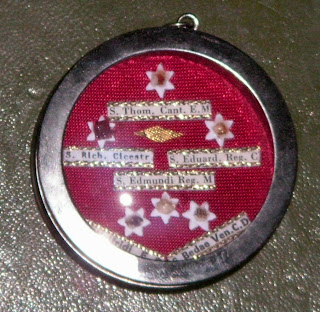
One of my most treasured possessions is a reliquary containing relics of some of the great English saints: St Thomas of Canterbury (at the top); St Richard of Chichester; St Edward the Confessor; St Edmund, King and Martyr; St Wilfrid and St Bede the Venerable. All of these are First Class, with the exception of St Richard. I will place the reliquary on the altar when I celebrate Mass this evening:
Finally, let me mention my favourite St Thomas story. The men of Strood in Kent (now part of Rochester) sided with the King in his dispute with Becket and cut off the tail of a pack-horse carrying supplies to the Archbishop's kitchen, in order to humiliate him. One source says that several horses were mutiliated and their riders wounded; others that it was Becket's horse that was attacked. When the Archbishop heard of this, he condemned all the inhabitants of Strood (or even the whole of Kent) and their descendants to be born with tails! Another version of the story of 'Kentish Long-Tails' is that it was a punishment for their ill-treatment of St Augustine and his monks, who were beaten and had fish-tails tied to their backs, 'in revenge of which, such appendants grew to the hind parts of all that generation.' If any readers can supply evidence of modern Kentishmen with tails, then please leave a message.

Labels: , ,

Wednesday, 13 December 2006

St Lucy's Slipper

I love the Advent saints - and today it is the turn of the Sicilian Virgin Martyr, St Lucy. She is an appropriate saint for the Season for her name is derived from lux (light) and points towards the coming of the Light of the World, her Bridegroom, in just over a week's time. According to the Julian Calendar, 13 December was the longest night of the year. In Sweden her feast is celebrated by processions and carol-singing, in which one young giril dresses as St Lucy in a white gown and wearing a crown of lit candles.

St Lucy is popularly invoked against eye problems and blindness - despite the tradition that she tore her eyes out in order to put off a suitor (which is why one of her iconographic symbols is a plate with her eyeballs!).

This time last year I was in Rome and, to mark the feast, visited the little-known church of Santa Lucia in Selci on the Esquiline Hill. The convent of Augustinian nuns is best known as one of the chief dispensaries of relics (which is referred to as the Lipsanoteca) - provided you have a letter of recommendation from a bishop. The little church was 'baroque-ified' in the seventeenth century, thanks to the likes of Maderno and Borromini. The doors are opened every 13 December and Romans pour in to pray to the martyr, attend one of the many Masses, pick up a santino or bottle of St Lucy's oil and venerate the relics. The body of the saint is claimed by the church of Santi Geremia e Lucia in Venice (near the railway station) but Santa Lucia in Selci boasts the relic of St Lucy's slipper. The picture below is an 'action shot' of a pilgrim wiping the shoe-shaped reliquary with her handkerchief!


Columna es immobilis, Lucia, Sponsa Christi!
Update: Mgr Mark Langham has a wonderful post of the Swedish Sankta Lucia festival that took place at Westminster Cathedral, complete with a young girl wearing the crown of five candles (which, Mgr Langham observes, is very similar to the head-dress of the Bridgettines).

Labels: , ,

<< # St. Blog's Parish ? >>