Wednesday, 24 December 2008

Happy Christmas!


How great the mystery and wondrous the sacred sign,
that beasts should look upon the Lord lying lowly in the stall!

Labels:

Sunday, 30 November 2008

Seasonal Music

Advent and Christmas are richly musical seasons and there are many recordings available of carols and noels, cantatas and oratorios. Each year I look with interest at the many new CDs produced for the festive Season, although it is always a great temptation to put on recordings of carols as soon as we light the first candle on the Advent Wreath.

Here are two particularly fine new CDs, though rather different from the usual ‘Ultimate Carol Collection’ or ‘Best Christmas CD Ever.’


Hieronymus Praetorius, Magnificats and motets
(The Cardinall’s Musick, Andrew Carwood)
Hieronymus Praetorius (1560-1629) – not to be confused with the slightly more famous Michael Praetorius (curiously not related) – worked in Hamburg and produced some ravishing and lively polyphonic music. This CD includes his masterpiece, the Magnificat quinti toni to which is attached two popular Christmas carols: Joseph, liber Joseph mein and In dulci jubilo (my favourite carol). The booklet notes that the former piece was ‘associated with the cradle-rocking ceremony at Christmas vespers – a priest would sit next to a cradle containing an effigy of the baby Jesus and would rock the cradle gently in time to the lilting rhythm of the music.’ The Cardinall’s Musick is one of our best choirs and its director, Andrew Carwood, was formerly Director of Music at the Brompton Oratory and is now in charge of the choir at St Paul’s Cathedral. For more information and samples, click here.


Natalis Cordat and Nicolas Saboly, Noel Baroque en Pays D’Oc
(La Camera delle Lacrime, Bruno Bonhoure)
This rather obscure CD contains C17 settings of French Noels by Natalis Cordat (c.1610-63), parish priest of Cussac-sur-Loire, and Nicolas Saboly, an organist in Avignon. It includes some familiar tunes, such as Li a pron de gens (allegedly written by Saboly to make fun of a lame priest he knew). The pieces are excitingly performed on period instruments and have a rustic charm, which makes you think back to C17 Provence. For more information and samples, click here.

Labels: , ,

Sunday, 6 January 2008

Vidimus stellam ejus in Oriente


Buona festa!

As I was doing my morning ablutions, I listened with interest to BBC Radio 4's Sunday Worship. The programme is normally a bit of a mixed bag, and can leave one feeling rather dry, but this week there is a meditation on Science and Religion from the Vatican Observatory at Castel Gandolfo, led by James Hanvey SJ and Guy Consolmagno SJ. There are some interesting points made, as well as intriguing references to the pope's collection of meteorites! For the time being, you can listen to it by following this link.

I missed part of it since I had to get ready for Mass. I'd never thought before of preaching an Epiphany Sermon on fides et ratio but it seems so obvious - I must remember that for next year!

Labels:

Tuesday, 1 January 2008

Happy New Year!

I'm now back in the parish, having spent a few days at home doing absolutely nothing. In the absence of the parish priest, it was my task to celebrate last night's Midnight Mass (for the Solemnity of Mary, the Mother of God). When I first came across these New Year Midnight Masses, I was rather dubious since they seemed to have no precedent in tradition and I wasn't sure whether they were officially approved. However, more and more parishes organise them and they are particularly popular with the African and West Indian communities.

Following on from last night, I think that organising some sort of religious service for New Year's Eve is an excellent idea since it effectively Christianizes a very secular celebration and provides a viable alternative to getting drunk or watching ridiculous TV shows like 'The Most Annoying People of 2007.' What better way is there to start the new calendar year than by adoring the Blessed Sacrament or attending Mass?

About 500 people came last night (which far exceeded my expectations). We started with half an hour's adoration of the Blessed Sacrament. At the moment of Midnight (more or less) Benediction was given, surrounded by bells (inside the church) and fireworks (outside). I then exchanged my cope for a gold chasuble and Mass began. We sang the Veni Creator, which is customary for the New Year and is also indulgenced. Another time it would be good to sing the Te Deum in the last moments of the old year, which is an indulgenced devotion for 31 December.

The Catholic papers recently had a report about the many (mostly urban) parishes that move the Christmas Midnight Mass to an earlier time due to security concerns (both for church and pasrishioners). I sympathise with them. However, living in a parish that straddles, according to a 2007 survey, two of the most 'undesirable' London Boroughs (Islington and Hackney), I'm delighted to report that there was absolutely no trouble at either of the Midnight Masses we've had this last week. And fears of security did not put off the 500 faithful who chose to attend each of them.

Labels: ,

Tuesday, 25 December 2007

Happy Christmas


And is it true? and is it true?
The most tremendous tale of all,
Seen in a stained-glass window's hue,
A Baby in an ox's stall?
The Maker of the stars and sea
Become a Child on earth for me?

And is it true? For if it is,
No loving fingers tying strings
Around those tissued fripperies,
The sweet and silly Christmas things,
Bath salts and inexpensive scent
And hideous tie so kindly meant.

No love that in a family dwells,
No carolling in frosty air,
Nor all the steeple-shaking bells
Can with this single Truth compare -
That God was Man in Palestine
And lives to-day in Bread and Wine.

(from 'Christmas' by Sir John Betjemin)

I wish everyone a very happy and blessed Christmas!

I'll wish you a merry Octave too, for I'm not sure when I'll next be posting. Most of Christmas Day will be spent in church and presbytery dining room (where nine of us will be sitting down to turkey et al, including five priests). Then on St Stephen's Day I'm going home for my second Christmas meal. I'm staying there a few days and may post something, though my father's ancient dial-up connection is painfully slow.
.
Update: We have a rather bare, modern (1964) church, so we did our best in decorating it for the great feast. At least there is a central tabernacle and plenty of space on the sanctuary, both behind and front of the altar.
.

Labels:

Monday, 24 December 2007

Thoughts on Christmas Eve


The Presbytery Christmas Tree


Christmas Eve is a bit like Holy Saturday. It might seem rather empty but it is, in reality, a day of expectant waiting for the sacred event that we commemorate and make present again at Midnight Mass. Tonight the angels will sing the birth of God’s Son. This morning, in the Gospel of the final Mass of Advent, the last word is given to the father of St John the Baptist – Zechariah. In his Benedictus, which we repeat every day at Lauds, God is praised for the way He visits His people. Zechariah looks back to the past – to Abraham, David and the ‘prophets from ancient times.’ He looks to the present, to his child, John, ‘who shall be called the Prophet of the Most High’ and ‘will go before the Lord to prepare the way for him.’ He looks to the future – to the mystery of Christmas night, when God will bring the rising Sun to visit us, ‘to give light to those who live in darkness and the shadow of death.’

The powerful image in Zechariah’s prayer points us to Christmas. The birth of Christ has long been celebrated near the point in the year when the sun grows stronger and the long winter nights begin slowly to shorten. This is why light is such an important feature of the Christmas Season –the lights of our Christmas trees and the decorations in the street. It is because Jesus, the Light of the World, the Sun of Justice, came to us in the middle of the night to shed away darkness and sin, and give us new life. That is the whole point of Christmas.

Let us spend Christmas Eve calmly, preparing ourselves spiritually as well as materially for the great Feast. Come, Lord Jesus, do not delay!

Labels:

Friday, 21 December 2007

Carols

Tonight I accompanied several parishioners (including Cally's Kitchen) to the London Oratory for the annual Christmas Carol Service and Solemn Benediction. I used to go along regularly as a seminarian, when I had normally just returned from Rome. It was delightful to step back from the busy parish schedule and immerse oneself in the traditional music and readings of the Season.

My favourite moment must have been four members of the Junior Choir (representing the angels) singing Quem pastores from the choir loft, answered from the body of the church by the Shepherds (the main choir) singing Nunc angelorum gloria. This was following an old German custom (Quempas) of alternating the verses of the two carols.

Benediction was as splendid as ever, the monstrance placed on the throne high above the altar, as the choir sang (amongst other things) Peter Cornelius' The Three Kings. The church was packed and, by the end, my heart was sufficiently full of Christmas cheer not to be bothered by some of the noisy toddlers running around the side aisles!

Some years ago the Oratory Choirs produced an excellent CD of Christmas music, though I'm not sure how available it now is.

Labels:

Friday, 5 January 2007

Epiphany Chalk

It is customary, especially in Central Europe, for the faithful to bless their houses at the Epiphany with blessed chalk. They write over their front door: 20 + C + M + B + 07. Obviously, the digits, which appear at the beginning and end of the line, designate the new year. ‘CMB’ stands for the traditional names of the Magi (Caspar, Melchior and Balthasar) and also signifies the Latin prayer Christus Mansionem Benedicat or ‘May Christ bless this dwelling!’

The inscription is made above the front door or porch, so that all who enter and depart the home may enjoy God’s blessing. It also provides a very public witness to the Faith.

In my previous parish, the priests blessed broken bits of chalk (easily purchased from a stationary shop) at the end of each Epiphany Mass, using the traditional formula from the Rituale:

O Lord God, bless this chalk that it may be used for the salvation of the human race. Through the invocation of Thy most Holy Name grant that whoever shall take of this chalk and write with it upon the doors of his house the names of Thy saints, Caspar, Melchior and Balthasar, may through their merits and intercession receive health of body and protection of soul. Through Christ our Lord. Amen.

After sprinkling the chalk with Holy Water, it was then distributed to the faithful, together with information sheets explaining the custom. The use of Epiphany Chalk is increasing slowly in this countruy - I keep noticing houses (and particularly presbyteries) with the 'CMB' inscription - and it is encouraged by the Directory on Popular Piety and the Liturgy (#118).

Labels:

Sunday, 31 December 2006

New Year Traditions


The Roman and Julian Calendars considered 1 January to be the beginning of the year but, although the twelve month cycle (commencing with January) was used by the medievals, the numbered year only began with a major feast like Christmas (in Germany and early medieval England) or Easter (in France between the eleventh and sixteenth centuries).

Between the thirteenth century and 1752 the English New Year began on 25 March, the Annunciation. What could be a more appropriate date for the start of the year than the Feast of Mary's fiat and Christ's conception? In later years the English observed this Calendar in order to be different from much of Catholic Europe, which from 1582 started adopting the Calendar of Pope Gregory XIII (the Gregorian Calendar) and (from the sixteenth century onwards) celebrating New Year on 1 January - but I think we can forgive them this given the beautiful symbolism of beginning the year with the Annunciation.

Incidentally, one survival of this old way of dating is the UK Tax Year, which still begins on 6 April. As the Wikipedia admirably explains:

This reflects the old ecclesiastical calendar, with New Year falling on March 25 (Lady Day), the difference being accounted for by the eleven days "missed out" when Great Britain converted from the Julian Calendar to the Gregorian Calendar in 1752 (the British tax authorities, and landlords were unwilling to lose 11 days of tax and rent revenue, so the 1752/3 tax year was extended by 11 days). From 1753 until 1799, the tax year in Great Britain began on 5 April, which was the "old style" new year of 25 March. A 12th skipped Julian leap day in 1800 changed its start to 6 April. It was not changed when a 13th Julian leap day was skipped in 1900, so the tax year in the United Kingdom is still 6 April.

Tonight at Kingsland we have Adoration of the Blessed Sacrament (from 11.30pm) and Midnight Mass, which I've been asked to organise. I thought I might use the opportunity to include two popular traditions. During the Adoration we will recite the Te Deum, to thank God for His graces in 2006 - there is a plenary indulgence attached to doing this on 31 December, under the usual conditions. Then, at the end of the Midnight Mass, we will sing the Veni Creator Spiritus - once again there is a plenary indulgence for doing this on 1 January, as we invoke the Holy Spirit at the beginning of the year. In many places this is done in a separate service. Last December I remember visiting one of the Castelli towns outside Rome and studying the Christmas programme of the Duomo, which included the New Year's Eve Te Deum and 1 January Veni Creator. I think it's a bit more wholesome than watching the various TV specials with a glass of liqueur balanced on the armchair (as I have had to do occasionally in the past!).

Happy Feast of the Holy Family to you all!

Labels:

Friday, 29 December 2006

St Thomas' Day


For the English Catholic, today is one of the most irritating days of the Church's Year. It's the feast of St Thomas of Canterbury: one of our greatest saints; celebrated by Chaucer and T. S. Eliot; the Patron of the English Secular Clergy and of the Venerable English College, Rome; whose shrine was one of the most popular in the Middle Ages. At any other time of the year it would be a Feast, if not a Solemnity, at least in this country. But because it falls in the Christmas Octave, one of our most important feasts is sidelined as a 'Commemoration' - not even a Memoria. In the old days a fuller celebration was allowed since it was a Double of the Second Class in England and Wales (and First Class in Northampton and Portsmouth) and up until the introduction of the new national propers in 2000 it happily counted as a Feast.

This time last year Becket was nominated as one the 'Ten Worst Britons' by a BBC panel of 'experts,' together with Jack the Ripper and Oswald Mosley. A journalist phoned me up to get my opinion, which is recorded here.

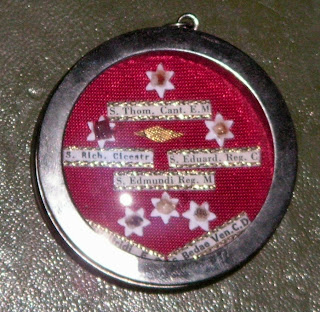
One of my most treasured possessions is a reliquary containing relics of some of the great English saints: St Thomas of Canterbury (at the top); St Richard of Chichester; St Edward the Confessor; St Edmund, King and Martyr; St Wilfrid and St Bede the Venerable. All of these are First Class, with the exception of St Richard. I will place the reliquary on the altar when I celebrate Mass this evening:
Finally, let me mention my favourite St Thomas story. The men of Strood in Kent (now part of Rochester) sided with the King in his dispute with Becket and cut off the tail of a pack-horse carrying supplies to the Archbishop's kitchen, in order to humiliate him. One source says that several horses were mutiliated and their riders wounded; others that it was Becket's horse that was attacked. When the Archbishop heard of this, he condemned all the inhabitants of Strood (or even the whole of Kent) and their descendants to be born with tails! Another version of the story of 'Kentish Long-Tails' is that it was a punishment for their ill-treatment of St Augustine and his monks, who were beaten and had fish-tails tied to their backs, 'in revenge of which, such appendants grew to the hind parts of all that generation.' If any readers can supply evidence of modern Kentishmen with tails, then please leave a message.

Labels: , ,

Monday, 25 December 2006

A Happy and Blessed Christmas to all my Friends in the Blogosphere!


'God's sign is simplicity. God's sign is the baby. God's sign is that He makes Himself small for us. This is how He reigns. He does not come with power and outward splendour. He comes as a baby defenseless and in need of our help. He does not want to overwhelm us with His strength. He takes away our fear of His greatness. He asks for our love: so He makes Himself a child. He wants nothing other from us than our love, through which we spontaneously learn to enter into His feelings, His thoughts and His will; we learn to live with Him and to practice with Him that humility of renunciation that belongs to the very essence of love. God made himself small so that we could understand Him, welcome Him, and love Him.' (Pope Benedict XVI, Midnight Mass, 25 December 2006)

Hodie Christus natus est:

Hodie Salvator apparuit:

Hodie in terra canunt Angeli, laetantur Archangeli:

Hodie exsultant justi, dicentes:

Gloria in excelsis Deo.

Alleluia.

Noé, Noé, Noé!

Labels:

A Christmas Sermon

We tend to think of the Christmas story in a rather sentimentalised way – the cosy manger, the picturesque shepherds, the happy angels, the friendly ox and ass. It’s the beautiful scene that we see on countless Christmas cards. But let’s never forget that the Christmas story contains pure dynamite. It literally turned the world upside down.

The traditional Christmas Proclamation puts Christ’s birth in context: at a particular moment (the 149th Olympiad, the 752nd year after the foundation of Rome and the 42nd year of Augustus’ reign) timelessness entered time, the invisible God became visible. Today we marvel at the fact that the baby boy lying wrapped in swaddling clothes is the Son of God, the long-awaited Messiah.
He came down to earth from heaven,
Who is God and Lord of all,
And his shelter was a stable,
And his cradle was a stall;
With the poor and mean and lowly,
Lived on earth the Saviour holy.
C. S. Lewis, the author of the Narnia stories, puts it well:
The Second Person in God, the Son, became human Himself: was born into the world as an actual man – a real man of a particular height, with hair of a particular colour, speaking a particular language, weighing so many stone. The Eternal Being, who knows everything and who created the whole universe, became not only a man but (before that) a baby, and before that a foetus inside a Woman’s body. If you want to get the hang of it, think how you would like to become a slug or a crab.(Mere Christianity)
From the first moment of His life on earth, it was clear that Jesus would be a very different Messiah from the one the Jews expected. He came to set Israel free – not from its temporal enemies but from evil, sin and death. He didn’t come as a powerful military leader but as a powerless infant. He is a great King but His first palace was a humble, dirty, uncongenial stable. Mary and Joseph could not even find a room in the inns of Bethlehem, a backward town on the margins of the Roman Empire.

The new-born King’s first courtiers were not the rich and powerful but local shepherds – and remember that shepherds in Jesus’ time were considered dishonest and listed among those ineligible to be judges or even witnesses in a law court. Outcast from respectable society but these rustics were visited by angels and became the first to pay homage to the new-born King.

Our Lord was born into poverty – He who created the Universe had nothing to His name: no clothing, no toys, no home, no food. And here’s the twist – that hungry baby came to be our food. It is indeed appropriate that בית לחם, Bêth lehem means ‘House of Bread’. It was in the ‘little town of Bethlehem’ that the ‘Bread of Life’ came into the world. At every Mass, but in an especially meaningful way at Christmas, Our Lord Jesus Christ is ‘born again’ as the priest says the words This is my Body, This is the cup of my Blood. He comes to us to be our spiritual food. Just as the shepherds worshipped Christ in the crib, so we worship the same Christ present on the altar; hidden then as a helpless child, hidden now beneath the forms of bread and wine. In the Holy Eucharist Christ makes for himself a ‘house of bread’ and at Communion we truly have amongst us Emmanuel – God with us.

We rejoice today because that powerless baby has come to do battle with sin and death. In the end He triumphed – but He triumphed through a degrading death on the cross and resurrection on the third day. The mysteries of Holy Week and Easter are never far away from our Christmas celebration; they fulfil the story that begins today. Our traditional decorations of holly and the ivy remind us of this – ‘the holly bears a prickle, as sharp as any thorn’, and ‘a berry, as red as any blood,’ making us think of the Passion; the ivy (and also the evergreen Christmas trees) signify the everlasting life which Christ won for us through his death and resurrection.

That’s why we rejoice today. That’s why we sing carols. That’s why writers and artists have celebrated the Christmas story down the centuries. Not just because we feel sentimental about the baby boy born to Mary and Joseph, but because that birth means something – it turns the world upside down, it defeats the world of darkness, it brings light into the world and it opens our way to Heaven.
Come to Bethlehem and see
Him whose birth the angels sing:
Come, adore on bended knee
The infant Christ, the new-born King.

Labels: ,

Sunday, 24 December 2006

The Twelve Days of Christmas

Another carol with (possible) recusant origins is The Twelve Days of Christmas.

Some people claim that the carol originated in the English Catholic Community. According to this theory, the persecuted Catholics had to find ways of expressing their faith through codes and signs. The seemingly innocent Twelve Days of Christmas is thus, in reality, a coded mini-catechism of the Catholic Faith. Thus:

My True Love = the Father/Jesus Christ
Partridge in a Pear Tree = Jesus Christ
Two Turtle Doves = the Old and New Testaments
Three French Hens = the Theological Virtues (Faith, Hope and Charity) or the Holy Trinity
Four Calling Birds = the Four Evangelists
Five Golden Rings = the Pentateuch
Six Geese A-laying = the six days of creation
Seven Swans A-swimming = the seven sacraments/ the seven gifts of the Holy Spirit
Eight Maids A-milking = the eight beatitudes
Nine Ladies Dancing = the nine Fruits of the Holy Spirit [there are twelve fruits but it is proposed that forbearance is combined with patience, goodness with kindness and self-control with chastity, thus making nine]
Ten Lords A-leaping = the ten commandments
Eleven Pipers Piping = the eleven faithful apostles
Twelve Drummers Drumming = the twelve articles of the Apostles' Creed

It's a beautiful theory but there is no hard evidence that the song has recusant origins - indeed, with the exception of the seven sacraments, all these truths are accepted by the Church of England and would not, therefore, need to be 'coded'. Moreover, the meanings are obscure - you would expect that the coded language in a catechetical song would have at least some relevance to the thing signified - but how, for example, do 'nine ladies dancing' remind somebody of the Beatitudes?! At the end of the day, we just don't know for sure the origins of the carol.

Mgr Mark Langham left a comment on Adeste Fideles, which inspired this post. He says: 'I was once told that the song of the "Twelve Days of Christmas" is based on Latin texts, as heard by a non-literate congregation. Thus, "A Partridge in a Pear Tree" was originally "Apparuit in Partibus". I have found no corroboration of this or, indeed, any hint at what the other 'days' might represent. Any clues?" I've never heard of this theory before - can any readers help or suggest Latin texts that might have been corrupted into other lines of the carol?

The familiar version of the Twelve Days of Christmas was first published in a childrens book called Mirth Without Mischief in 1780. Based on an earlier French version, it was designed to be a memory and forfeit game to amuse the children during Christmastide.

Even if the recusant background behind the Twelve Days of Christmas is not historically accurate, the symbolism is still a helpful way of catechising children in the truths of the Faith in the form of a memory game. So, whatever the real origins of the carol, we shouldn't simply write it off as a 'nonsensical' secular song. After all, so many of our Christmas customs have pagan or secular origins that were later Christianized for the glory of God!

Labels: ,

Adeste Fideles


Here's the third in the Roman Miscellany carol series. Adeste Fideles was not written by St Bonaventure, as some people think, but by an eighteenth century English recusant, John Francis Wade. He spent most of his life in exile overseas because of his Jacobite sympathies and was strongly associated with the English College, Douai. The tune was probably based on the Air Anglois in Favart's comic opera Acajou.

The popular carol was first used by the English Catholic Community and it gained the name the 'Portuguese Hymn' simply because it could be heard at the Portuguese Embassy Chapel in London (the extra-territorial embassy chapels were open centres of Catholicism in Protestant London during 'penal times', often with impressive musical and liturgical resources).

In 1841, nearly a century after its composition, the carol was translated by Frederick Oakeley. He became a Catholic in 1845 and, after Ordination, founded the Mission of St John's, Islington - just down the road from my current parish.

Labels: ,

Saturday, 23 December 2006

In Dulci Jubilo


In Dulci Jubilo: this is one of my favourite carols (here performed by King's College, Cambridge). This type of carol is called 'macaronic' - the text is a mix of Latin and vernacular (another example is the Boar's Head). In Dulci Jubilo first appeared in manuscript from around 1400, but its origins are normally dated to Blessed Henry Suso's vision one night in 1328. According to an early life of the Dominican mystic:

Now this same angel came up to the Servant brightly, and said that God had sent him down to him, to bring him heavenly joys amid his sufferings; adding that he must cast off all his sorrows from his mind and bear them company, and that he must also dance with them in heavenly fashion. Then they drew the Servant by the hand into the dance, and the youth began a joyous song about the infant Jesus, which runs thus: In dulci jubilo etc.

Labels: ,

Roman Pifferari


It is a spectacle at once edifying and picturesque, to see a street in Rome brilliantly lighted by thousands of luminous specks [the lights before the street shrines], like the fire-flies of Italy, and resounding with the rustic music of the pifferari of Calabria or the Abruzzi. At all times these mountain musicians assemble a great concourse of people at the foot of the Madonnas, especially in Advent; for they seem anxious to introduce by their rural airs the feast of the shepherds, the most holy night of Christmas. (Abbe Orsini)

A familiar aspect of the traditional Roman Christmas - which is sadly becoming less common in the twenty-first century - is the presence of pifferari (bagpipers) on the streets.These musicians originally came from the Abruzzi to the Eternal City at this time of year to play devotional music before the shrines. However, they could be a nuisance. Stendhal complained that the pifferari 'have been waking us up at 4 in the morning. It's enough to make man hate music.' They could even introduce lyrics questioning the virtue of the wives of those who failed to give them donations! After a Christmas in Rome, some of these pipers could return to the Abruzzi with as much as 100 scudi.

The following video gives a good impression of what these instruments sound like. Be patient, the zampogna (pipes) only get going about 45 seconds into the footage! It may not be your cup of tea, but you immediately think of the shepherds (often shown with bagpipes) adoring the Christ Child in the great Old Masters.

Labels: ,

Friday, 22 December 2006

The Boar's Head - Servitur cum Sinapio


A carol I've always loved - but one that is sadly not suitable for liturgical use - is the Boar's Head Carol. First published in 1521, the carol is particularly associated with The Queen's College, Oxford, where it was sung every Christmas as the boar's head (complete with apple in the mouth) was ceremonially carried into the dining hall). Washington Irving, in his Old Christmas (1886), described a similar scene:

There was now a pause, as if something was expected; when suddenly the butler entered the hall with some degree of bustle: He was attended by a servant on each side with a large wax-light, and bore a silver dish, on which was an enormous pig's head decorated with rosemary, with a lemon in its mouth, which was placed with great formality at the head of the table.

According to legend, a student of the College, while walking in a nearby wood, was attacked by a savage wild boar. The student saved himself by stuffing his book of Aristotle into the boar's mouth, as he exclaimed:'Graecum est, non potest legi' ('it's Greek, it's unreadable'). The boar ended up being served at table - and so it passed into an annual custom. Here is one version of the carol - I particularly like the line about serving it with mustard (sinapio)!
The boar's head in hand bear I
Bedecked with bay and rosemary,
I pray you, my masters, be merry,
Quot estis in convivio. [so many as are at the feast]

Caput apri defero,
Reddens laudes domino.
[I bring the boar's head, giving praises to the Lord]

The boar's head, as I understand,
Is the rarest dish in all this land,
Which thus bedecked with a gay garland
Let us servitur cum sinapio [serve it with mustard]
Caput apri...

Our steward hath provided this
In honour of the King of bliss
Which, on this day to be served is
In Reginensi atrio [in the Queen's hall].
Caput apri...


Click here to listen to a lively version courtesy of the King's Singers. The picture at the top of the post, by the way, was taken in Rome this time last year. I rather like cinghiale (wild boar) and the dish makes me think of the grand banquets in the Asterix books. Wild boar was particularly popular as a Christmas dish in the past because it came to symbolise the Babe of Bethlehem's victory over sin (the ferocious boar was a symbol of evil).

Labels: ,

Preparing the Way for the Lord


Greetings from a very cold London. As you can see from the photo I've just taken from my study window, it's foggy (hence all the chaos at the airports) and London feels rather Dickensian at the moment (though thankfully it is fog rather than smog).

Any infrequency in blogging is caused by all the preparations for Christmas, which certainly succeed in building up the Advent sense of expectancy. This morning, for example, some chaps in the parish began the difficult task of erecting our giant crib (a la Piazza San Pietro), which stands on the busy roadside outside the church and acts as a local landmark over the coming weeks. It will hopefully be finished tomorrow:


Meanwhile, the church was filled with flowers and decorations - there's going to be a rather colourful feel to the Fourth Sunday of Advent, but this can't be helped this year with Christmas falling on a Monday:


Over the last week, two mosaics commissioned by the Parish Priest have been completed, which makes our 1960s church seem a bit more festive. These include a blue border around the statue of Our Lady (resembling a Rosary) and an image of the Flight into Egypt in the porch (this was deemed a fitting subject because of the many ethnic groups in our parish).


Good luck with all your preparations for the Holy Night!

Labels: ,

Sunday, 17 December 2006

The True Spirit of Christmas

Christmas Linebacker

Add to My Profile More Videos

This great video comes via fanatholic - I think every parish should be policed by a 'Christmas Linebacker' who puts the 'Christ' back into 'Xmas.'

Labels: ,

<< # St. Blog's Parish ? >>