Sunday, 25 January 2009

New Books

Alumni of the Venerable English College, Rome in recent years have been rather prolific in publishing books. In the last week or so two of my classmates have produced interesting titles.


Fr Gerard Skinner, parish priest of Northolt and South Harrow and co-author of The English Cardinals, has arranged an anthology of Benedict XVI's teachings on the Sacred Priesthood. Entitled Priests of Jesus Christ, it is published by the ever-excellent Family Publications and will be essential reading for priests, seminarians and anyone considering a priestly vocation, as well as those who want to learn more about the role of the Priesthood in the Church.
.

Fr Richard Whinder, a Southwark priest who occasionally appears on the blogosphere, has written a useful CTS pamphlet, The Extraordinary Form of the Mass Explained, containing a short commentary on 'the Mass of the Ages', a history of its development across the centuries and an explanation of Summorum Pontificum. Priced at only £1.95, I'm sure it will help those who are either discovering the Usus Antiquior or are confused by recent events.

Labels:

Monday, 24 November 2008

A Glimpse of Heaven DVD


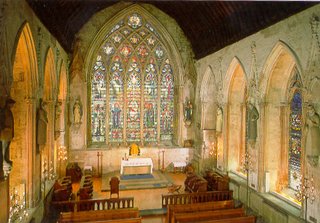
Many of you will have a copy of Christopher Martin's A Glimpse of Heaven on your shelves, a handsome coffee table book about the most beautiful Catholic churches in England and Wales. This historical and architectural survey starts with the handful of pre-Reformation chapels in Catholic hands (East Hendred, Stonor, Ely Place, Slipper Chapel at Walsingham, Fitzalan Chapel at Arundel, Rotherwas) and finishes with the new Brentwood Cathedral, which is presented as a 'return to the past.'

Now there is a companion DVD, which has just arrived in the post and looks excellent, with good photography and commentaries from Christopher Martin and a host of special guests, including the bishop of Brentwood, the Abbot of Douai and Lord Camoys. I think I might show this to a parish group.
.
I was particularly interested in the chapters regarding C20 architecture, about which I know very little. There is a fairly balanced section on the 'liturgical and architectural revolution' of the 1960s and 70s, speaking of the tragic 'iconoclasm' of church buildings perpetuated by 'ignorant priests' and 'greedy architects.'

The double-DVD retails at £12.99 - but there's current a special offer in which you get both the book (worth £25) and DVD for only £25. A good idea for Christmas? Visit the Gracewing webpage and scroll down to A Glimpse of Heaven.

Labels:

Saturday, 4 October 2008

The Papal Zouaves


I've just read a recently-published book, The Pope's Legion: The Multinational Fighting Force that Defended the Vatican, by Charles A. Coulombe. It's the first English study of the Papal Zouaves in over a century and serves as a good introduction to this regiment of volunteers from all over Christendom who banded together to defend Blessed Pius IX and his temporal sovereignty between 1860 and 1871.

The New York Herald of 10 June 1868 numbered the zouaves at 4,592, including 50 Englishmen, 10 Scots, 101 Irish, 14 Americans and 135 Canadians. Even Africa and China were represented. The largest nationality was, perhaps surprisingly, the Dutch (1,910), followed by the French (1,301).

One of the most interesting parts of the book is the Appendix, containing 'Songs of the Zouaves' and a homily preached by Mgr Ignacio Barreiro of HLI at a Mass in Memory of the Pope's Soldiers. There is a useful list of 'Zouave Sites,' ranging from the monument in the Lateran's Blessed Sacrament Chapel to the Netherlands Zoavenmuseum at Oudenbosch, near the Basilica of SS Agatha and Barbara built in the Zouaves' honour (a must visit, it seems, if you happen to be passing Oudenbosch). In France there are several 'uniformed societies of descendants and re-enactors,' such as the Societe Royale des Zouaves Pontificaux de Thuin and a similar organisation at Jumet. Every parish needs one:
.

Coulombe's book tells a thrilling story, although those who know little about the process of Italian Unification might get lost amidst the narrative of battles and campaigns. It would also have been good to have had more quotes from primary sources. However I'm delighted that a book has been published about this neglected story and hopefully future studies will bring us more details about recruitment, organisation, the daily life of the Zouave and the individuals who joined.

The English Zouaves included:
  • Alfred Collingridge, who left a Jesuit novitiate in order to join and died in action.

  • George Collingridge, his brother, who later emigrated to Australia and became a well known wood engraver and author.

  • James Coventry from the New Forest who later became a skilled photographer - a book was recently published about him.

  • Joseph Stanislaus Hansom, son of the famous architect and inventor of the 'Hansom cab,' who himself entered his father's profession. The former Zouave designed the churches of the Holy Name, Manchester; Arundel Cathedral; St Aloysius, Oxford (now the Oratory); Our Lady, Teignmouth; the Servite Churches at Bognor and Fulham, and portions of Fort Augustus Abbey and Portsmouth Cathedral.

  • John George Kenyon, who was received into the Church while at Christ Church, Oxford (1870) and joined the Zouaves shortly afterwards. He built the church at Gillingham and was named a Private Chamberlain to Leo XIII.

  • Joseph Powell, author of Two Years in the Pontifical Zouaves.

  • Bartholomew Teeling, who later became the first Secretary of the Catholic Union of Ireland and was named a Private Chamberlain by St Pius X in 1907.He wrote My First Prisoner, a tale of Rome in the first days of its occupation by Victor Emmanuel.

  • Julian Watts-Russell (‘Giulio’), son of the Vicar of Benefield who converted in 1845 and joined the Zouaves, together with his brother Wilfrid. Julian was killed at the battle of Mentana (1867), one of the most notable papal victories, and was treated almost as a martyr; his monument is still preserved at the Venerable English College, Rome. Interestingly, the year after his death Julian's father, Michael (a widower), was ordained as a Westminster priest. Another brother, Michael junior, became a Passionist and superior of their house at Highgate.

Labels: , ,

Friday, 11 July 2008

St Lucius, King of Britain


I’ve always been fascinated by the legend of a mysterious British King, St Lucius, who supposedly wrote to Pope St Eleutherius (above) in the late 17os to request baptism. Missionaries were dutifully sent and the King subsequently founded several churches, including a ‘Cathedral’ in London on the site of St Peter-upon-Cornhill.

St Bede writes: ‘while the holy Eleutherius ruled the Roman Church, Lucius, a British King, sent him a letter, asking to be made a Christian by his direction. This pious request was quickly granted, and the Britons received the Faith and held it peacefully in all its purity and fullness until the time of the Emperor Diocletian.’ The King later abdicated and travelled to Switzerland as a missionary, where he won a martyr’s crown. His shrine can still be found at Chur.

Thus states the legend. In 1904 the story was ‘deconstructed’ by the German historian Carl Gustav Adolph von Harnack, who suggested that St Lucius had been mixed up with Lucius Abgar IX (179-214), King of Edessa and a contemporary of St Eleutherius. The confusion may have resulted when the Edessian fortress of Birtha was latinised into Britium Edessenorum. In the hands of a medieval copyist, Britio may have become Britannio. This theory seems to have been accepted almost universally over the last 100 years.

But the archaeologist, David J. Knight, has just written a whole book about the legend of King Lucius of Britain. It arrived in the post yesterday and the few chapters I’ve managed to read convincingly question Harnack’s deconstructive theory and opens the way to proposing that St Lucius actually did exist!

One of the many interesting details – especially for those in the Archdiocese of Westminster – is the traditional list of the ‘Archbishops of London’ between the reign of St Lucius and the coming of St Mellitus, the bishop of London appointed after the mission of St Augustine of Canterbury. There would be no more Catholic Archbishops in London until 1850…

Thean (c.179-185)
Eluanus
Cadar
Obinus
Conan
Paludius
Stephen (martyr, +17 September 304)
Augulus (martyr, +7 September 305)
Iltutus Restitutus (attended the Council of Arles, 314)
Dedwin
Thedred
Hilary (c.367)
Fastidius (c. 431)
Guidelium (c.410)
Vodinus (martyr, +23 July 436)
Theanus (c. 587)

Note the three martyrs, SS Stephen, Augulus and Vodinus, now totally forgotten. These cults were probably discouraged by St Augustine, who preferred the ancient Roman martyrs and arranged for their relics to be brought to England to replace those of the more dubious British saints.

If you’re interested in the origins of Christianity in this country, then you’ll find Knight’s book very interesting…

Labels: , ,

Saturday, 15 December 2007

A Champion of the Faith - RIP


I was very saddened to hear of the death, today, of a great English champion of the faith - Denis Riches, the Founder of Family Publications and the husband of family and pro-life campaigner,Valerie Riches. He had been battling cancer since August 2005. On 6 October this year he and Valerie were invested as a Knight and Dame of the Order of St Gregory (see picture), in recognition of their great work, and they also recently published their autobiography, Built on Love.
.
As someone who has been involved with several of his publishing projects, I met Denis on numerous occasions and always benefitted from his wisdom and enthusiasm. He was a true Christian gentleman. Say a prayer for the repose of his soul and the solace of his family, who can be sure that his legacy will continue for many years in Family Publications.

Requiescat in pace.

Labels: ,

Sunday, 9 December 2007

An Early Christmas Present

One of my parishioners - and a leading light in our Young Adults Group - is the great-nephew of Mgr Ronald Knox. We sometimes speak about his famous relation and I recently lent him Fr Milton Walsh's Ronald Knox As Apologist: Wit, Laughter and the Popish Creed.

Anyway this evening he gave me a handmade Christmas card and inside, as an early Christmas present, was a letter from his great-uncle which he had recently found in an old book. It is dated 30 April 1924 from Courtfield, Herefordshire (where Cardinal Vaughan grew up). The contents aren't particularly amazing but they show the author's great gifts as a man of letters.

Mgr Knox refers to a tour in the country he recently completed with 'the bard' and says: 'I will only emphasize the undesirability of going at any time or for any purpose to the Lamb inn at Wallingford, which is a whited sepulchre and a wolf-cub in Lamb's clothing.' One wonders what was so objectionable about this establishment and trusts that it has improved in more recent years (though the fact it was once visited by William of Orange doesn't bode well).

Knox seems to have done something of a pub crawl, in the Chesterbelloc tradition, for he also refers to a don he met at the Bear Inn at Wantage who is 'now at Oxford, extending the Universities, and boring the countryside.'

A few weeks ago I passed through Mells, the little Somerset village where Mgr Knox is buried. It is a quintessentially English village - a medieval church, with a little row of almshouses leading to the front gate:


Next to the church is a sixteenth century manor house, the home of the Asquiths, where Mgr Knox spent his latter years. The manor was purportedly procured by Jack Horner upon discovering the deed in a pie given to him to carry to London by Richard Whiting, the last Abbot of Glastonbury. Here is the gate, designed by Lutyens:

The churchyard unusually contains the graves of some distinguished Catholics. Here is Mgr Knox's:

The tombstone also has an inscription on the back - ''You have died and your life is hidden with Christ in God':

Nearby are the tombs of the war poet and convert, Siegfried Sassoon, who asked to be buried near Knox, and Christopher Hollis, Catholic politician and writer (and father of the present bishop of Portsmouth!).
.

Labels: ,

Saturday, 3 November 2007

James By the Grace of God...

I popped over to Westminster Cathedral this morning to attend the Towards Advent Festival of Catholic Culture. It's a great place to bump into people (including the Cardinal and 'Auntie Joanna') and I listened to an excellent talk from Fr Richard Whinder on his namesake, Bishop Richard Challoner. I also bought a few surplus books from the Catholic Central Library.

A new book was also launched, for which I wrote a short Introduction: James by the Grace of God..., a historical novel about King James II written by Hugh Ross Williamson (1901-78) and originally published in 1955.

Ross Williamson is someone that everybody should be reading at this time of year, since one of his great works was a study of the Gunpowder Plot, in which he convincingly argued that the Government had known about the conspiracy well in advance and had used this information to damage the English Catholic community. However, he also wrote a whole series of novels and plays, based on extensive historical research. It was his belief that a carefully written novel could do as much as a textbook (if not more) in giving an accurate picture of the past.

James By the Grace of God...
deals with one of the most misunderstood figures in British history: King James II, our last Catholic King. He’s normally seen as a popish tyrant, removed from the throne by the ‘Glorious Revolution’ of 1688. The novel gives a more sympathetic- and historical - picture of the last six months of the reign. James had been warmly welcomed by the country when he succeeded his brother, Charles II, despite his Catholic faith. The dramatic events of 1688 were caused not by what King James did but by what he was perceived to do, combined with the opportunism of his Dutch son-in-law, William of Orange.

The novel is fast-moving and contains all the great ingredients of a historical epic: hidden staircases and secret letters, attempted kidnappings and nocturnal escapes, and, at the heart of it all, a family argument between a Catholic father and his two Protestant daughters - all-in-all, a fast-moving narrative, based on undeniable fact.

To buy a copy (£11.99 + £1.52 postage & packing in the UK) you need to write to Fisher Press, P.O.Box 41, Sevenoaks, Kent TN15 6YN (01732 761830). Cheques can be made out to 'Fisher Press'.

Labels:

Sunday, 9 September 2007

God's Architect


I've been reading Rosemary Hill's wonderful new biography of the Catholic architect, Augustus Welby Northmore Pugin, who was single-handedly responsible for much of the nineteenth century Gothic Revival. The first two paragraphs of the book sum up his importance:

Travelling through England on a train, or flying into London, low along the Thames and over the suburbs, the landscape is still, to a great extent, made up of little pitch-roofed houses and gardens. Sprinkled among them are the towers and spires of Gothic churches, while here and there are small village schools and big Victorian town halls. The architectural texture of our towns and of the countryside is still largely nineteenth-century and none of it would look, quite, as it does had A.W.N.Pugin never lived.

Pugin gave Britain's capital cities two of their greatest landmarks, the clock tower of the Palace of Westminster, generally, if inaccurately, known as Big Ben, and, in Edinburgh, the spire of Tolbooth St John's. He built the first English cathedral since Wren's St Paul's and he reinvented the family house. But his influence depended not only, not even primarily, on his buildings, it was both wider and more elusive. He gave the nineteenth century a new idea about what architecture could be and mean. He saw it as a moral force in society and as a romantic art.
I have always been fascinated by the eccentric genius of Pugin. My mother's late cousin was Prior of Ramsgate Abbey and I occasionally went to stay with him, convinced at the age of eight that I would one day be a monk. The atmospheric abbey church, where the architect is buried, captured my imagination, as did the vague stories that Pugin haunted the abbey precincts. I was interested to read that there is a local connection here in Islington - Pugin's mother, Catherine Welby, grew up at what is now 88 Islington High Street (formerly 3 Pullins Row), near the Angel. She also began her married life there with Auguste Pugin. Next time I'm down there, I must look it up.

Hill's definitive new biography is highly readable and brings the age of Pugin vividly to life. Highly recommended.

Labels:

Sunday, 8 July 2007

The English Cardinals


Can I draw people's attention away from all the exciting documents being issued by the Holy See for a moment? I'm certainly not trying to compete but a book of mine is being published tomorrow (9 July) by Family Publications. It's called The English Cardinals and it is co-written by my friend, Fr Gerard Skinner, who recently published a study of the pallium.

The book has individual chapters on each of the 50 English Cardinals, from Robert Pullen (created c.1144) to Cormac Murphy-O'Connor (created 2001). These include pre-Reformation prelates such as Stephen Langton, Henry Beaufort and Thomas Wolsey; heroes of the Catholic resistance like St John Fisher, Willam Allen and Philip Howard; and the 'big three' of the 'Second Spring' - Wiseman, Manning and Newman. There are many less well-known figures, such as Edward Howard, who led the funeral procession of the Duke of Wellington before entering the clerical state, and English Cardinals who spent most of their lives overseas - such as Pope Adrian IV, the Cardinal Duke of York and Rafael Merry del Val (a priest of Westminster and Secretary of State to St Pius X).

Best of all, the book has loads of pictures, some of which make their first appearance in print - there are four colour sections and black and white illustrations throughout (including coats of arms and pictures of the titular churches). The book is hardback, 304pp, and sells at a modest £19.50. Probably the easiest way of getting the book is from the Family Publications website. Waterstone's has a link here, with free postage. Or a slightly more expensive deal from Amazon:


No pressure!

Labels: , ,

Wednesday, 11 April 2007

The Pallium


A friend of mine, Fr Gerard Skinner, has just published The Pallium: A Brief Guide to its History and Significance, issued by Family Publications. Fully illustrated, it studies this intriguing archepiscopal vestment and I'm sure it will interest many readers, especially in the light of Pope Benedict's reflections on the subject. Indeed, 'the book has numerous discoveries in store for all who are interested in history and in the liturgy, or who want to know more about this simple yet beautiful symbol of divine service.' Click here to buy a copy, priced £9.95.
.

Labels:

Saturday, 3 February 2007

Thornton's Bookshop

John Thornton's bookshop on the Fulham Road is a veritable London Catholic icon, which has already featured in these pages. For well over 40 years it has specialised in secondhand Catholic books and Mr Thornton has had the melancholic (though for us consumers not completely unfortunate) task of buying the libraries of religious houses that are closing down.

Since the time I was a sixth former interested in learning more about the Faith (and beginning to think about the Sacred Priesthood) I have been a frequent visitor to their basement. Luckily, since most books were priced under £10 (and many under a fiver) it was even affordable as a University student and seminarian. Looking at my shelves, I owe at least 50% of my library to this shop - especially the hagiography, spirituality and Church history sections.

Alas, Thornton's is closing down in a few months time. The good news is that the entire stock (including the antiquarian books) is now selling at half price! I urge all my London readers to pay them a speedy visit - 455 Fulham Rd, SW10 9UZ (near the Servite church and the Fulham Rd entrance to Brompton Cemetery), tel: 020 7352 8810.

Happy shopping - but do leave a few items for me!

Labels: ,

Saturday, 16 December 2006

Online Library

H/T to Dappled Things and Hermeneutic of Continuity for drawing our attention to two great liturgical books now available on the web:
  1. The Marquess of Bute's rather eccentric edition of the Roman Breviary (this link is to the first volume only).

More marvellous still is the website that provides these books (all out of copyright) - www.archive.org. Next time I'm writing an article or a talk, the online library will prove to be invaluable. For example, I typed in a few random keywords (which will tell you something of my present historical interests) and found:

  1. Richard Challoner's Garden of the Soul and Lives of the Desert Fathers

  2. Newman's Lives of the English Saints (the link is to the volume covering St Augustine of Canterbury)

  3. The complete works of Cardinal Wiseman, such as his Four Lectures on the Offices and Ceremonies of Holy Week, as performed in the Papal Chapels.

  4. The whole of Pastor's monumental History of the Popes from the Close of the Middle Ages (translated by Antrobus).

  5. A book I've been looking for and only ever found in the monastic library at Farnborough Abbey - Dunbar's Dictionary of Saintly Women (Vol 1 and 2), which contains lots of obscure details you won't find elsewhere.

  6. Gillow's Bibliographical Dictionary of the English Catholics.

  7. Benedict XIV's important work on Heroic Virtue.

And so on! Visit the site and type in the subjects that interest you.

NB The picture shows the fabulous Bibliothek at Stift Admont in Austria.

Labels:

Tuesday, 28 November 2006

Catholic London

Yesterday was a busy day that took me to two of London's most beautiful and interesting churches.


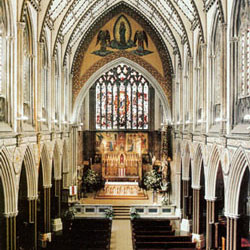
First of all I went to St Etheldreda's, Ely Place - a Rosminian church that was founded from my current parish (Kingsland). It is one of the oldest Catholic churches in this country for the chapel dates from the late thirteenth century and was used by the bishops of Ely as their London base. This connection ended at the Reformation but it returned to Catholic hands briefly in the seventeenth century, when it was used by the Spanish Ambassador, and again in 1873, when Fr William Lockhart purchased the property for the Institute of Charity. American readers might be interested to know that the Catholic chapel at West Point Military Academy is modelled on St Etheldreda's.

I went to this venerable church to meet the archivist of the Rosminians, who is an Englishman and was passing through London on his way to Africa. We retired to Ye Old Mitre Tavern, hidden in a nearby alley and originally dating from Elizabeth I's reign. I'm trying to find out more about my new parish's history and, although the Institute's archive contains a file of documentation (including plans of the original church), one would need to go all the way to the Mother House at Stresa in northern Italy. The archivist has kindly invited me to visit at the end of May - an offer I intend to take up (and this has nothing to do with the fact that the place is on the western shore of Lake Maggiore!).


After a stint at the diocesan archives I then made my way to Mayfair and the stunning Jesuit church of the Immaculate Conception, Farm Street, which was opened in 1849 (just before the Restoration of our Hierarchy). The occasion was a Council meeting of the Catholic Records Society - and I urge all readers with an interest in English Catholic history to join. For a very reasonable subscription you get two issues of an internationally respected journal (Recusant History) and a hardback monograph.
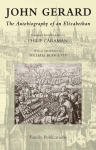
There was time, also, to pop into the book launch of the latest offering from Family Publications: a reprint of John Gerard: The Autobiography of an Elizabethan, with a new introduction by Michael Hodgetts. It's a gripping story - as the write up says,
John Gerard was a Lancashire man, educated at Oxford and ordained in Rome. After a ministry in East Anglia he was arrested and tortured in the Tower of London but, miraculously, escaped and continued working as a priest for the next eight years, even gaining access to the courts of Elizabeth I and James I. After the Gunpowder Plot, however, he fled to the continent where he wrote this autobiography, which transports the reader into a world of priest-holes, secret Masses and high intrigue. He died in Rome in 1637 without ever seeing England again.
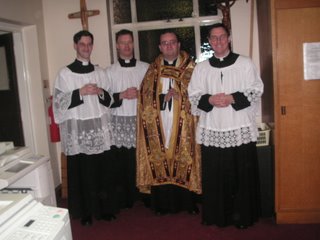
Finally I rushed back to Kingsland where I was meeting some priest friends for Vespers and Benediction in preparation for the Feast of the Martyrs of the Venerable English College, Rome (1 December). Here is the scene in the sacristy afterwards:

And the evening finished with a jolly meal on Newington Green. A great Catholic London day!
Labels: , ,

Saturday, 18 November 2006

In Praise of Saki


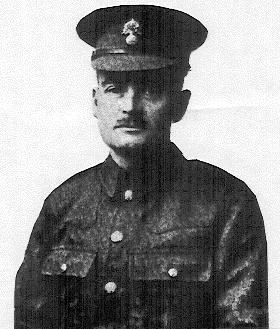
Today's Telegraph reminded me that last Tuesday (14 November) saw the 90th anniversary of the death of H.H.Munro (better known by his pen name 'Saki'), who rivals Oscar Wilde as one of the wittiest authors produced by this country. He had joined the army during WWI, despite being over age, and was killed by a German sniper as he hid in a shell crater. A comrade had alerted the enemy to their presence by smoking and Saki's last recorded words are said to have been: 'put that bloody cigarette out.'

As a modest commemoration of Saki, I include below a few of my favourite quotes:

'Isn't there a bishop or somebody who believes we shall meet all the animals we have known on earth in another world? How frightfully embarrassing to meet a whole shoal of whitebait you had last known at Prince's! I'm sure in my nervousness I should talk of nothing but lemons. Still, I daresay they would be quite as offended if one hadn't eaten them. I know if I were served up at a cannibal feast I should be dreadfully annoyed if anyone found fault with me for not being tender enough, or having been kept too long.'

'People may say what they like about the decay of Christianity; the religious system that produced green Chartreuse can never really die.'

'Every reformation must have its victims. You can't expect the fatted calf to share the enthusiasm of the angels over the prodigal's return.'

'The young have aspirations that never come to pass, the old have reminiscences of what never happened. It's only the middle-aged who are really conscious of their limitations - that is why one should be so patient with them.'

Labels: ,

Monday, 13 November 2006

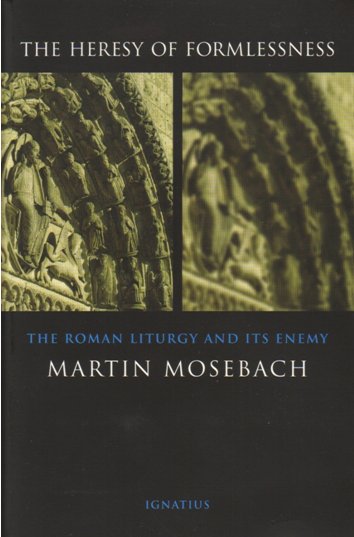
Heresy of Formlessness

I've been asked to advertise the presentation of the English version of Martin Mosebach's book, Heresy of Formlessness, at 6.30pm in St Wilfrid's Hall (London Oratory) on 7 December.

Martin Mosebach, who will be present, is a well-known and award-winning German author who has published novels, stories, and collections of poems; he has also written scripts for several films, opera libretti, theatre, and radio plays. He is a regular contributor to the Frankfurter Allgemeine Zeitung, and also writes on art and literature for other newspapers and journals (like the New York Times). Most recently, Mosebach has been awarded the Großer Literaturpreis der Bayerischen Akademie der Schönen Künste.

Heresy of Formlessness is a collection of essays on the liturgy and its recent reform not from the perspective of a theologian, but from the perspective of a literary writer. The book helped a lot to bring the debate on the liturgy into a wider public in Germany and an extract can be read here.

Like all good book launches it will be preceded by Solemn First Vespers of the Immaculate Conception in the Oratory church. All are welcome.

Labels: , ,

Saturday, 4 November 2006

'Gregory XVI is Here'

This afternoon I popped over to Westminster Cathedral Hall for the annual 'Towards Advent' festival - which is really a gathering of various Catholic stalls. The best thing about it is bumping into all sorts of friends and acquaintances. I spent an enjoyable hour visiting Southwell Books, Catholic Truth Society, FSSP, Association of Catholic Women, etc.

It was a red letter day for Fr Richard Whinder (Britain's most blogged about priest?) because Fisher Press were launching a new edition of the final part of Cardinal Wiseman's Recollections of the Last Four Popes. Pius VII, Leo XII and Pius VIII have already been produced; now it was the turn of Gregory XVI. This Pontiff has always been something of an obsession for Fr Whinder - he famously began a sermon at the Venerable English College, Rome with the words: 'one of my heroes is Gregory XVI.'

This Pontiff, you will recall, banned railways and street lighting from the Papal States - the former because it would bring bad influences from the Protestant North; the latter because Rome's streets were already lit by the votive lights around the wayside shrines (Madonnelle).

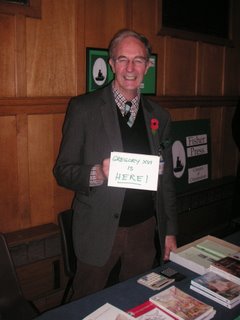
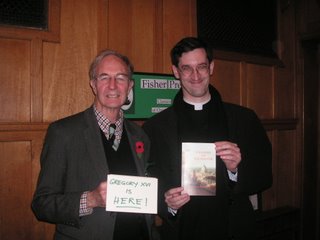
Anyway, Fr Whinder has penned the introduction to the new edition of Wiseman's work. Here is the founder of Fisher Press, Antony Tyler OBE, holding the dramatic notice: 'Gregory XVI is here!'


Here is Fr Whinder and Antony proudly displaying the new book:


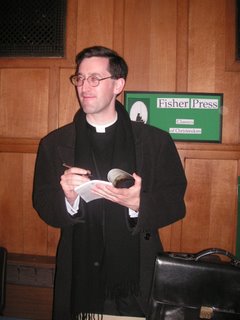
And, finally, a pastoral moment from Fr Whinder's book-signing session:

Fisher Press don't have a website (I think Gregory XVI would approve) but they can be contacted at PO Box 41, Sevenoaks, Kent TN15 6YN, UK. Wiseman's Gregory XVI is essential reading for the modern Catholic!

Labels:

<< # St. Blog's Parish ? >>