Monday, 23 June 2008

400th Anniversary of a Martyrdom


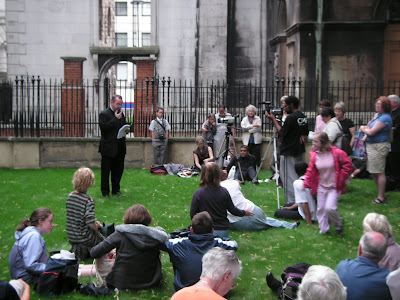
Today is the 400th anniversary of the martyrdom of St Thomas Garnet, who suffered at Tyburn on 23 June 1608. On Saturday evening I celebrated Mass at Tyburn Convent for those who had made the Martyrs' Walk (organised by Miles Jesu and led by Joanna Bogle) and I took the opportunity to honour St Thomas Garnet in the homily:

Deep below the streets that surround us lies the river Tyburn, a tributary of the Thames that gave its name to a small village on this spot and the infamous gallows (or ‘Tyburn Tree’) that served the capital as a place of execution between the twelfth and eighteenth centuries. Like London’s other lost rivers, the Tyburn has long since been hidden underground and largely forgotten – although the Mayor of London has recently proposed raising some of these waterways once again to the surface.

By making the Martyrs’ Walk today, we have raised up to the surface of our memories the many Catholics who suffered here and in other parts of London and the country. We not only remember their brave witness but are fully confident that the blood of the martyrs provides us with a channel – indeed a river – of grace and intercession. The blood of the martyrs is the seed of the Church.

I'd like to especially recall one of the Tyburn martyrs, the Jesuit St Thomas Garnet, the 400th anniversary of whose death we celebrate on Monday (23rd June).

The saint was born in Southwark around 1575 and was the nephew of Henry Garnet, the famous Superior of the English Jesuits at the time of the Gunpowder Plot. After being educated at a grammar school in Horsham, St Thomas Garnet went overseas to continue his education, like so many other Catholics of the day: he first spent time at the Jesuit college of St Omers. This institution later moved to Stonyhurst and Garnet is considered its first martyr (or protomartyr). Garnet then proceeded to the English College at Vallodolid, although his arrival there became quite an adventure. The ship that was going to take him across the Channel was delayed by bad weather and the young man was discovered hiding in the hold when the vessel was searched by the authorities, who always kept an eye open for young Catholics travelling overseas. He was taken to London for interrogation but eventually managed to escape.

Garnet’s life was marked by several periods of imprisonment. As a priest, he worked for a time in Warwickshire but was arrested at the time of the Gunpowder Plot, partly in the hope that he would give information concerning his uncle, Henry Garnet, who was eventually executed for his alleged involvement in the conspiracy. St Thomas Garnet was kept at the Tower in close confinement for the best part of a year and the fact that he had to lie on the bare floor during the winter led to the development of rheumatism. However, he was released in July 1606 and banished to the continent on pain of death. In Flanders he entered the Jesuit novitiate and returned to England the following year. After only six weeks of ministry, he was betrayed by an apostate priest called Rouse and arrested. He was found guilty of being a Catholic priest and remaining in England illegally – the main evidence for his Priesthood being a piece of graffiti he had supposedly added to the walls of his prison cell, reading: Thomas Garnet, Priest. He was quickly sentenced to death but professed that he was the happiest man alive and, when someone suggested that he might have an opportunity to escape, he spoke of an interior voice that said quite clearly: Noli fugere, Don’t run away. And so St Thomas Garnet was put to death at Tyburn on 23rd June 1608, aged 34.

Noli fugere, Don’t run away! We often think of the English Martyrs – in fact, of most saints – as flawless heroes who never wavered in their faith and in their actions. They were heroes most certainly but a large part of their heroism was the way that grace triumphed despite our frail human nature. The temptation to run away, to escape the terrible death of hanging, drawing and quartering would have been a natural human reaction for Garnet and the other martyrs. So too would be the temptation to reach a compromise or accept the offers that were normally made promising clemency and even preferment in return for conformity in matters of faith. The martyrs probably lay awake in their prisons at night struggling with these temptations and fears. But the English Martyrs realised that God’s truth was more important than their personal well-being and safety. They lived and died according to the words of our Gospel: ‘do not be afraid of those who kill the body but cannot kill the soul: fear him rather who can destroy both body and soul in hell.’ The martyrs were prepared to go through great bodily suffering if it meant the preservation of the spirit.

Noli fugere, Don’t run away! Garnet’s words echo down to us 400 years later. It’s unlikely that we’ll win a martyrs crown in the same way as him but we do face the lesser martyrdom of facing indifference, secularism, relativism and ridicule. The Christian Life involves following Our Lord and even being hated in His Name. Practising as a Catholic in the twenty-first century involves the same struggle with the temptation to compromise and conform as it did in the sixteenth and seventeenth centuries. Today we ask St Thomas Garnet and all the English Martyrs for their intercession: that we will be steadfast in our Faith and not compromise our principles even (and especially) when they are unpopular; to stand by the Rock of Peter and not be swept up by stormy waters; to realise that the only thing to be feared is losing God – for whoever loses Him loses everything; to carry the cross of Christ and not be tempted by an easier life. Let the words of St Thomas Garnet resound in our hearts today: Noli fugere, Don’t run away!

Labels: ,

Thursday, 17 April 2008

Old St Pancras


I was meeting a friend at London's St Pancras International recently and, since I had some time to kill, walked up the road to Old St Pancras church, just behind the station (not a place to linger in after dark!). For some unaccountable reason, I had never been there before, and yet it claims to be one of the oldest Christian sites in the country. Indeed, the sign boldly claims that the church has been 'a site of prayer and meditation since 314 AD.'


There is no hard evidence for the claim, but it is an impressive one to make - the dedication of St Pancras is certainly a very ancient one and may have originated with the mission of St Augustine of Canterbury, who promoted the cults of Roman saints as part of his evangelization of the south-east. In the nineteenth century what was thought to be a sixth century altar stone was found - and immediately dubbed 'St Augustine's Altar'! Some think that the site of the church was a pagan shrine that was converted to Christian use in Roman times, long before St Augustine (and 314, just after the conversion of Constantine, seems a convenient date).

The interior of the (Anglican) church is pleasant enough, with a few old monuments (including that of the minaturist, Samuel Cooper), an exposed bit of Norman wall (on the extreme left of the photo below) and a shrine to Our Lady of Walsingham (out of view). One feels a million miles away from the bustling station nearby!


The most interesting dimension of Old St Pancras is the graveyard, which was once favoured by the Catholic community due to its ancient origins and the tradition that the church was one of the last where Mass was said publicly at the Reformation (the Elizabethan incumbent, a Marian priest, seems to have celebrated Mass in Latin well into the second half of the sixteenth century and was tolerated by the authorities). Several of the Vicars Apostolic were buried in the churchyard, including Bonaventure Giffard, and many of the French refugees during the Revolution (including Archbishop Dillon, whose porcelain false teeth were recently found). Other famous burials include J. C. Bach and Sir John Soane. Next time you're at King's Cross or St Pancras, it's worth popping down Midland Rd (the road in between St Pancras and the British Library) and visiting this site, sanctified by centuries of Catholic associations.

Labels:

Sunday, 25 November 2007

Ely Place


Yesterday I led a small pilgrimage of parishioners to St Etheldreda's, Ely Place. As I've probably mentioned several times before, this church was founded by the Rosminian Fathers who formerly served Kingsland (my current parish). Though it was taken over by the Fathers of Charity in 1874, its Catholic history goes back much further. The church was built as a chapel for the Bishops of Ely in the late thirteenth century, making it the oldest church building used for Catholic worship in this country. After the Reformation it was also used for a time by the Spanish Ambassador and several martyrs are associated with the parish (including the monks of the nearby Charterhouse).

I celebrated a Requiem Mass for Fr Lockhart and the other priests who have served our parish, after which the legendary Fr Kit Cunningham (Rector of Ely Place) gave us an informative tour. It was also a chance to celebrate the beatification of Antonio Rosmini. If you don't know this church, situated near Holborn, then it's well worth a visit.


Labels: , ,

Thursday, 15 November 2007

Catholic Social Teaching in Action


The Priestly Life is full of variety. Having returned from the dreaming spires of Oxford yesterday morning and spent the afternoon dealing with queries at the Diocesan Archives, I had dinner with a small Polish community that has recently moved to my parish, called Barka UK.
.
My hosts were Thomasz Sadowski, the co-founder, and his daughter Ewa. Barka was set up in Poland at the time of the fall of Communism to look after those on the margins of society, particularly the homeless and alcoholics. They were invited to live in communities - more families than cold institutions - so that they could rebuild their lives and even set up small businesses, helped by 'leaders' who had been in the same situation themselves.

Barka UK was set up to deal with the most recent phase of Polish immigration following EU expansion in May 2004. Hundreds of thousands have come over to the UK over the past few years, encouraged by the Government, but many find themselves unemployed, homeless, exploited, defrauded of their passports and money, and without income support. Even in homeless day centres, tensions are raised because it is perceived that the Poles are 'taking over.'

Barka UK currently works mostly in Hammersmith and Fulham and helps homeless migrants in desperate situations return to Poland and live in Barka communities (such as the four farms they run in Wladyslawowo, Marszewo, Posadowek and Chudobczyce). Between July and October 2007 over 40 migrants were repatriated in this way.

It was indeed inspiring to hear of the work of Barka (based firmly on Christian values and the Church's social teaching) and sad to hear of the plight of so many migrants from A8 countries. I encourage you to visit the websites of Barka UK and their sister organisation, European Migrant's Integration Network.

Labels: , ,

Saturday, 20 October 2007

Prior Bolton's Fishpond


I have previously mentioned one of our local landmarks, Canonbury Tower (see above, partly obscured by the more recent building), which was built by William Bolton, the Prior of the Augustinian Priory of St Bartholomew's, Smithfield (1505-32). You can still see his device of a barrel (tun) pierced by a crossbow bolt on some nearby buildings. Bolton was also Master of the King's Works and was involved in many other building projects, such as Westminster Abbey's Henry VII Chapel and monument to Lady Margaret Beaufort.

Last night I visited a parishioner and passed a road called 'Prior Bolton Street'. I was then told that the remnants of a fishpond that once belonged to the good Canons occasionally 're-appears' and floods the basements of certain houses in the area. England is full of stories of ghosts who lament the destruction of the 1530s - phantom monks and nuns and all that - but it is curious to hear of a pond that serves to remind the people of twenty-first century Islington of pre-Reformation days!

Labels: ,

Sunday, 22 July 2007

Little Italy

Look who I saw on the streets of London this afternoon:


The occasion was the annual procession in honour of Our Lady of Mount Carmel, which has been organised by St Peter's Italian Church in Clerkenwell since 1883. The floats were arranged by parish groups and confraternities, as well as Italian associations from Manchester, Birmingham and elsewhere. Here you can see the clergy and (I think) members of the Confratelli del SS Sacramento waiting in the porch:


The main floats depicted Biblical scenes, such as Our Lord standing before Pontius Pilate:


These two angels, announcing the Assumption, are obviously wearing parts of a rather fine High Mass set belonging to the church:


The First Communion children were led by Jesus, holding a ciborium:


There were many statues in evidence, including Our Lady of Mount Carmel herself. In true continental fashion, each statue was greeting with the crowd's applause:


There were lesser known saints, like Santa Franca (a patron of Piacenza) and, as seen below, San Calogero (who seems to be a Greek hermit who evangelized the isles of Lipari and ended his days in Sicily):


I often wondered what England would be like if it was Catholic - and a glimpse of the answer was provided this afternoon!


I hadn't been before to London's Italian church, cared for by the Pallotine Fathers. It is a fine building, opened in 1863 and modelled on San Crisogano in Trastevere, Rome. It's hard to believe that you're in the midst of London, especially on a day like today. In the surrounding streets, which were closed to traffic, there were stalls selling Italian specialities. In honour of Our Lady of Mount Carmel I treated myself to a bottle of grappa from the Valle d'Aosta!


The next procession is on 20 July 2008, starting at 3.30pm - so make a note of it in your diary!

Labels: ,

Wednesday, 27 June 2007

St John Southworth


Today, in the Archdiocese of Westminster, we keep the memory of St John Southworth.His significance for the diocese lies in the discovery of his body at Douai in 1927 and his subsequent translation to Westminster Cathedral in 1930. I posted an item on the discovery of his body last year, and Mgr Langham has some good pictures on his blog, including the one above (I hope he doesn't mind me 'borrowing' it). Note that the martyr's consecrated hand is priestly even in death since his thumb and forefinger are joined together (as the rubrics required for the period between the Consecration and the ablutions after Holy Communion).

Southworth acts as a representative figure for the many priests who courageously worked in London in the sixteenth and seventeenth centuries, at the risk of imprisonment and execution. Southworth originally hailed from Lancashire and began his studies at Douai in 1613. As a priest, he spent time in Flanders and Lancashire, as well as London, where he helped St Henry Morse care for plague victims in 1636. He spent several years in prison, and was finally executed on 28th June 1654, together with two counterfeiters.

At Tyburn, the martyr said: 'I was brought up in the truly ancient Roman Catholic apostolic religion, which taught me that the sum of the only true Christian profession is to die. This lesson I have heretofore in my lifetime desired to learn; this lesson I come here to put to practice by dying, being taught it by our Blessed Saviour, both by precept and example. To follow His holy doctrine, and imitate His holy death, I willingly suffer at present; this gallows I look on as His cross, which I gladly take to follow my dear Saviour'.

St John Southworth, pray for us!

Labels: , ,

Sunday, 24 June 2007

The English Franciscan Martyrs


In case anyone is interested, here is the text of my talk on the Franciscan martyrs, which I gave at Christ Church Greyfriars (the site of London's medieval Franciscan house - above).

If we were standing here in 1507 rather than 2007, the first thing you would have noticed was the smell. It’s no accident that a nearby street was called Stinking Lane (now King Edward Street) because this was the butcher’s quarter, and it was consequently considered a rather undesirable area.

Just the sort of place, you might think, for the humble sons of St Francis, who established a house here in 1225. They soon attracted the attention of many rich benefactors and a large church was built in the first quarter of the fourteenth century: 300 feet long and boasting at least eleven chapels. The rose garden, on the other side of the tower, roughly occupies the site of the choir of this church. Where we are standing now was the nave; so we would not have been in the open air but in a large gothic church, near the altars of the Holy Cross, St Mary and St Louis.
.
Two Queens of England were buried in the church: Marguerite of France, second wife of Edward I, and Isabella, widow of the unfortunate Edward II. These two Queens spent the princely sum of £2,100 on the choir of the church alone. The heart of Eleanor of Provence, wife of Henry III, was also interred here. This shows the great prestige that came to be attached to the London Greyfriars. And if we remember that this was just one of 73 Franciscan houses in pre-Reformation England, we can appreciate the Order’s importance in this country.

Of course, the London Greyfriars has long disappeared. The friary was emptied at the Reformation and the great medieval church and much of the monastery buildings (later used by Christ’s Hospital) were destroyed in the Great Fire of London (1666). Christopher Wren’s smaller replacement church was itself destroyed in the Blitz of 1940 – its remains now form the walls of the rose garden. But, if the buildings and friars themselves have gone, the memories linger. For the next few minutes, I invite you to pause and listen to the voice of the past.

The community here at the London Greyfriars did not provide any martyrs at the time of Henry VIII’s break with Rome. But it is worth remembering that the Franciscan Order provided perhaps the strongest opposition to the King’s divorce. As early as 1534, just as the crisis was breaking, two friars, Richard Risby and Hugh Rich, were executed alongside the ‘Holy Nun’, Elizabeth Barton, a visionary who had attacked the King’s divorce ‘in the name and by the authority of God’.

Another Franciscan to suffer for the Faith, Blessed John Forest, belonged to the Observant friary at Greenwich and was placed here under house arrest for several years. His house was strict and also highly influential, since it was next door to the royal palace at Greenwich. It was in the Franciscan church there that the future Henry VIII was baptised; as were all three of his children, the future Edward VI, Mary I and Elizabeth I. It was (probably) there that Henry married Catherine of Aragon. In 1513 the King had praised the Observants in a letter to Pope Leo X, saying that he could not sufficiently commend the Observant Friars' strict adherence to poverty, their sincerity, charity and devotion. How things would change!

It is little surprising that the Observants of Greenwich were so closely involved in opposing the King’s divorce. This placed them in grave danger. The Warden, William Peto, preached a sermon to the Court condemning the King’s divorce and predicting that black dogs would lick the blood of Henry, like King Ahab in the Old Testament. This was supposedly fulfilled fifteen years later as the King's body was taken to Windsor. Peto, unsurprisingly, had to escape to the continent, though, it is worth mentioning, he returned in Mary Tudor’s reign and was even named a Cardinal in 1557.

Blessed John Forest was less fortunate. He had acted as one of the confessors of Catherine of Aragon, who herself was a Franciscan Tertiary, and he was forthright in his opposition. After several years of imprisonment, he was tried for denying the Oath of Supremacy and condemned to death. On 22 May 1538 he was brought to Smithfield, not far from where we are standing now. A large crowd had gathered, including the bishop of London, the Dukes of Norfolk and Suffolk and the Lord Mayor. Forest made a brave confession of faith; according to one bystander:

That if an angel should come down from Heaven and show him any other thing than he had believed all his lifetime past he would not believe him, and that if his body should be cut joint after joint or member after member, burnt, hanged, or what pain soever might be done to his body, he would never turn from his old sect of this Bishop of Rome.
They hanged him from the gibbet, with a chain placed around his waist. They then lit a fire and placed on it a statue of a Welsh saint, Derfel Gadarn. Curiously, according to tradition, it had been predicted that this venerated statue would one day ‘set a Forest on fire'. ‘The holy man', we read, ‘beat his breast with his right hand, and then raised both his hands to Heaven and said many prayers in Latin, his last spoken words being, Domine, miserere mei: and when the fire reached his breast he spoke no more and gave up his soul to God'.

Many other Franciscans were placed in prison at this time – as many as two hundred, fifty of whom died in captivity. A few of these have been recognised by the Church, including theVenerable Anthony Brookby, a former Oxford lecturer who spoke against the King’s Supremacy and was imprisoned, tortured and eventually strangled in prison, the executioner using Brookby’s Franciscan girdle.

The English Franciscans continued, based in houses overseas, and many of them returned to England as missionaries; some paid the ultimate price. Two of them were included among the Forty Martyrs: the Welshman,St John Jones, who suffered in Southwark in 1598, and St John Wall, martyred in 1679, a victim of the hysteria following the Titus Oates Plot.


There is no time to look at all the Franciscan Martyrs individually, but I thought we might look at the group of English Friars who suffered in the 1640s: Blessed Thomas Bullaker, Arthur Bell, Henry Heath and John Woodcock. All of these, except Bullaker, were members of the newly founded English Franciscan House at Douai.

This group of witnesses were captured in different ways. Blessed Thomas Bullaker was apprehended while saying Mass in London – he had just reached the Gloria and was taken away in his vestments. Blessed Arthur Bell was arrested in Stevenage, Hertfordshire. As he was being interrogated, one of the soldiers exclaimed: ‘What! A Roman Catholic?', to which he replied, ‘How do you mean Roman? I am an Englishman. There is but one Catholic Church, and of that I am a member'.

Blessed Henry Heath had just arrived in England, disguised as a sailor and had even concealed some Catholic literature in his cap. In the spirit of St Francis, Heath refused an offer of speedy transport to London and chose to walk, begging his way. On the night of his arrival he could find no accommodation and was forced to sleep on a doorstep near London Bridge. When the owner of the house found him sleeping on his property he called the local constable and he was taken into custody. The papers found in his cap betrayed his identity.

All of them met death bravely. As Bullaker was leaving the prison he met Blessed Arthur Bell, who said to him, ‘Brother, I was professed before you. Why do you take precedence of me?’ Bullaker answered, ‘It is the will of God. But you will follow me'. When Bell’s turn came a year later, he embraced the executioner. Indeed, he had sung the Te Deum as sentence was passed at court. Woodcock had to endure being hanged twice, because on the first occasion the rope snapped.

There is a beautiful story relating to the martyrdom of Blessed Henry Heath. Several years previously, his aged father, John, visited him in Douai. So impressed was he that he not only converted to Catholicism but decided to remain at Douai as a lay brother. On the day of his son’s martyrdom, he saw a brilliant light ascending to Heaven and he knew at that moment that his son had paid the ultimate price. His premonition was proved some time later when the reports reached Douai of Heath’s death.

Just as the Franciscans provided some of the first martyrs, such as Blessed John Forest, so they produced some of the last confessors of the Faith. We think not only of St John Wall but the Venerable Francis Levison, who died in prison in 1680 after fourteen months imprisonment; we remember Paul Atkinson, who was perpetually imprisoned for the Faith in Hurst Castle in 1700 and died, still in captivity, 29 years later; we also recall Germanus Holmes, who died in Lancaster Castle in 1746, after the Jacobite rising.

We honour these brave witnesses of the Faith today, as we make this pilgrimage and follow their footsteps, now almost entirely hidden beneath the modern, bustling, secular city.

I said at the beginning that where we now stand was once the smelliest part of London, because of the nearby abbatoir. But now this has been replaced by the powerful odour of the roses in the nearby Greyfriars garden, a place of calm oasis in the midst of this busy city. How appropriate this is, because the blood of the martyrs has sanctified this land and been the seed of the English Catholic Revival for the last 200 years, which we now so take for granted. We do not forget our Martyrs – and we pray that we will imitate their example by courageously bearing witness to the Faith in the face of indifference and open hostility. Let us end with the prayer of the Franciscan, Blessed Henry Heath: ‘Jesus, convert England, Jesus, have mercy on this country; O England, be converted to the Lord thy God!’

The Franciscan Martyrs of England and Wales – pray for us!

Labels: ,

Saturday, 23 June 2007

A Walk in Honour of the Martyrs


Today I attended part of the Martyrs' Walk, organised by the Continuity Movement. The pilgrimage started at Tower Hill, the site of the martyrdoms of SS John Fisher, Thomas More and others, and ended at Tyburn Convent with Mass this evening. I was only able to meet them at Christ Church Greyfriars on Newgate Street, within the shadow of St Paul's Cathedral, and stay to give a talk, before dashing back to the parish for an afternoon of classes and meetings.

I had the honour of meeting Catholic Mom of 10, who can be seen in the picture below together, of course, with Auntie Joanna. 'Catholic Mom' won major brownie points by holding an umbrella over me when it began raining, halfway during my talk. Thanks, Jackie.


There were about 150 pilgrims making the walk, including four priests. It was wonderful to talk about the Franciscan martyrs in the open air, on the site of the nave of London Greyfriars - though I developed a repetitive thumb injury through having to press down the button on the walkie-talkie for 20 minutes! Still, it was nothing compared to what the martyrs suffered.

Labels: ,

Sunday, 17 June 2007

Martyrs' Walk

I'm currently writing a short talk I'll be giving next Saturday (23 June) at the site of London's medieval Franciscan monastery, Christ Church Greyfriars (near St Paul's Cathedral). This will be one of the 'stations' during the Martyrs' Walk, organised by Miles Jesu/Continuity Movement.

Hope to see some of you there, though I'll only be able to stay for my talk and then dash back to the parish for an Adult Confirmation class. The pilgrimage starts at Tower Hill (11am), will reach Greyfriars about 1pm and will finish with Mass at Tyburn Convent (5.30pm). For more details, click here.

Labels: ,

Saturday, 16 June 2007

Ceremonial City


What a great day to be in central London, as it was Her Majesty the Queen's official birthday and (even more importantly) the Feast of the Immaculate Heart. I celebrated the latter by attending a twin Ordination at Westminster Cathedral. There must have been 100 priests there to welcome into our ranks Fr Richard Nesbitt and Fr John Elliott - ad multos annos!

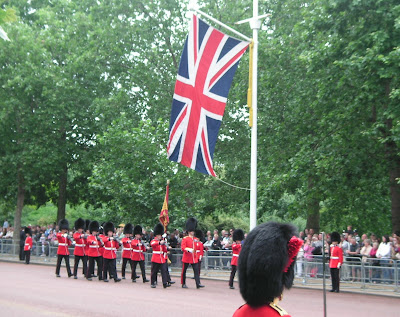
As I made my way to the Cathedral, I stopped off on The Mall, that great ceremonial road leading to Buckingham Palace. The Queen's Birthday Parade (Trooping the Colour) was finishing at Horse Guards and the crowds were expectantly waiting to see the stately procession return to the Palace.
.

The procession came in stages - first a small detachment of Foot Guards (above) and then The King's Troop, Royal Horse Artillery. Then it was the turn of two barouche carriages containing members of the Royal Family. Here is a picture of the Duchess of Cornwall and (partly obscured by her large hat) Prince William, wearing his Blues and Royal uniform.
.

Eventually the Household Cavalry appeared, with their magnificent mounted band. Centre of everybody's attention were the two Drum Horses, such as this one:


Then it was the turn of the Foot Guards, with their equally magnificent Massed Band - led by the splendid Drum Majors.


Her Majesty The Queen whizzed into view, accompanied by Prince Philip, dressed as Colonel of the Grenadier Guards. Since the crowd - including (mea culpa) myself - was so pre-occupied with taking photos on their cameras and mobiles, there was very little applause. I hope the Queen didn't think we were rampantly republican. It is perhaps unfortunate that we live in such a technological age.


The Princess Royal (Colonel of the Blues and Royals), the Duke of Kent (Colonel of the Scots Guards), and the Prince of Wales (Colonel of the Welsh Guards) were mounted on horses behind Her Majesty. You can the latter two in this picture (on black horses):


Behind came the Foot Guards, headed by their colour:


Various important-looking dignitaries closed the procession, looking forward, no doubt, to a festive luncheon:


Her Majesty's last duty was taking the salute for the last time at Buckingham Palace and then watching a fly past. Here you can just see the Royal Family assembling on the Palace balcony.

There's nothing like a bit of pomp and circumstance on a Saturday in June. Happy Birthday, Ma'am!

Labels: , ,

Thursday, 8 February 2007

Presbytery Snowball Fight

London is currently under a blanket of snow. Here's the view from my window at 6 this morning:


And a view taken later of the front of the church:


My next-door neighbour, Fr Albert Ofere, the National Nigerian Chaplain, had never experienced such heavy snow before.


Naturally I was eager to induct him into the art of snowballs. A match followed - Archdiocese of Westminster v Nigerian Chaplaincy - but I'm happy to say it was a draw.


I was, admittedly, rather out of practice. The last time I indulged in the sport was this time last year, when I led a pilgrim group to Bavaria in the footsteps of Pope Benedict. I remember a group of my pious pilgrims aiming a particularly large snowball at me in the monastery of Ettal! Anyhow, sadly the clerical snowballs at Kingsland this morning did not pose as impressive a sight as this famous advert from a certain 'reassuringly expensive' beer:

Labels: ,

Saturday, 3 February 2007

Thornton's Bookshop

John Thornton's bookshop on the Fulham Road is a veritable London Catholic icon, which has already featured in these pages. For well over 40 years it has specialised in secondhand Catholic books and Mr Thornton has had the melancholic (though for us consumers not completely unfortunate) task of buying the libraries of religious houses that are closing down.

Since the time I was a sixth former interested in learning more about the Faith (and beginning to think about the Sacred Priesthood) I have been a frequent visitor to their basement. Luckily, since most books were priced under £10 (and many under a fiver) it was even affordable as a University student and seminarian. Looking at my shelves, I owe at least 50% of my library to this shop - especially the hagiography, spirituality and Church history sections.

Alas, Thornton's is closing down in a few months time. The good news is that the entire stock (including the antiquarian books) is now selling at half price! I urge all my London readers to pay them a speedy visit - 455 Fulham Rd, SW10 9UZ (near the Servite church and the Fulham Rd entrance to Brompton Cemetery), tel: 020 7352 8810.

Happy shopping - but do leave a few items for me!

Labels: ,

Wednesday, 15 November 2006

God Save the Queen!


Above (drumroll please) is the debut You Tube video from Roman Miscellany, taken on my digital camera (apologies for the quality).

On my way to work at the diocesan archives this morning I made a detour at Green Park and walked to The Mall, the ceremonial street linking Buckingham Palace to Whitehall and Trafalgar Square.

Why? Today Her Majesty the Queen solemnly opened Parliament and so I thought I might catch a glimpse of her in the Australian State Coach. Amazingly there were more soldiers around than spectators and I overheard a number of confused tourists asking police officers what on earth was going on! It's rather impressive that such pagentry continues regardless of whether or not there are actually crowds of spectators. The State Opening is not a gimmick but a time-honoured ritual expressing the fact that the Monarch is our Head of State and it is her Government and her Parliament that sits in Westminster. This comes across in the Queen's Speech, even though it is written for her by her Government.

The first part of the procession, whizzing past around 10.40am, were the coaches containing the Imperial Crown (which you can just make out through the window of the carriage in the first photo below) and the other royal insignia. Such is the symbolic importance of these items that the Guards lining the street present their arms.


Very little happened during the next twenty minutes, except a car passing containing lots of excited looking page boys in their red uniforms. Then the royal procession slowly emerged from the Palace at 11am, as the bells of Westminster Abbey wafted over St James' Park. The unfortunate consequence of using digital technology on such occasions is that you're too busy concentrating on the camera to observe all the finer details of the spettacolo. However, I certainly noticed Princess Anne in one carriage.

Despite the 'reforms' of Tony 'Bugnini' Blair in our State Ceremonial, it's good to see such pageantry alive and well in the twenty-first century!

Labels: ,

Friday, 13 October 2006

'Good King Edward'


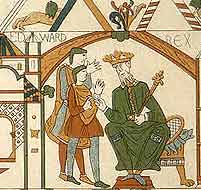
Today is the festa of St Edward the Confessor, a feast extended to the Universal Church by Blessed Innocent XI at the recommendation of Philip Cardinal Howard OP, but now sadly only in our local Calendar (grrrr). I should wish my dad a buona festa, since it's his name day.

Most people have heard of St Edward because he built Westminster Abbey and died in the most famous year of English history, 1066. In fact the succession crisis that followed his death led to the battle of Hastings and the death of King Harold.

But there’s more to St Edward than ‘1066 and all that.’ Last year Cardinal Murphy-O'Connor preached a rather good sermon at Westminster Abbey on the occasion of the saint's one thousandth birthday. It's worth reading in full. He pointed out:
Kings in the Middle Ages knew what was expected of them. They had to defeat their enemies in war, and they had to beget sons to ensure the succession of the crown and provide political stability. Edward the Confessor did neither: he fought no battles, and he fathered no children. And partly because of that, after him English rule gave way to foreign conquest. But for more than twenty years Edward ruled as an effective and peaceable king. He took the taxes raised for war and gave some of them at least to the poor, he defused international aggression by negotiation, he tempered harsh laws to human frailty, he made himself available to his subjects, and he built on this site a great monastery dedicated to St Peter.
When Edward built the first minster here in the West, London already had a great minster in the East, its cathedral church of St Paul’s. By dedicating the new West Minster to St Peter, Edward poised his capital and its people between the two great founding Apostles of the Church, and placed the life of London, and of England, under the light of that church’s teaching and witness and wisdom. This was to be no secular city, but a community shaped by Christian faith and hope and love; and the Abbey’s continued presence at the heart of our city is a twitch upon London’s thread, tugging it always back to its heart.
We remember St Edward as a man of faith, who faced adversity with a strong trust in providence, exercised an extraordinary piety and was generous to the poor. According to legend, he gave a ring to a beggar one day at Westminster. Two years later a group of English pilgrims in the Holy Land met an old man, who identified himself to be St John the Beloved Disciple and gave them a ring, saying 'for the love of Edward I will not fail you, and you shall arrive safe and sound in England. Then go to Edward, and say you have brought a ring which he gave to me when I besought him in poor array. And tell him that in six months he shall come to me in Paradise.'


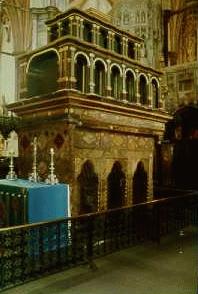
St Edward was buried in his Abbey at Westminster and, because of his royal birth, his shrine survived the Reformation. We celebrate him today not as a great King but as a great Christian. Mgr Ronald Knox hits the nail on the head in the second reading in today’s Office of Readings: we might say rather harshly that ‘when we venerate St Edward, we venerate a failure.’ However,

ask yourself which you would rather have been, in life, of all those great dead who lie in Westminster Abbey, and you will find it a difficult question to answer: there is so much that dazzles, so much that captures the imagination…but ask yourself which of those great dead you would rather be now, your body there, your soul far away – is there any Christian who would not ask to change places with the Confessor, who would not choose his resting-place, there to wait for the opening of the great Doomsday Book?

Labels: ,

Friday, 6 October 2006

Archepiscopal False Teeth

They're not a very attractive sight but they're a link to an important episode in our ecclesiastical history. These porcelain teeth belonged to Arthur Richard Dillon, Archbishop of Toulouse (1721-1806), one of the hundreds of Catholic clergy who sought sanctuary in Protestant England during the French Revolution. The arrival of the emigre clergy led to the opening of a number of missions around England and was an important step on the road to Catholic Emancipation.

Archbishop Dillon was the son of an Irish officer who was 'exiled' on account of his Jacobite sympathies and found service in the French army. According to one report:

Archaeologists discovered the teeth, still snugly in his mouth, when they opened his coffin in London's St Pancras graveyard during excavations for a terminus for a rail link to the undersea Channel Tunnel. Made of porcelain with gold springs, and individually crafted for a perfect fit, dentures like these were
invented in France in the 1770s.

It is believed Dillon may have bought them from the celebrated Parisian dentist, Nicholas De Chemant, before fleeing to England at the time of the 1789 Revolution."These unique artifacts reflect a pivotal time in dental history, with the adoption of new materials and methods of manufacture," said Natasha Powers, a Museum of London archaeologist who has written a paper about the teeth for the latest issue of the British Dental Journal."They also represent a period of significant social and economic change for the upper echelons of French society."

Phil Emery, an archaeologist with Gifford, the engineers working on the rail link, said the teeth, "are in remarkably good condition - they have seen considerable use." The dentures are slightly cracked, he said, and worn down on the left, suggesting the archbishop chewed more on that side.

When Archbishop Dillon died in London he was buried in Old St Pancras graveyard, which was particularly favoured by English Catholics because it was said that the adjoining church was the last to hold celebrations of Mass at the Reformation. These amazing teeth went on display today at the Museum of London, apparently because it's World Smile Day.

PS I'm just back from my Day of Recollection, so I've given myself permission to turn on the computer!

Labels: ,

Sunday, 3 September 2006

The Marian Shrine of London


I've mentioned Our Lady of Willesden before on this blog but, as it's my last evening here, I feel I should pay tribute to her maternal patronage over the last five years. Here is a talk about the shrine which I normally give to pilgrims:

I’m sure that many of you have been to one of the great Marian shrines: Lourdes, Fatima, Loreto, Altoetting or Guadalupe. And even though many of you have probably been to Walsingham as well, it’s very easy to associate these great sanctuaries with other countries and to forget that England was once well known for it’s remarkable devotion to Our Lady, especially before the Reformation.

In the middle ages, Our Lady was considered one of the patrons of England, together with St Peter, St Edward and St George. From at least the fourteenth century, England was known as ‘Our Lady’s Dowry’ – a land given especially to her as a wedding gift for her protection. Indeed, at the Battle of Agincourt (1415) the English soldiers were supposed to have cried ‘Our Lady for her Dowry; St George and St Edward to our aid!’ Devotion to Our Blessed Lady saturated everyday life: even many of our common flowers were named after her: ‘Marigold’ (or ‘Mary’s Gold’), ‘Foxgloves’ were ‘Our Lady’s Gloves’ and the ‘Fuchsia’ was ‘Our Lady’s Eardrops’.

At the heart of this veneration of Our Lady were her shrines. This afternoon I’d like to introduce to you Our Lady of Willesden: a shrine particularly popular with Londoners of St Thomas More’s generation and a shrine that still thrives today, in the heart of suburban London.

Twenty-first century Willesden may seem a rather strange place for a Marian shrine – the grey, bustling streets; the endless shops selling exotic foods; the distant strains of reggae music. But once, not that long ago, these busy streets were quaint country paths lined with hedgerows and the parish of Willesden was a collection of sleepy hamlets (like Harlesden and Neasden) and acres of farmland and woodland.

At the heart of it all was the parish church – St Mary’s, Willesden, about 20 minutes walk from here. The church is first mentioned in 1181, though there was probably a wooden church from at least the tenth century. The church of St Mary’s has, of course, a special pertinence for our story since it was here that the shrine of Our Lady of Willesden was originally located before the Protestant Revolution. And that brings us to a rather difficult question: why Willesden?

Most Marian shrines are blessed with carefully handed-down traditions concerning their origins - normally involving a vision, miracle or vow. For example, the most famous English shrine - Walsingham - originated with a vision of Our Lady to a wealthy widow ordering the building at Walsingham of a replica of the Holy House of Nazareth. But the origins of the shrine at Willesden are more obscure – we know it existed, but we don’t know how it started.

It seems, from a study of the early sources, that pilgrims only started travelling to Willesden in the late fifteenth century, probably during the reign of Henry VII (the first Tudor King). Though there are plenty of references to the church of Our Lady at Willesden, the phrase ‘Our Lady of Willesden’ is only first mentioned in a will of 1500.

Our Lady must have answered the prayers of locals and word must have spread. Moreover there seems to have been an ancient holy well near the church which was supposed to cure blindness and other eye disorders – this isn’t mentioned in early sources but it exists to this day, having been restored a few years ago. Indeed the Anglican vicarage of St Mary’s must be one of the few in the Church of England that distributes bottle of water from a holy well! It’s interesting to note that Marian shrines often had “holy wells”: in Lancashire there’s a place called Ladyewell; the name “Walsingham” means the “village of wells”; and “Willesden” itself comes from the Anglo-Saxon Wiell-dun, meaning “hill of springs” or “spring at the foot of the hill”.

Willesden became a sanctuary beloved by Londoners. Situated in a charming setting on the Paddington-Harrow road, a pilgrimage to Willesden also meant an excursion into the country. Pilgrimages were not only seen as works of devotion and penance, but as a welcome change to the daily routine, an opportunity to visit far-flung places and perhaps indulge in a spot of sight-seeing, shopping and recreation. Indeed, several contemporaries noted the drunken behaviour of the pilgrims to Willesden!

Archaeologists have found pilgrim badges to Willesden in the London area. In 1502 Willesden was included by no less a person than the Queen, Elizabeth of York, in a list of Marian shrines to whom she was sending an offering.

Willesden’s most famous pilgrim must be St Thomas More, as can be seen on our painted sign outside the church. He was not only attracted to Willesden by the shrine but also by the nearby home of his step-daughter, Alice, and her husband, Sir Giles Alington. In early April 1534 the saint visited Willesden for the last time, aware, no doubt, of his imminent arrest and trial for treason, and we can imagine him praying for strength before the statue of Our Lady.

St Thomas More also mentioned Willesden in his writings against the Protestant reformers, who themselves cite Willesden as an example of idolatrous pilgrimage. It was clear that things were changing. July 1538 saw the removal of some of the most famous images of Our Lady from their shrines to Thomas Cromwell’s house in Chelsea. By the end of the month, the statues from Walsingham and Ipswich were awaiting their fate in London. According to the chronicler Edward Hall, “the ladie of Wilsdon” was one of those taken to London, where she perished on a great bonfire of “notable Images” arranged by Cromwell in the early autumn of 1538.

As time went on, Our Lady of Willesden was forgotten, though there is evidence of some secret Catholic activity in the area as late as the seventeenth century. But it is in 1885 that the next chapter begins, when Cardinal Manning sent a Catholic priest to Harlesden – Fr Bernard Nicholas Ward (who later became the first Bishop of Brentwood) – and Mass was said for the first time since the Reformation, in a house near Willesden Junction station.

Soon, the medieval shrine was revived. A piece of wood was obtained from an old oak which had overlooked the original shrine at St Mary’s and a new statue was carved and blessed by Cardinal Vaughan in 1892. Eleven years later, the open-air processions of the statue were begun. Public Catholic processions were fairly uncommon at the time and therefore attracted controversy. In 1905 protests were made to the Willesden Petty Sessions and it was even suggested that the priest should pay a fine of £50. On the day of the procession, banners appeared with the slogan: HARLESDEN PROTESTANTS PROTEST AGAINST THE ILLEGAL AND IDOLATROUS PROCESSIONS. Insults were thrown out from the more vocal Protestant spectators of the procession, who started to sing, “There is a Fountain filled with Blood” (calling to mind the Protestant martyrs under the Catholic Mary Tudor). The Catholics fought back with “God Save the Pope” and soon the full armoury of Celtic Catholicism was brought into action - a band of pipes and drums effectively silenced the hecklers!

In 1931, the present church was opened and pilgrimages continued. Perhaps Our Lady of Willesden’s finest hour came in 1954, when she crowned by Cardinal Griffin at Wembley Stadium during the Marian Year, before a crowd of over 90,000. In 1958 the shrine was visited by a holy priest who would later be canonised – St Josemaria Escriva, founder of Opus Dei, who took the opportunity of his pilgrimage to make his annual dedication of Opus Dei to Our Lady. He visited on at least two other occasions. Willesden is unique among English shrines in claiming two saints amongst its pilgrims – More and Escriva, a martyr and a confessor, both great devotees of the Sacrifice of the Mass, both great models in the living out of an authentic lay apostolate.

So Willesden has been given a new prominence - not only because of its links with our Catholic past but also because of its location on the edge of Central London, in the midst of one of the world’s largest and most ethnically diverse cities. Downtown Harlesden may lack the peaceful hedgerows of Walsingham or the rolling grounds of Aylesford but this shrine is unique in witnessing to the presence of Mary in the midst of our busy metropolis – a great capital, for sure, but also a city with many problems: poverty, marginalisation, prejudice, crimes against Life, crimes against our fellow men and crimes against God. And Mary is here in our midst, protecting us, interceding for us, channelling grace upon grace to us and comforting us. And because Mary is here, so is her Son. Mary is pointing to her Son in the statue – she holds Him up as He blesses the world. Ad Jesum per Mariam. To Jesus through Mary.

Shrines like this show us that our Faith is ‘incarnational.’ Ours is not a Faith that tries to escape from the world or to ignore human weakness. No, God fully involves Himself in His Creation. The Word became flesh in the womb of a Virgin, taking on the condition of a servant and even dying on the cross so as to raise us up to the life of the Blessed Trinity. Before He ascended to the Father, Christ promised that He would be always with us – in good times and bad times, in sickness and in health, in our successes and in our sorrows. That’s what a shrine like this in the midst of twenty-first century London proclaims to the world. God is with us! Through Mary, Our Lady of Willesden, Jesus is with us! We pray to her, especially, for the protection and evangelisation of London, of other cities and towns, indeed of our whole country! We pray that we will rediscover our roots and make England, the ‘Dowry of Mary’, a country where the Blessed Virgin is honoured, just as she was of old.

Our Lady of Willesden, pray for us!

Labels: , ,

<< # St. Blog's Parish ? >>